
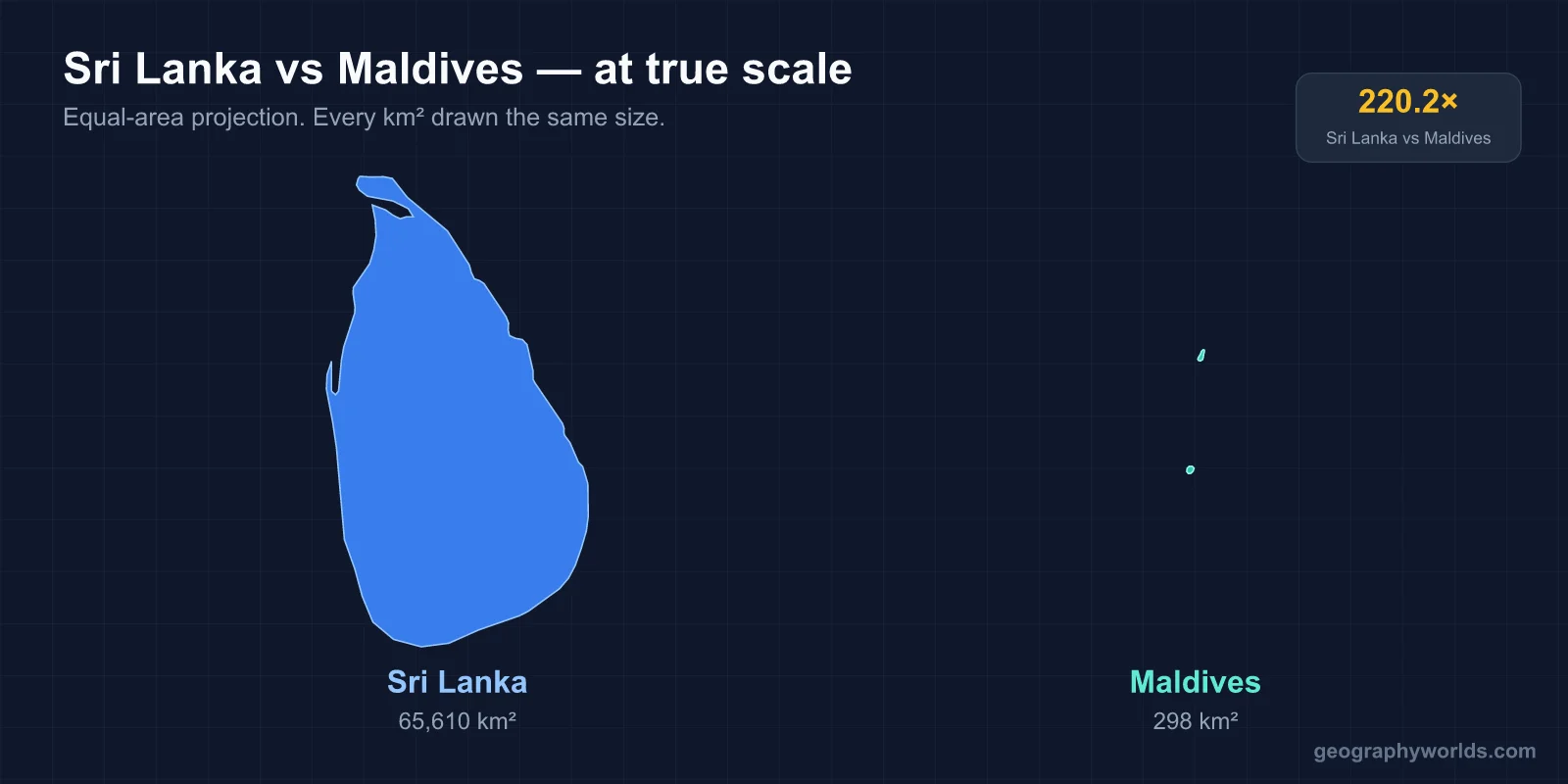
Sri Lanka is by far the bigger country: about 65,610 km² against the Maldives’ 298 km² of dry land, a difference of roughly 220 times. It also has vastly more people, 21,781,800 at its 2024 census compared with 515,132 in the Maldives’ 2022 census. The Maldives, though, is much richer per person, with a nominal GDP per capita of about US$17,290 (IMF, 2024) against Sri Lanka’s roughly US$5,000 (2025), largely thanks to tourism, which accounts for about 28% of its GDP. Sri Lanka’s commercial capital is Colombo, with parliament in neighbouring Sri Jayawardenepura Kotte, and its official languages are Sinhala and Tamil, with English as a link language. The Maldives’ capital is Malé, and its official language is Dhivehi. For a traveller the gap is just as sharp: one is a mountainous island rising to 2,524 metres, tea country and ancient cities, the other a scatter of coral islands whose highest natural ground is 2.4 metres above the sea.
First Impressions in Colombo and Malé
Most visitors to Sri Lanka land near Colombo, on the west coast. The city was the island’s capital under the British from 1815 and kept that role at independence in 1948; since 1978 the administrative functions have sat next door in Sri Jayawardenepura Kotte, and Colombo is described as the executive and judicial capital as well as the commercial centre. About 753,000 people live within the municipal limits and an estimated 5.6 million in the wider metropolitan area. Its name, first used by the Portuguese in 1505, is a reminder that three European powers passed through: Portuguese, Dutch and then British. It is the jumping-off point for the rest of a large island, and many visitors leave it within a day for Kandy, the south coast or the hills.
Arrival in the Maldives is different from the first minute. Velana International Airport occupies Hulhulé Island, and the capital sits on the next island along, linked by the Sinamalé Bridge. Malé had 211,908 people in 2022 in an administrative area of just 1.9 km², which makes it the most densely populated city in the world. The old royal palace was demolished after the monarchy ended in 1968, but the coral-stone Friday Mosque, completed in 1658 over the site of an earlier mosque of 1153, still stands. Because Malé has nowhere left to grow, the government has been pumping sand from the seabed to build Hulhumalé, a reclaimed island inaugurated in 2004 that now covers about 4 km². Many resort guests never stay in Malé at all: they step from the terminal onto a speedboat or a Twin Otter seaplane and fly straight to their island.

From Pidurutalagala’s Tea Slopes to Atolls 2.4 Metres High
Sri Lanka is a single large island of 64,058 km², about the size of Tasmania, plus dozens of small offshore islands. Most of it is flat to rolling coastal plain, but the south-central interior rises into the hill country, where Pidurutalagala reaches 2,524 m. Next to it sits Nuwara Eliya, at 1,868 m the coolest town on the island and the most important centre of tea growing; the British, who founded it in the 1840s, called it Little England. Elsewhere in the hill country, pilgrims climb the 2,243 m cone of Adam’s Peak, or Sri Pada, whose summit rock hollow is revered as the Buddha’s footprint by Buddhists, as Shiva’s by Hindus and as Adam’s by some Muslims and Christians. The island has 103 rivers, the longest being the Mahaweli at 335 km, and 51 waterfalls of 10 m or more, topped by Bambarakanda Falls at 263 m.

The lowlands hold the historic sites. Sigiriya, near Dambulla, is a granite column about 180 m high on which King Kashyapa (reigned 477–495 CE) built a palace, reached through a gateway shaped as a lion. Kandy’s Temple of the Sacred Tooth Relic houses a tooth of the Buddha, and every July and August the Esala Perahera procession parades through the city in its honour. On the south-west coast, Galle Fort was first built by the Portuguese in 1588 and heavily fortified by the Dutch from 1649. In the south-east, Yala National Park covers 979 km² and protects Sri Lankan elephants and leopards.
The Maldives offers none of that relief. Its 1,192 coral islands form a double chain of 26 atolls stretching 871 km from north to south across about 90,000 km² of ocean, yet only 298 km² of that is land. The average natural ground level is 1.5 m, the highest is 2.4 m, and more than 80% of the land stands less than one metre above the sea, which makes it the lowest country on Earth. What the visitor comes for is below the waterline: reefs that support whale sharks and other marine life, lagoons in every shade of turquoise, and the “one island, one resort” model in which a single hotel occupies an entire island. Only about 200 islands are inhabited by Maldivians; others are given over to resorts or farming.
Monsoon Timing on Sri Lanka’s Coasts and the Maldivian Atolls
Both countries are hot all year and both are governed by the same two monsoons, but they play out differently. In Sri Lanka the northeast monsoon blows from December to March and the southwest monsoon from June to October. The windward “wet zone” in the south-west and parts of the hills get up to 2,500 mm of rain a year; the dry zone of the north and east gets 1,200 to 1,900 mm; and the arid north-west and south-east coasts only 800 to 1,200 mm. The temperature swing is set by altitude, not season: Colombo’s monthly means stay between 27 °C and 29 °C, while the Central Highlands average around 17 °C and can see frost on winter nights. Colombo’s wettest months are October and November, with more than 340 mm each, and May is almost as wet.
In the Maldives, the dry northeast monsoon runs through the northern-hemisphere winter, the switch comes in April and May, and the wet southwest monsoon lasts from June to the end of November. Malé’s driest month is February, with under 40 mm, against about 245 mm in October. The south of the chain is wetter than the north, receiving about 3,810 mm a year against 2,540 mm. The average high is 31.5 °C and the average low 26.4 °C, so the sea is warm in every month; what changes is wind, cloud and the chance of a squall on the boat transfer.
The practical upshot is that January to March is dry on both Sri Lanka’s west coast and in the Maldives, which is why the two are so often combined on one trip. In mid-year, when the southwest monsoon drenches Colombo and Galle, Sri Lanka’s drier east and north stay in better shape, while the Maldives simply becomes cloudier and windier rather than inaccessible.
Rice and Curry, Kottu and Mas Huni on the Table
Sri Lankan food is built on rice, coconut and spice. The everyday meal is rice and curry, a plate of rice surrounded by several small curries of vegetables, fish or meat. Hoppers, known as appa in Sinhala and appam in Tamil, are made from a fermented batter of rice flour and coconut milk; savoury versions such as egg hoppers are often eaten with lunu miris, a relish of red onion and chilli. Kottu is shredded roti stir-fried on a griddle with vegetables, egg or meat, and its name comes from the Tamil word for “chopped”. The island’s cinnamon gave the true cinnamon tree its old botanical name, Cinnamomum zeylanicum, and tea from estates like those around Nuwara Eliya is served everywhere.
Maldivian cooking rests on three things: coconut, fish and starch. The fish is mostly skipjack tuna, eaten fresh, boiled or cured, and the cured form, known as “Maldives fish”, is so prized that Sri Lankan cooks rely on it too, to add savoury depth to vegetable curries. A popular breakfast is mas huni, tuna mixed with grated coconut, onion and chilli, often eaten with roshi flatbread. Short eats called hedhika, such as gulha, deep-fried balls filled with coconut, tuna and chilli, are usually served with hot tea as a snack. Unlike Pacific island cuisines, Maldivian cooking has no tradition of raw fish. On resort islands the menus are international, and many visitors taste Maldivian food only if they stay in one of the guesthouses on inhabited islands that have been allowed since 2009.
Sinhala, Tamil and Dhivehi: Scripts, Faiths and Customs
In Sri Lanka, Sinhala and Tamil are both official and national languages, and the constitution names English as the link language, widely used in education and business, so English-speaking visitors rarely struggle in towns. Buddhism holds the “foremost place” under Article 9 of the constitution, and 69.8% of people identified as Buddhist at the 2024 census, most of them Sinhalese following Theravada tradition, which chroniclers trace to the monk Mahinda in the 3rd century BCE. Hindu kovils, mosques and churches are all part of the landscape too, especially in the north, the east and the coastal towns.
The Maldives speaks Dhivehi, an Indo-Aryan language closely related to Sinhala, though not mutually intelligible with it, and written in the Thaana script; English is widely used in business and tourism. Buddhism dominated until the 12th century, when the last Buddhist king, Dhovemi, converted to Islam, traditionally in 1153, and today Islam is the religion of the entire citizen population, because adherence is a requirement for citizenship. For a visitor, that makes the inhabited islands, where daily life follows the call to prayer from mosques such as Malé’s Friday Mosque, feel very different from the privately run resort islands.
The two countries are close neighbours, connected by direct flights between Colombo and Malé, and tourism matters to both: Sri Lanka received about 2.36 million international visitors in 2025, while the Maldives welcomed more than 1.7 million in 2019, over three for every resident. For more on each place, see our guide to the geography of the Maldives, our month-by-month guide to visiting Sri Lanka, and our comparison of Nepal and Sri Lanka.