
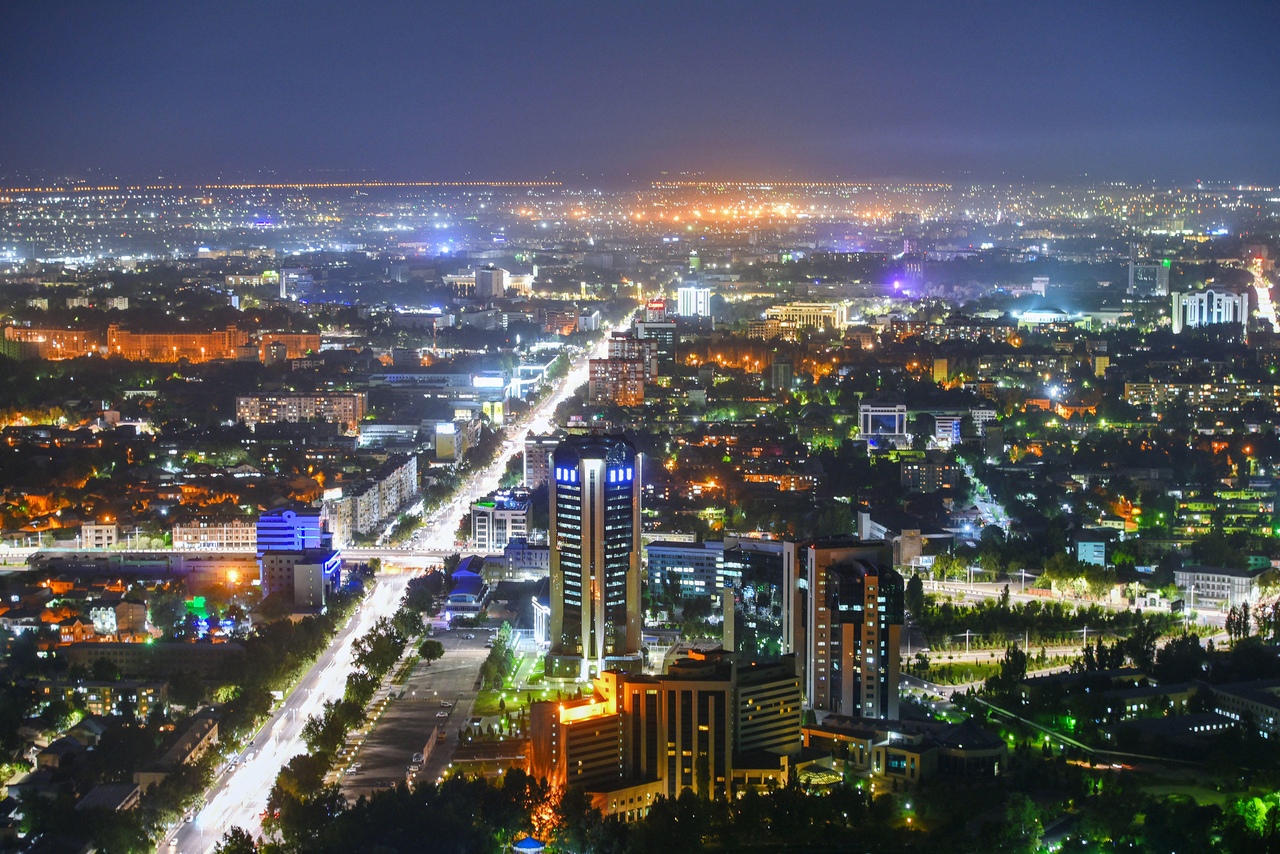
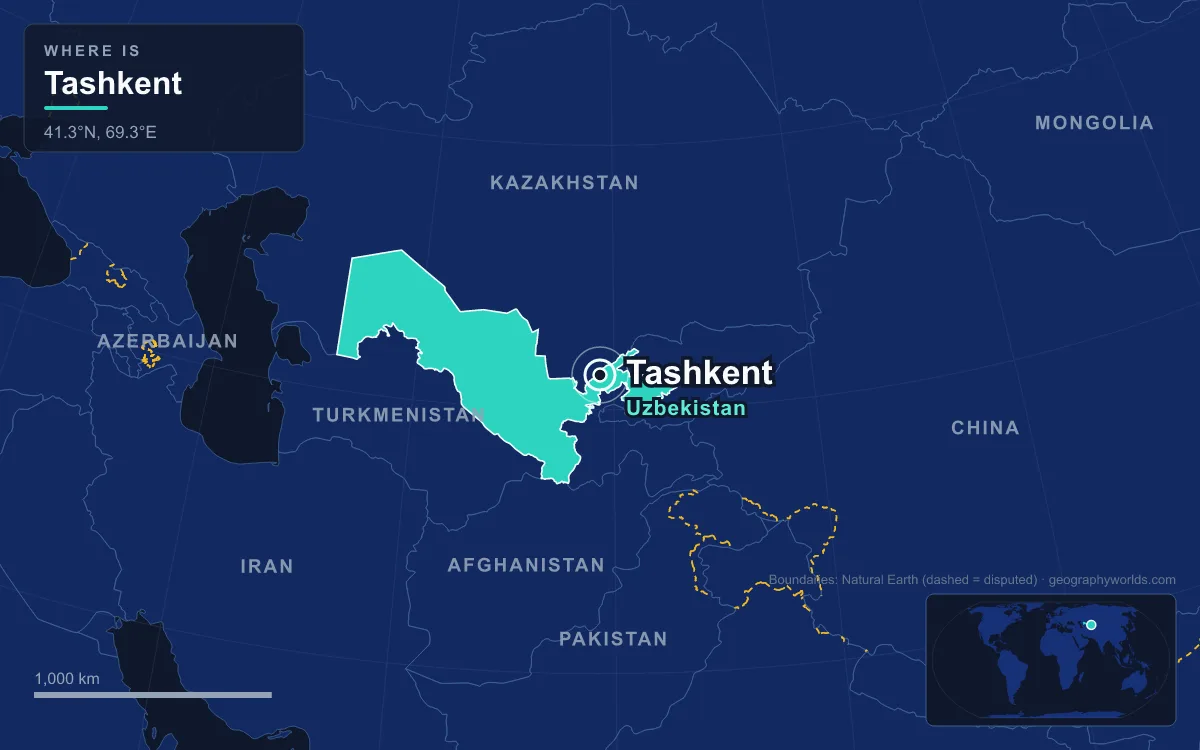
Tashkent is the capital of Uzbekistan and the most populous city in Central Asia, home to 3,164,030 people as of 1 October 2025. It lies in the north-east of the country on the Chirchiq River plain, just 13 kilometres from the Kazakh border. It has been the capital of Soviet and then independent Uzbekistan since 1930, when it took the title from Samarkand, and it produced about 19% of the country’s GDP in the first half of 2024. Most of what you see today was rebuilt after the earthquake of 1966.
Why Tashkent, Not Samarkand, Became Capital in 1930
Uzbekistan’s capital was not always Tashkent. When Moscow redrew the map of Central Asia along ethnic lines in 1924, it abolished the Turkestan ASSR and the Bukharan and Khorezm people’s republics. It created the Uzbek Soviet Socialist Republic on 27 October 1924. The new republic’s first capital was Samarkand, which held the role from 1925 until 1930. Samarkand had the older claim: Timur made it the capital of his empire in the 14th century, and the Timurid and Bukharan eras gave it the Registan.
In 1930 the capital of the Uzbek SSR was moved to Tashkent, and it has stayed there ever since. The sources do not record one official reason. The context is clear enough, though. By then Tashkent had been the administrative centre of the whole region for more than sixty years, first as seat of the Governor-General of Russian Turkestan and then, from April 1918, as capital of the Turkestan ASSR. It had the railway, the military district headquarters and the Soviet institutions. The move matched the reality of where power in Soviet Central Asia already sat. The republic’s map had also just changed: in 1929 the Tajik ASSR, until then part of Uzbekistan, was upgraded to a union republic of its own.
To understand why Tashkent had that head start, you have to go back to the water that first put a town here.
Chach and the Chirchiq Oasis
Tashkent sits where the Chirchiq River and several of its tributaries fan out across a well-watered plain, on the road between Samarkand and Shymkent. The first identified inhabitants of the Tashkent oasis, the Burgulik culture of the 9th to 4th centuries BC, kept animals and probably farmed with some irrigation, drawing water from a branch of the Chirchiq. Chinese sources place a settlement at the oasis by the 2nd century BC.
For much of its history the town and its district were called Chach, or Shash in Arabic. By the 7th century AD Chach had more than 30 towns and a network of over 50 canals, and it traded between the Sogdian cities and the Turkic nomads of the steppe. The Umayyad Caliphate conquered it early in the 8th century. After the 11th century the name drifted from Chachkand to Tashkand. The scholar al-Biruni explained it as Turkic tash and Persian kent, “stone city”.
Genghis Khan destroyed the city in 1219. It revived under Timur and the Shaybanids, whose era left the Kukeldash Madrasah, built in the reign of Abdullah Khan II (1557–1598). From 1784 a local ruler, Yunus Khoja, united the city as an independent Tashkent state. In 1809 it was annexed by the Khanate of Kokand. At that point it had around 100,000 people and was considered the richest city in Central Asia, enclosed by a moat and an adobe wall roughly 20 kilometres long.

Chernyayev’s 1865 Assault and the Seat of Russian Turkestan
Tashkent’s career as a capital began with a Russian general who disobeyed orders. In May 1865 Mikhail Chernyayev attacked the city against the Tsar’s direct instructions. His force was outnumbered at least 15 to 1 by some 30,000 defenders behind a wall about 25 kilometres long. After a diversionary attack and two days of street fighting, the city fell. Russian losses were 25 dead, against several thousand defenders, including the Kokand ruler Alimqul. Chernyayev, nicknamed the “Lion of Tashkent”, abolished taxes for a year and proposed that the city become a separate khanate under Russian protection.
St Petersburg had other plans. Chernyayev was replaced, and in 1867 Konstantin von Kaufman became the first Governor-General of the new province of Turkestan, with Tashkent as its capital. A Russian cantonment and new town were built across the Ankhor Canal from the old city, and Tashkent became a centre of espionage in the Great Game between Russia and Britain. The Turkestan Military District followed in 1874 and the Trans-Caspian Railway in 1889. Tashkent was now the administrative, military and rail hub for all of Russian Central Asia, the role that would carry it into the Soviet era.
Kokand’s Rival Government, 1917–1918
For a few months after the Russian Revolution, Tashkent’s claim to rule the region was openly contested. The Tashkent Soviet, which primarily represented Russian residents, who made up about a fifth of the city, took power and refused to let Muslims hold leading positions. In response, Turkestani leaders proclaimed the Turkestan Autonomy on 27 November 1917, based not in Tashkent but in Kokand. It claimed to be the legitimate government of Russian Turkestan and won wide popular support, but it could not raise taxes or an army. When its forces seized Soviet buildings in Kokand in February 1918, the Soviet government answered with force, and the Autonomy ended on 22 February 1918.
Two months later, in April 1918, Tashkent became the capital of the Turkestan Autonomous Soviet Socialist Republic, the largest city of a territory that took in most of former Russian Turkestan. That status lasted until the 1924 delimitation. Six years after it, Tashkent took Samarkand’s place as capital of the Uzbek SSR.
Rebuilt After the Earthquake of 26 April 1966
As capital, Tashkent absorbed the Soviet Union’s crises. After Germany invaded in June 1941, whole factories were moved here from western Russia and Ukraine, and wartime evacuees pushed the population well over a million. Many stayed. In January 1966 the city hosted the talks that produced the Tashkent Declaration, signed on 10 January by India’s Lal Bahadur Shastri and Pakistan’s Ayub Khan with Soviet Premier Alexei Kosygin mediating. Shastri died in the city the next day.
Then, at 05:23 on 26 April 1966, a magnitude 5.2 earthquake struck with its epicentre directly beneath central Tashkent, at a depth of only 3–8 kilometres. Between 78,000 and 95,000 homes were destroyed, most of them traditional adobe houses in the dense old city. Between 200,000 and 300,000 people were left homeless. The Alisher Navoi Opera and Ballet Theatre, built by Japanese prisoners of war, came through unharmed. Most of the older mosques and pre-revolutionary buildings did not.
Leonid Brezhnev flew in to oversee recovery, and other Soviet republics sent builders, many of whom settled for good. The capital was rebuilt as a model Soviet city of wide tree-lined avenues, parade squares, fountains and apartment blocks, with about 100,000 new homes completed by 1970. Planning for a metro began in 1968. The first line opened on 6 November 1977, making Tashkent the first city in Central Asia with an underground railway. By the collapse of the USSR it was the fourth-largest city in the Soviet Union, after Moscow, Leningrad and Kyiv.

Capital of Independent Uzbekistan Since 31 August 1991
Uzbekistan declared independence on 31 August 1991, after the failed coup in Moscow, and Tashkent moved from republican capital to national capital. Unlike Kazakhstan, which moved its capital from Almaty in 1997, Uzbekistan kept the seat of government where the Soviets had put it.
What changed was the symbolism. The largest statue ever built of Lenin was replaced by a globe showing a map of Uzbekistan. Amir Timur Square, ringed by gardens and fountains, is now centred on an equestrian statue of Timur, with the blue-domed Amir Timur Museum beside it. The Russian Orthodox church on the square, built in 1898, was demolished in 2009. Tashkent also holds the Samarkand Kufic Quran, one of the earliest surviving copies of the Quran, which was taken to Saint Petersburg in 1868 and returned to the region in 1923.
What the Capital Carries Today: 19% of GDP and a Plan to 2045
Being capital has made Tashkent the country’s economic engine as well as its seat of government. A 2023 report by the Center for Progressive Reforms ranked it first among Uzbekistan’s regions, leading in five of seven categories: healthcare, education, economy, infrastructure and environment. Since 2018 a new Tashkent City business district has been rising, with skyscrapers, international hotels and a planned International Business Center. Ethnic Uzbeks formed 84.4% of the population in 2021, followed by Tajiks at 4.9%. Uzbek is the main language, with Russian as a lingua franca.
Transport shows the reach of the capital. The metro now runs four lines and 50 stations and carried 286.8 million passengers in 2025, an average of about 785,000 a day. Tashkent International Airport, named after the first president Islam Karimov in 2017, handled 8.7 million passengers in 2024. High-speed trains cover the 600 kilometres to Bukhara in under four hours and reach Samarkand in just over two.
Growth has costs. The city has been divided into 12 districts since Yangihayot was created in 2020. According to the World Bank, its average annual air pollution is more than six times the level recommended by the WHO, driven by heating, transport and industry. The government’s master plan, running to 2045, aims to balance expansion with ecological protection and the preservation of what heritage survived 1966.
Tashkent is far ahead of Samarkand, Namangan and the rest, as our ranking of the largest cities in Uzbekistan shows. Its position near the Kazakh frontier makes more sense once you see the map of the countries that border Uzbekistan. For the country beyond the capital, from the Aral Sea to the Fergana Valley, continue with the Uzbekistan country guide.
Quick Facts About Tashkent
- Country: Uzbekistan
- Continent: Asia (Central Asia)
- Country population: approximately 37.7 million
- Capital city status: Tashkent is the capital of Uzbekistan, the seat of national government, and the location of foreign embassies, parliament, and the head of state's official residence.
Frequently Asked Questions
What is the capital of Uzbekistan?
The capital of Uzbekistan is Tashkent. Tashkent is the seat of national government, hosts most foreign embassies and consulates, and is typically where the head of state and parliament are located.
What continent is Tashkent in?
Tashkent, the capital of Uzbekistan, is located in Asia, in the Central Asia region. As Uzbekistan's capital, Tashkent serves as the country's primary connection to the broader Asian political, economic, and cultural sphere.
Why is Tashkent the capital of Uzbekistan?
Tashkent was chosen as the capital of Uzbekistan for reasons that typically combine geography, history, and politics. Capital city selections often reflect a desire for centrality (being accessible from across the country), historical importance (being a longstanding seat of government or culture), or neutrality (being acceptable to multiple regions or ethnic groups within the country). The specific reasons for Tashkent's designation are detailed in the city's history above.
What is Tashkent known for?
As the capital of Uzbekistan, Tashkent is best known for housing the country's central government institutions — parliament, presidential or royal residences, supreme court, and key ministries. It is also typically a major cultural and economic center within Uzbekistan, hosting national museums, embassies, and signature monuments. The introduction and history sections above provide detailed coverage of the city's specific notable institutions and landmarks.
Related Pages
- Uzbekistan Country Guide — full geography, climate, economy, and culture overview
- Flag of Uzbekistan — meaning, history, and design of Uzbekistan's national flag