
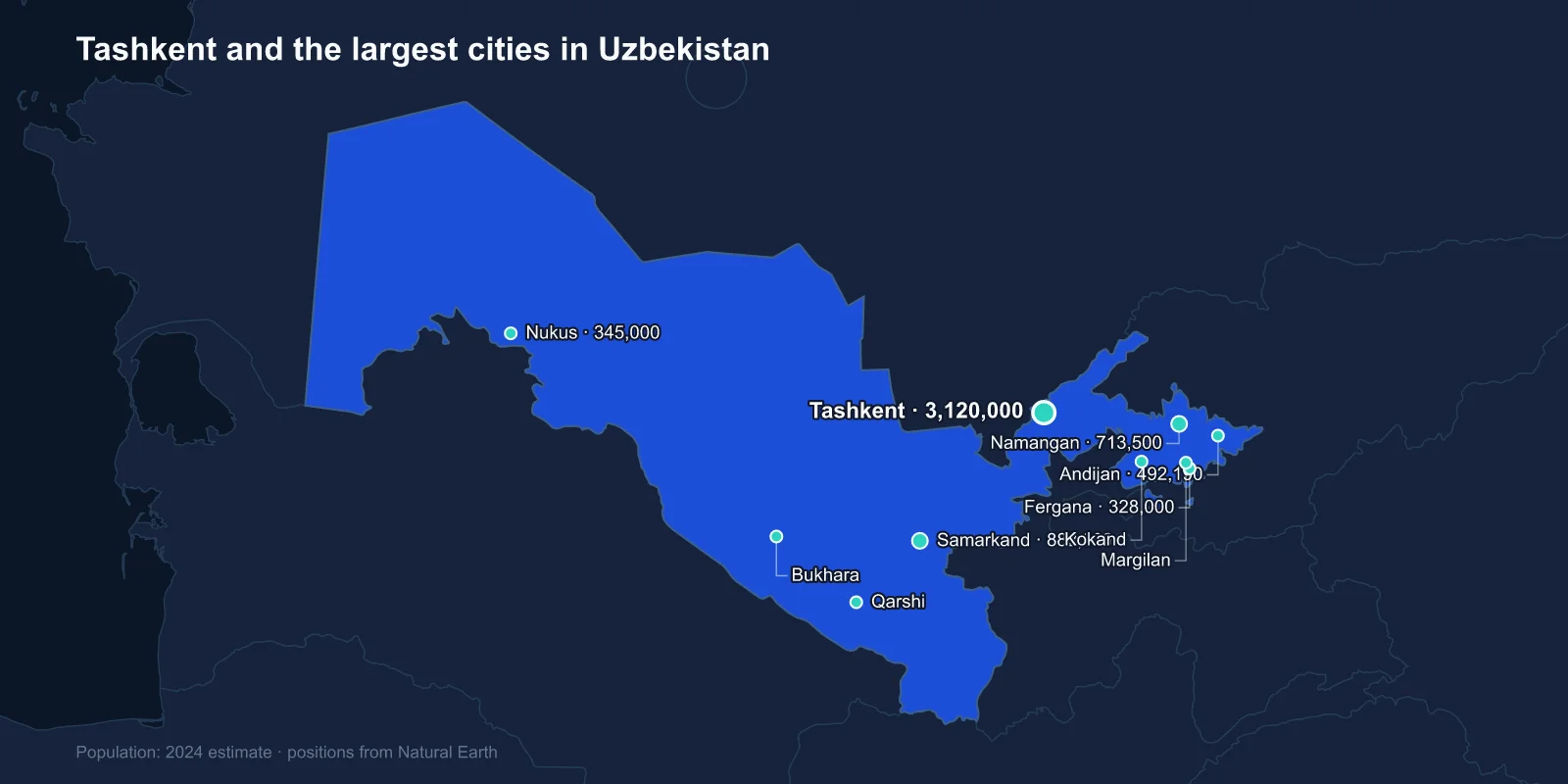
The largest cities in Uzbekistan are Tashkent (about 3,120,000), Samarkand (882,000), Namangan (713,500), Andijan (492,190), Nukus (345,000), Fergana (328,000), Kokand (314,000), Qarshi (301,000), Bukhara (300,000) and Margilan (258,000). These are 2024 estimates, and they are unusually current by the standards of this region.
Uzbekistan is the most populous country in Central Asia and the only one with a genuine urban hierarchy rather than a single dominant capital surrounded by small towns. Four of the ten largest cities sit in one valley.
The Fergana Valley Holds a Third of the Country
Namangan, Andijan, Fergana, Kokand and Margilan are all in the Fergana Valley, a broad, well-watered basin enclosed by the Tian Shan and Pamir-Alay ranges in the east of the country. It is one of the most densely populated rural landscapes in Asia.
The valley is fed by the Syr Darya and by a dense network of irrigation canals, some of them very old, and it has supported intensive agriculture and settled urban life for well over two thousand years. It was the Ferghana of Chinese records, famous for the heavenly horses the Han dynasty sent expeditions to acquire.
It is also carved into three countries. Soviet border-drawing in the 1920s and 1930s left the valley divided between Uzbekistan, Kyrgyzstan and Tajikistan along lines that follow neither the terrain nor the ethnic distribution, producing a scatter of enclaves and exclaves and a set of border disputes that have repeatedly turned violent.
A Capital Rebuilt After an Earthquake
Tashkent is by far the largest city in Central Asia, and most of what you see there was built after 1966. On 26 April of that year an earthquake struck directly beneath the city; the magnitude was moderate but the focus was shallow and the old adobe housing stock performed catastrophically. Official figures recorded relatively few deaths but several hundred thousand people were left homeless.
The Soviet response was a reconstruction campaign drawing building brigades from across the union, and the city was rebuilt as a showcase of Soviet modernism: wide boulevards, large squares, prefabricated housing blocks and a set of public buildings in a style that mixed modernist concrete with Central Asian ornament.
The Tashkent Metro opened in 1977, the first in Central Asia, and its stations are among the most elaborately decorated anywhere — marble, carved ganch plasterwork and chandeliers, with themes running from cotton harvests to the cosmonaut programme. Photography in them was banned until 2018 because they doubled as nuclear shelters.
Samarkand and the Timurid Inheritance
Samarkand is the second city and much the most famous internationally. It was already ancient when Alexander took it as Maracanda in 329 BC, and it reached its height under Timur, who made it the capital of an empire stretching from Anatolia to the edge of India and imported craftsmen from every conquered city to build it.
What survives from that period is extraordinary. The Registan, three madrasas facing a common square with tiled portals and ribbed domes, is one of the most photographed architectural ensembles in the world. The Gur-e-Amir holds Timur's tomb, and the Bibi-Khanym mosque was built at a scale that exceeded the engineering of its day and began collapsing almost immediately.
Timur's grandson Ulugh Beg built an observatory on the edge of the city in the 1420s and used a huge buried sextant to measure the length of the year to within about a minute. The foundation of the instrument was rediscovered in 1908 and can still be visited.
Bukhara Is Smaller Than Its Reputation
Bukhara appears only ninth on the list, which surprises most visitors. It was for centuries the leading centre of Islamic scholarship in Central Asia — the city of the hadith collector al-Bukhari, of Ibn Sina, and of several hundred madrasas.
Its old town survives more completely than Samarkand's, because it was not rebuilt on the same scale: a compact warren of covered bazaars, the Kalyan minaret that Genghis Khan reportedly spared, the Ark fortress, and the tenth-century Samanid mausoleum, which is probably the oldest intact Islamic building in the region.
Bukhara's modest size is exactly why the historic fabric survived. Cities that kept growing built over themselves; Bukhara did not.
Nukus and the Sea That Went Away
Nukus, fifth on the list, is the capital of Karakalpakstan, an autonomous republic covering the whole north-west of the country. It is a Soviet-planned city with no old town at all, and its significance is almost entirely modern.
It sits near what was the southern shore of the Aral Sea. Soviet irrigation schemes diverted the Amu Darya and Syr Darya to grow cotton, and the sea — once the fourth-largest lake in the world — lost the great majority of its volume. The fishing fleet at Moynaq is now stranded on sand tens of kilometres from any water, and the exposed seabed generates salt and pesticide dust storms that affect health across the region.
Nukus also holds one of the more improbable art collections in the world. Igor Savitsky spent decades acquiring Soviet avant-garde work that had been banned in Moscow and Leningrad, and housed it in a museum so far from the centre that nobody came to inspect it. It survived intact.
Cotton, and What It Cost
Uzbekistan was the cotton plantation of the Soviet Union, and independence did not change the model quickly. The crop shaped the cities on this list — Margilan has been a silk and textile town for centuries, Fergana was built as a Russian garrison and became a refining centre, and the valley's canals exist to water fibre rather than food.
The system was sustained by compulsory labour. Each autumn, students, teachers and public employees were sent to the fields to pick by hand, a practice that drew an international boycott of Uzbek cotton from 2010. The government dismantled organised forced labour over the following decade, and the boycott was lifted in 2022.
The water cost has been harder to undo. The Aral Sea is not coming back, and the irrigation network that emptied it is still the basis of the rural economy around several of these cities.
Kokand, Qarshi and the Khanate Towns
Kokand was the capital of an independent khanate that governed the Fergana Valley until the Russian conquest of 1876, and the palace of its last ruler still stands with its painted ceilings and tiled facade.
Qarshi, in the south, sits on the route towards Termez and the Afghan border and is the centre of a gas-producing region. Termez itself, on the Amu Darya, is the crossing point into Afghanistan — the Friendship Bridge there carried the Soviet army in in 1979 and out again in 1989.
The Language Question in the Cities
Uzbekistan switched its official alphabet from Cyrillic to Latin in 1993, and more than three decades later the transition is still incomplete. Street signs, newspapers and shopfronts in Tashkent carry both, often on the same block, and a final changeover has been announced and postponed repeatedly.
Russian remains widely spoken in the capital and in Nukus, less so in the Fergana Valley, and the distribution maps onto the cities in a readable way: Soviet-built administrative centres retained Russian, while the older Uzbek towns did not. Tajik is the first language of a substantial part of Samarkand and Bukhara, a fact that sits awkwardly with the national framing of both cities as Uzbek heritage sites.
Where the Country Ends
Uzbekistan is one of only two doubly landlocked countries in the world, along with Liechtenstein — meaning every one of its neighbours is itself landlocked, and reaching an ocean requires crossing at least two borders.
That fact bears directly on the cities. Termez and Qarshi in the south face Afghanistan; Nukus faces Kazakhstan across the desert; the Fergana cities are hemmed in by Kyrgyz and Tajik territory. Every export route out of these cities is a negotiation with a neighbour, which is why the border openings and rail agreements of the past decade have mattered so much to them.
Why These Figures Are Recent
Unlike most countries in this series, Uzbekistan has reasonably current statistics. It ran a continuous population register inherited from the Soviet system, and it conducted preparatory work for a full census scheduled for 2023, subsequently moved to 2026 — the first since 1989.
The estimates in this list come from that register and are updated annually, which makes them considerably more reliable than projections built on a decades-old base. The main caveat is the usual one about municipal boundaries: Tashkent's figure covers the city proper, and the surrounding Tashkent region adds several million more.
Depth Instead of a Single Centre
Uzbekistan's city list is unusual for the region in having depth. There is a large Soviet-rebuilt capital, two of the great cities of the Islamic world, a cluster of valley towns that together outweigh the capital, and a planned city beside a vanished sea.
The scholarly tradition that made Bukhara and Samarkand what they are is traced in Uzbek religious life. The Tashkent profile covers the rebuilt capital, and the deserts, rivers and mountain borders that box the country in are mapped in our Uzbekistan country guide.
