
Uzbekistan is roughly 96 per cent Muslim, overwhelmingly Sunni of the Hanafi school, with a Russian Orthodox minority of about two per cent and small Catholic, Protestant, Jewish and Baha'i communities. It is also one of the most tightly regulated religious environments in the Muslim world: mosques must be registered, imams are approved by the state, sermon content is coordinated centrally, and unregistered religious teaching is a criminal matter. The country simultaneously markets itself as the cradle of Islamic scholarship and treats independent religiosity as a security problem.
The Man From Bukhara Who Sorted the Hadith
Muhammad al-Bukhari, born in Bukhara in 810, spent sixteen years collecting reports of the words and actions of the Prophet Muhammad, travelling across the Islamic world and evaluating chains of transmission. The resulting compilation, Sahih al-Bukhari, is regarded by Sunni Muslims as the most authentic book after the Quran itself.
He is not an isolated case. Al-Tirmidhi, compiler of another of the six canonical hadith collections, came from Termez in the south. Al-Maturidi, whose school of theology underpins Hanafi orthodoxy across much of the Muslim world, worked in Samarkand. Al-Khwarizmi, whose name gives us the word algorithm, and Ibn Sina, the physician-philosopher known in Europe as Avicenna, both belong to this region.
The Uzbek state invests heavily in this inheritance. Al-Bukhari's mausoleum outside Samarkand has been monumentally rebuilt, an international research centre bearing his name operates in Samarkand, and a Centre of Islamic Civilisation is under construction in Tashkent. The message is that Uzbek Islam is scholarly, moderate and locally rooted — a claim with a policy purpose attached.
Maturidi Theology, and Why the Government Talks About It
Abu Mansur al-Maturidi, who died in Samarkand in 944, developed a theological framework that allows a substantial role for human reason in understanding revelation. Maturidism became the dominant creed alongside Hanafi law across Central Asia, South Asia and the Ottoman lands.
Uzbek officials invoke it constantly, because it provides an indigenous alternative to imported Salafi thought: a theology that is authentically local, intellectually serious and historically associated with tolerance. Whether ordinary Uzbek Muslims think in Maturidi categories is doubtful, but the state's promotion of it is a deliberate counter-programming exercise.
The Naqshbandi Order and the Shrine Outside Bukhara
Sufism shaped religious life across the region for centuries, and the most influential order originated here. Baha-ud-Din Naqshband, who died in 1389, gave his name to the Naqshbandi order, which spread from Bukhara to India, Anatolia, the Caucasus and eventually Indonesia.
The Naqshbandi were distinctive for practising silent rather than vocal remembrance of God, and for insisting that spiritual discipline was compatible with ordinary working life rather than requiring withdrawal. Naqshband's shrine, a complex of courtyards and a mosque some kilometres from Bukhara, remains the most visited pilgrimage site in the country. Visitors circle a fallen mulberry trunk said to have grown from the saint's staff.
The Soviet authorities treated shrine visitation as superstition and closed many sites, but pilgrimage never fully stopped, and it has expanded sharply since independence with state encouragement — again because a shrine-centred, saint-venerating Islam is precisely the kind that Salafi movements reject.
Architecture as Argument
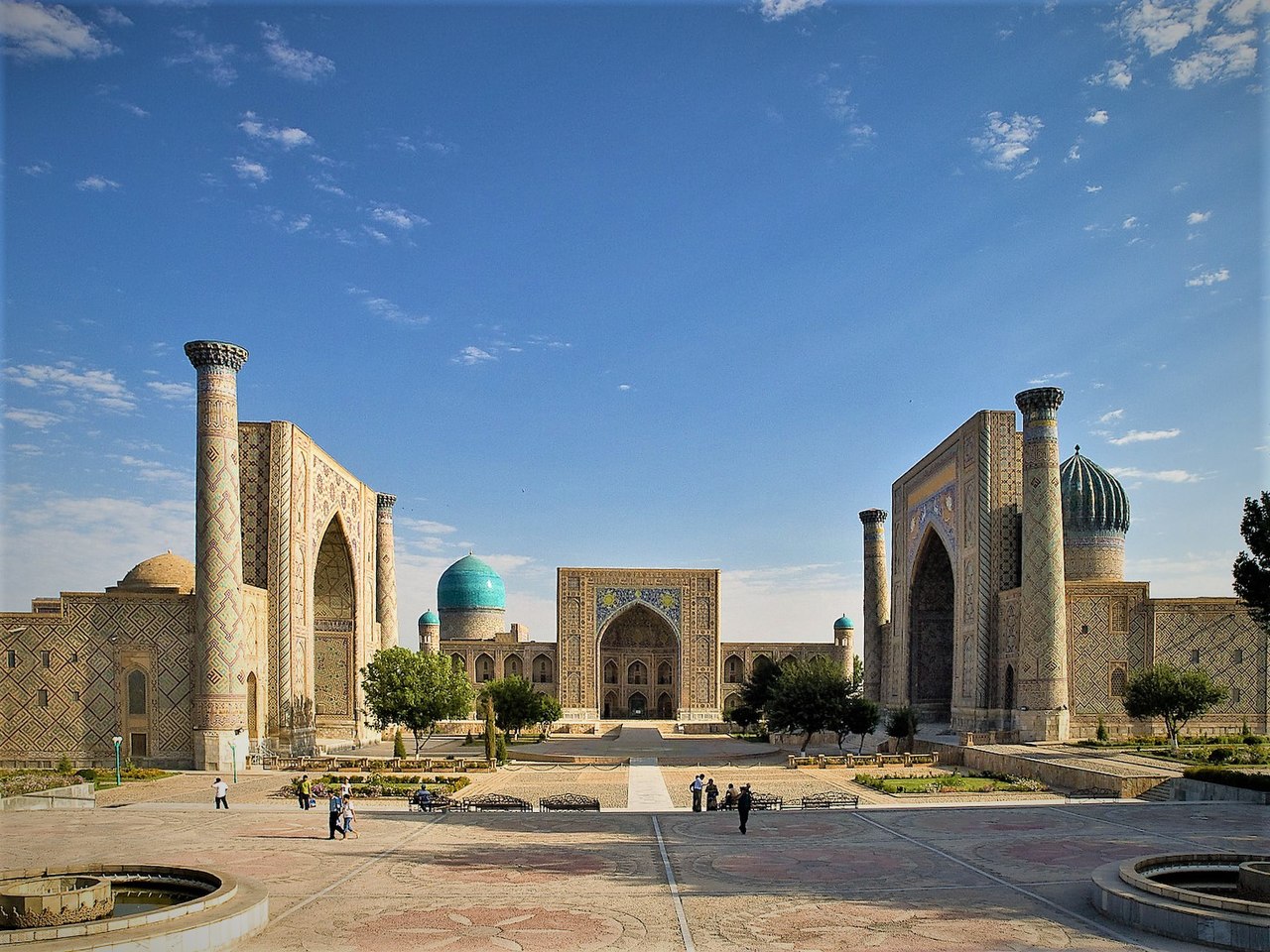
The Registan in Samarkand is three madrasas facing a single square: the Ulugh Beg Madrasa of the 1420s, built by the astronomer-prince who also constructed a monumental observatory; the Sher-Dor of the 1630s, whose facade depicts tigers chasing deer beneath human-faced suns, a striking departure from the usual prohibition on living images; and the gilded Tilya-Kori.
Bukhara's Kalyan Minaret, completed in 1127, was reportedly spared by Genghis Khan, who is said to have looked up at it and ordered it left standing. Beside it, the Mir-i-Arab Madrasa of 1536 holds a distinction that belongs to the twentieth century rather than the sixteenth: it was one of only two madrasas permitted to operate anywhere in the Soviet Union, which made it the training ground for nearly every senior Muslim cleric in the USSR.
Shah-i-Zinda, the avenue of tombs in Samarkand, is built around the supposed grave of a cousin of the Prophet, and remains an active pilgrimage route rather than a museum.
What the Soviet Period Did
Bolshevik policy toward Islam moved from cautious accommodation to assault. The hujum campaign, launched in 1927, pressed Uzbek women to publicly burn the horsehair-and-cotton paranja veil; the campaign produced mass unveilings and also a wave of killings of women who complied. Waqf endowments were confiscated, sharia and customary courts abolished, Arabic script replaced first with Latin and then Cyrillic, and the great majority of mosques closed.
In 1943, needing Muslim support for the war effort, Stalin authorised a Spiritual Administration of the Muslims of Central Asia and Kazakhstan, headquartered in Tashkent. SADUM registered a small number of mosques and clerics, issued fatwas convenient to state policy, and represented Soviet Islam to the outside world. Everything outside it was unofficial, and unofficial Islam — household observance, underground teachers, shrine visits — is what actually carried the religion through to 1991.
Independence, and the Fear of What Might Fill the Gap
The end of the Soviet Union produced a rapid religious revival: mosques reopened in large numbers, pilgrimage to Mecca resumed, and foreign missionaries and funders arrived from Turkey, Saudi Arabia and Pakistan.
President Islam Karimov's government grew alarmed quickly. The 1998 religion law required registration of all religious organisations, banned proselytising and private religious instruction, and prohibited religious dress in public places. Groups that failed to register became illegal by default, and the threshold for registration was set high enough to exclude most small congregations.
The Crackdown Years
After bombings in Tashkent in 1999, which the government blamed on Islamists, the state moved from regulation to suppression. Hizb ut-Tahrir, a transnational movement calling for a caliphate through non-violent means, was banned and its suspected members imprisoned in large numbers. Human rights organisations documented thousands of religious prisoners, torture in detention and convictions based on planted evidence.
Men with beards and women in hijab were detained for questioning; mosque attendance by young men was monitored. In 2005, security forces fired on a large crowd in Andijan following a prison break and demonstration; estimates of the dead run into the hundreds, and the episode led to years of isolation from Western governments. The official account described the events as an Islamist uprising.
What Changed After 2016
Shavkat Mirziyoyev, who took office after Karimov's death in 2016, loosened several of the tightest restrictions. Thousands of names were removed from the security services' register of suspected religious extremists, a number of religious prisoners were released, the call to prayer was permitted to be amplified again, and new mosques were built and old ones restored.
The structure of control, however, remained. A revised religion law in 2021 kept compulsory registration, retained the ban on private religious teaching and on proselytising, and preserved state approval of clergy. The Muslim Board of Uzbekistan continues to coordinate Friday sermon themes. Restrictions on face coverings in public have been reinforced rather than relaxed.
The result is a country where religious observance is easier and more visible than at any point since the 1920s, and where the state's claim to define what counts as legitimate Islam is undiminished.
What Observance Looks Like Day to Day
Everyday Uzbek Islam is heavily shaped by the life cycle rather than by weekly attendance. The sunnat toi, the circumcision feast for a boy of five to seven, is one of the largest events a family will host, often involving hundreds of guests and taking years to save for. Weddings follow a religious nikah alongside the civil registration, and funerals and the commemorations at set intervals afterwards are observed closely even by the non-observant.
Ramadan is widely kept, and iftar tables in Tashkent and the Ferghana Valley are a substantial social institution. Alcohol, however, is openly sold and consumed — a legacy of the Soviet period that sits alongside high rates of fasting without much apparent tension. Hajj participation is regulated through a national quota administered by the Muslim Board, and places are heavily oversubscribed.
Regional variation matters too. The Ferghana Valley in the east, densely populated and historically the most devout part of the country, has consistently been treated by the authorities as the area requiring closest attention, while Tashkent and the western regions are visibly more secular.
The Bukharan Jews, and Other Minorities
Bukhara held one of the oldest Jewish communities in Central Asia, with a distinct language, a synagogue quarter in the old city and a documented presence going back many centuries. Numbers ran into the tens of thousands in the Soviet period. Almost all emigrated to Israel and the United States after 1991 — the neighbourhood of Rego Park in Queens is now a larger Bukharan Jewish centre than Bukhara — and only a few hundred remain, with synagogues still operating in Bukhara, Samarkand and Tashkent.
The Russian Orthodox Church serves the Slavic minority, whose numbers have also fallen through emigration, and maintains a cathedral in Tashkent. Protestant and Baptist congregations, particularly those that attract ethnic Uzbek converts, face the most consistent legal pressure, since conversion from Islam is socially fraught and missionary activity is prohibited outright. There is more in our Uzbekistan country guide. Why Bukhara and Samarkand sat exactly where the scholarship happened is explained in the geography of the Silk Road, and our guide to the Central Asian states compares the five republics.
