
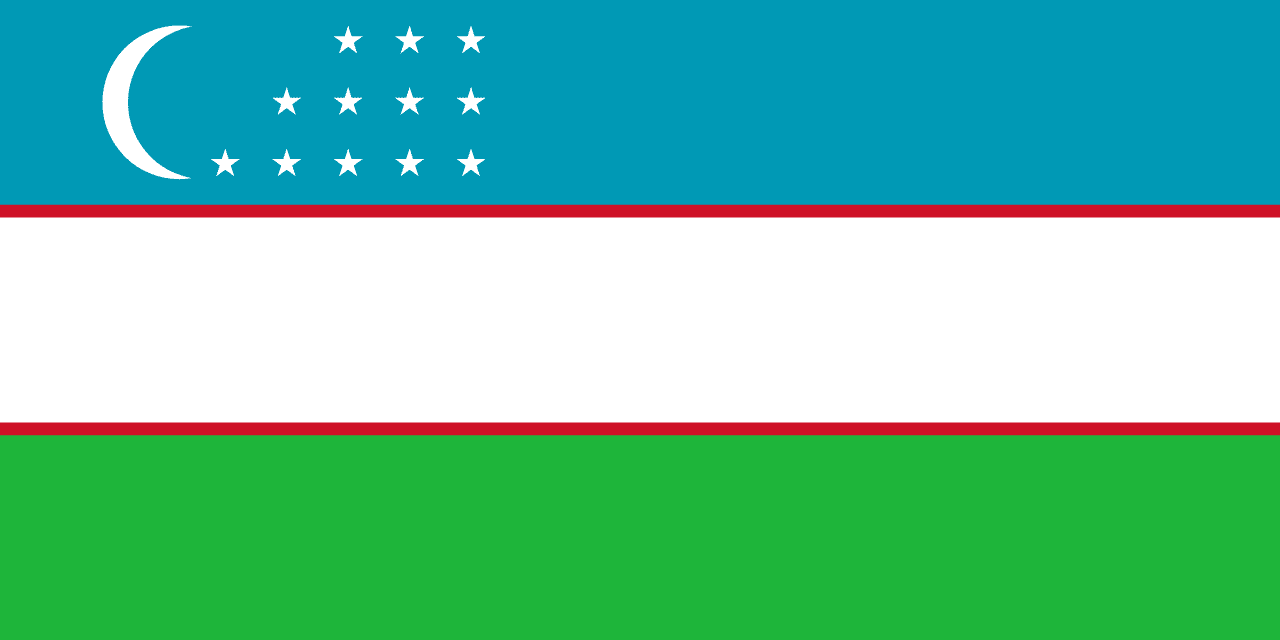
When Uzbekistan raised its own flag in 1991, the gesture carried more weight than most outsiders could appreciate. For nearly seven decades the country had flown variations of the Soviet red banner, its identity folded into a much larger empire. The new design that replaced it was not chosen casually. Across three calm horizontal bands of blue, white, and green, separated by thin red fillets, and crowned with a white crescent and a cluster of twelve stars, Uzbekistan announced a story about land, faith, and the rhythm of time itself. It remains one of Central Asia's most recognizable national emblems.
A Banner Born from Independence
Uzbekistan adopted its current flag in 1991, in the immediate aftermath of the collapse of the USSR. As the Soviet Union dissolved, the newly sovereign republic needed a symbol that owed nothing to Moscow and everything to its own heritage. The result was deliberate: a complete break from the single-color Soviet aesthetic in favor of a layered composition that could speak to the nation's geography, its predominant religion, and its hopes for the future. Few flags arrive at such a precise moment of national rebirth, and the Uzbek flag wears that origin proudly.
Reading the Colors
Each shade on the Uzbek flag is assigned a clear meaning, which makes the banner unusually legible once you know the code. Blue, the top band, stands for water, an element of profound importance in a largely arid, doubly landlocked country where rivers and oases have shaped where people live for millennia. White, the central band, represents peace, that universal aspiration that so many young nations stitch into their first official symbols. Green, along the bottom, evokes nature and the fertile land that sustains the population.
Between these three broad stripes run thin red fillets. Though slender, the red carries its own significance as the thread of life force that runs through every living thing, binding the calmer bands together. The interplay of these four colors gives the flag a balance that feels both serene and quietly energetic, never relying on a single dominant hue to carry the message.
The Crescent and the Twelve Stars
The most striking feature sits in the upper hoist corner: a white crescent moon accompanied by a tidy arrangement of twelve white stars. The crescent is a nod to Islam, the faith of the great majority of Uzbeks, and also a broader symbol of a newborn republic finding its feet. The crescent's open shape has long been read as a sign of fresh beginnings, which suits a flag designed at the dawn of independence.
The twelve stars are where interpretations multiply in a satisfying way. Officially they are linked to the twelve months of the year and the signs of the zodiac, tying the flag to ancient ideas of astronomy and the calendar that flourished in the region's intellectual history. There is also a popular reading that the twelve stars correspond to the twelve administrative regions of Uzbekistan, giving every part of the country a place in the sky. Both meanings coexist comfortably, and the layered symbolism is part of the flag's appeal.
The Design and Layout
Structurally, the flag is a horizontal triband: three roughly equal bands of blue over white over green, with the two narrow red lines slipped in as dividers. The crescent and stars occupy the blue band near the staff, arranged so the crescent opens toward the stars. The stars themselves are stacked in a neat formation of rows, building from a single star up through ascending lines, a tidy pyramid of light against the blue.
This arrangement keeps the composition organized rather than cluttered. The eye reads the bands as a stable horizon and then settles on the celestial cluster as the focal point. It is a layout that photographs and renders well at any size, from a stadium banner to a lapel pin, which matters enormously for a flag meant to represent the country on the world stage.
How It Compares to Neighboring Flags
Set the Uzbek flag beside those of its Central Asian neighbors and the family resemblances and crucial differences both emerge. Several regional flags lean on blue, green, and celestial imagery, reflecting shared cultural threads, the importance of water and sky, and the prominence of Islam. The crescent-and-star motif, in particular, links Uzbekistan visually to many flags across the Muslim world, from Turkey to Pakistan, though each treats the motif differently.
What sets Uzbekistan apart is the specific combination: the four-color palette with those thin red dividing lines, and especially the count of twelve stars rather than a single star or a handful. Many crescent flags pair the moon with just one star; Uzbekistan's generous constellation is distinctive and immediately identifies the banner once you know to count. The horizontal triband structure also distinguishes it from neighbors who favor different field arrangements. For more on the country behind the symbol, see our uzbekistan country guide.
Cultural Significance and Modern Life
Within Uzbekistan the flag is woven into civic life. It flies over government buildings, schools, and public squares, and it takes center stage on Independence Day, when the country celebrates its 1991 break from Soviet rule. Athletes carry it at international competitions, and it appears on uniforms, official documents, and the backdrops of state occasions. For a nation still defining its place in the post-Soviet world, the flag functions as a compact statement of who Uzbeks are: people of water and land, peaceful in aspiration, and rooted in a long heritage of faith and learning.
Because its symbolism is so explicit, the flag also serves as a teaching tool. Schoolchildren learn the meaning of each color and each element, so the banner doubles as a memory aid for national values. That clarity has helped the design endure without controversy or major revision since its adoption.
Interesting Facts at a Glance
- The flag was adopted in 1991, very shortly after Uzbekistan declared independence from the Soviet Union.
- Its four colors are blue, white, and green in broad bands, with thin red lines as dividers.
- The crescent represents Islam and the idea of a republic being born anew.
- The twelve stars are linked to the twelve months and zodiac signs, and are also popularly tied to the country's twelve regions.
- Uzbekistan sits in Central Asia, part of the Asian continent, and is one of only two doubly landlocked countries in the world.
- The crescent-and-star pairing connects the flag visually to many other flags across the Muslim world, though the twelve-star count is unusual.
Frequently Asked Questions
When was the flag of Uzbekistan adopted?
The flag was adopted in 1991, in the wake of the Soviet Union's dissolution and Uzbekistan's move to independence. It replaced the Soviet-era banner the republic had used for decades and was among the first acts of the newly sovereign state.
What do the colors of the Uzbek flag mean?
Blue stands for water, white for peace, and green for nature. The thin red lines that separate the bands represent the life force running through all living things. Together the palette emphasizes the country's landscape and its peaceful aspirations.
What do the crescent and twelve stars symbolize?
The crescent represents Islam and the birth of a new republic. The twelve stars are associated with the twelve months of the year and the zodiac, and they are also widely interpreted as standing for the twelve administrative regions of Uzbekistan.
What continent is Uzbekistan on, and how does its flag compare to others?
Uzbekistan is in Central Asia, on the Asian continent. Its flag shares the crescent-and-star motif with many flags across the Muslim world, but its specific four-color palette and its cluster of twelve stars, rather than a single star, make it easy to tell apart once you know what to look for.
