

The five "Stans" of Central Asia — Kazakhstan, Uzbekistan, Turkmenistan, Kyrgyzstan, and Tajikistan — form one of the most geographically remote and strategically important regions on the planet. Spanning approximately 4 million square kilometers of steppe, desert, and mountain terrain, these five post-Soviet republics are home to roughly 75 million people and sit at the crossroads of Russia, China, the Middle East, and South Asia.
Introduction
The suffix "-stan" means "land of" in Persian, reflecting the deep Iranian cultural influence on a region that served as the heart of the ancient Silk Road. Central Asia was the conduit through which ideas, religions, technologies, and trade goods flowed between East and West for millennia. After seven decades of Soviet rule, the five republics gained independence in 1991 and have since navigated between the competing influences of Russia, China, and the West while developing their own national identities.
Geography & Landscape
- Total Area: ~4 million km²
- Largest Country: Kazakhstan (2.72 million km², world's 9th largest)
- Highest Peak: Ismoil Somoni Peak, Tajikistan (7,495 m)
- Major Water Bodies: Aral Sea (shrinking), Caspian Sea, Lake Issyk-Kul
Central Asia's geography ranges from the vast, flat Kazakh steppe in the north — the world's largest dry steppe — to the towering Pamir and Tian Shan mountain ranges in the southeast, where peaks exceed 7,000 meters. The Karakum and Kyzylkum deserts cover much of Turkmenistan and western Uzbekistan respectively, while the fertile Fergana Valley, shared by Uzbekistan, Kyrgyzstan, and Tajikistan, is one of the most densely populated areas in the region.
The Aral Sea, once the world's fourth-largest lake, has become one of the planet's worst environmental disasters. Soviet-era irrigation diversions from the Amu Darya and Syr Darya rivers to grow cotton shrank the sea by over 90 percent, leaving behind a toxic, salt-crusted desert that spreads dust storms across the region. Lake Issyk-Kul in Kyrgyzstan, one of the world's largest alpine lakes, remains pristine by comparison and is a growing tourism destination.
History & the Silk Road
- Silk Road Period: ~2nd century BCE to 15th century CE
- Timur's Empire: Centered in Samarkand, 14th-15th century
- Soviet Period: 1920s-1991
- Independence: All five nations became independent in 1991
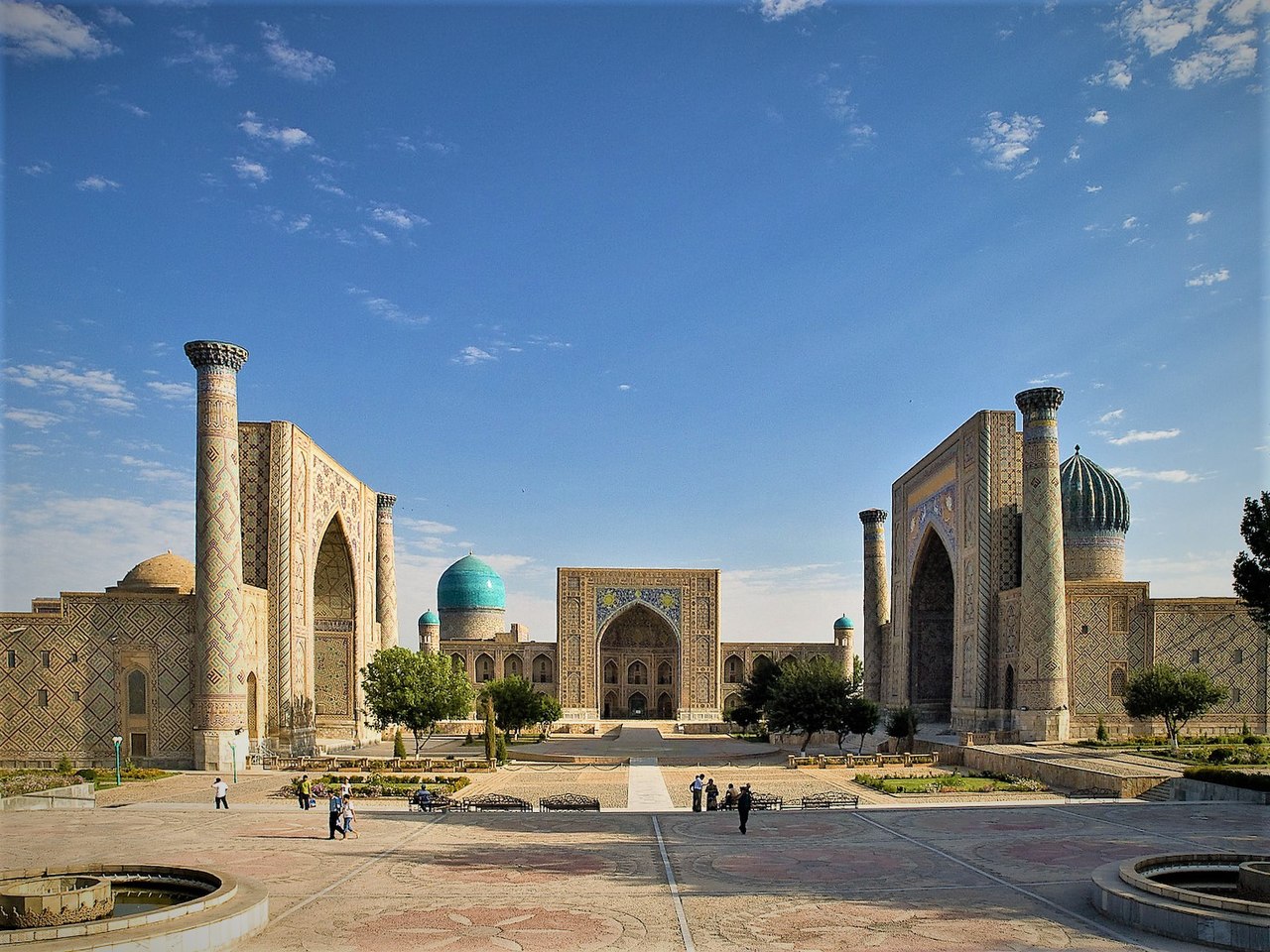
Central Asia was the beating heart of the Silk Road, the ancient network of trade routes connecting China to the Mediterranean. Cities like Samarkand, Bukhara, and Khiva became fabulously wealthy centers of commerce, scholarship, and architecture. The region produced great scientists and thinkers including al-Khwarizmi (who gave us the word "algorithm") and Avicenna (Ibn Sina), whose medical texts were used in European universities for centuries.
The Mongol conquests of the 13th century devastated the region, but Timur (Tamerlane) later built a vast empire from Samarkand that stretched from India to Turkey. Russian and then Soviet conquest from the 19th century onward radically transformed the region, imposing new borders, the Cyrillic alphabet, cotton monoculture, and atheist ideology. Independence in 1991 came suddenly and largely without violence, leaving the new states to build national identities from the fragments of their pre-Soviet and Soviet pasts.
Energy & Resources
- Kazakhstan Oil: Proven reserves of 30 billion barrels
- Turkmenistan Gas: 4th largest natural gas reserves in the world
- Uzbekistan: Major gold and uranium producer
- Pipeline Politics: Competing routes to Russia, China, Europe
Central Asia is enormously rich in energy resources. Kazakhstan's Kashagan and Tengiz oil fields are among the largest in the world, making it the region's wealthiest nation on a per-capita basis. Turkmenistan holds the world's fourth-largest natural gas reserves, centered on the giant Galkynysh field, though the country's authoritarian government and geographic isolation have limited development.
Pipeline routes are a major source of geopolitical competition. Russia historically controlled Central Asian energy exports through Soviet-era pipeline networks. China has built the Central Asia-China gas pipeline, which now carries Turkmen gas eastward. Western-backed projects like the Trans-Caspian Pipeline, which would carry gas to Europe bypassing Russia, have been discussed for decades but face Russian and Iranian opposition. Uzbekistan and Kyrgyzstan possess significant gold, uranium, and rare earth deposits that are increasingly attracting Chinese and Western investment.
Governance & Society
- Kazakhstan: Authoritarian, most reformed economy
- Uzbekistan: Gradually liberalizing since 2016
- Turkmenistan: One of world's most isolated and repressive states
- Kyrgyzstan: Most democratic, two revolutions since independence
- Tajikistan: Authoritarian, poorest of the five
The five Stans display a spectrum of governance from Kyrgyzstan's turbulent democracy to Turkmenistan's almost totalitarian personality cult. Kazakhstan and Uzbekistan occupy a middle ground of authoritarian modernization, maintaining tight political control while pursuing economic reforms and international engagement. Tajikistan, the poorest of the five, experienced a devastating civil war from 1992 to 1997 and remains under the firm rule of President Rahmon since 1994.
Central Asian societies are predominantly Muslim (Sunni, Hanafi school), though Soviet-era secularization means religious observance is generally moderate compared to the Middle East. Ethnic identities are strong but fluid, with Kazakh, Uzbek, Tajik, Kyrgyz, and Turkmen identities overlapping across borders. Russian remains widely spoken as a language of inter-ethnic communication and higher education, though national languages are increasingly promoted.
Geopolitical Competition
- Russia's Role: Former colonial power, still dominant security partner
- China's Belt and Road: Massive infrastructure investment across the region
- Western Engagement: Military partnerships, democracy promotion
- Key Organization: Shanghai Cooperation Organisation (SCO)
Central Asia is one of the world's most active arenas of great-power competition. Russia considers the region its traditional sphere of influence and maintains military bases in Kyrgyzstan and Tajikistan. China's Belt and Road Initiative has poured tens of billions of dollars into Central Asian infrastructure — railways, highways, pipelines, and industrial zones — making Beijing the region's largest trading partner and creditor.
The five Stans have pursued a multi-vector foreign policy, balancing relationships with Russia, China, the United States, the European Union, Turkey, and others to maximize their independence and leverage. Kazakhstan and Uzbekistan in particular have skillfully used their strategic position to attract investment and diplomatic attention from all sides. The Shanghai Cooperation Organisation provides a multilateral framework for Sino-Russian engagement with the region, while individual states maintain varying degrees of cooperation with NATO and Western institutions.
Key Facts
- The five Central Asian Stans cover approximately 4 million km² with a combined population of 75 million.
- Kazakhstan holds 30 billion barrels of proven oil reserves, making it a major global energy producer.
- The Aral Sea has shrunk by over 90% due to Soviet-era irrigation, creating one of the world's worst environmental disasters.
- Samarkand, Bukhara, and Khiva were among the wealthiest cities in the world during the Silk Road era.
- China's Belt and Road Initiative has made Beijing the largest trading partner and creditor of most Central Asian states.
Fun Facts
- The suffix "-stan" means "land of" in Persian — Kazakhstan literally means "Land of the Kazakhs."
- Turkmenistan's former president renamed the months of the year after himself and his mother.
- Kazakhstan is the world's 9th largest country by area but has a population density of only about 7 people per km².
- The ancient scholar al-Khwarizmi from Khiva gave us the word "algorithm" from the Latinization of his name.
Final Thoughts
The five Stans of Central Asia are emerging from the shadows of Soviet rule and Silk Road nostalgia to claim a new role in the 21st century. Sitting atop vast energy reserves and positioned at the intersection of Russian, Chinese, and Western interests, these nations face the challenge of translating geographic and resource advantages into genuine prosperity and stability for their people. How they navigate the competing pressures of great-power competition while building their own institutions will shape the destiny of the Eurasian heartland.
Test Your Knowledge!
Think you know the world's regions? Try our interactive geography quiz!
Play Geography Games →