
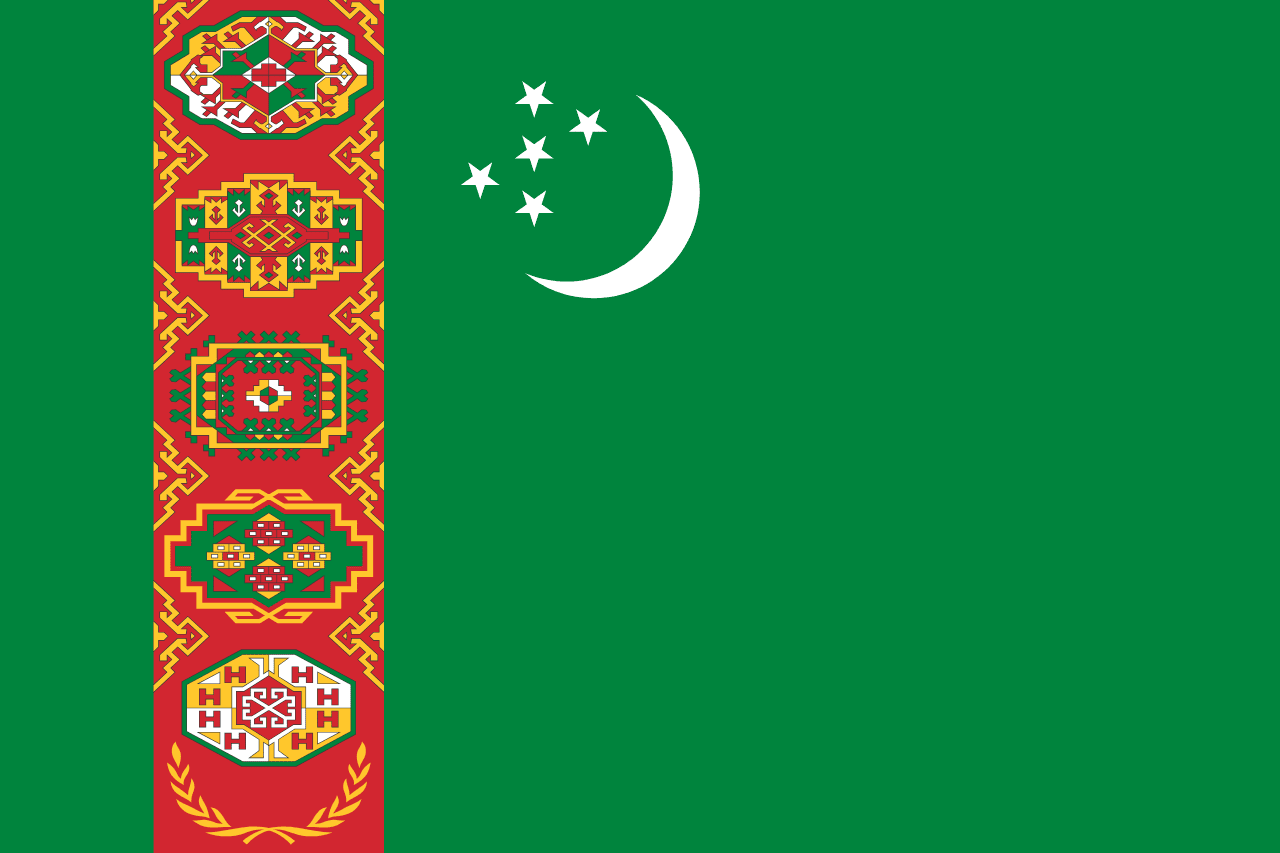
Few national banners pack as much intricate visual storytelling into a single rectangle as the flag of Turkmenistan. Where many countries settle for clean horizontal stripes or a lone central emblem, Turkmenistan chose a deep green field, a soaring crescent and stars, and a vertical band woven with the kind of geometric patterns you would expect to find knotted into a handmade carpet. The result is widely described as one of the most detailed national flag designs in the world, a banner that doubles as a portrait of the nation's faith, its tribal heritage, and its craft traditions. Adopted in 1992, shortly after the Central Asian republic gained independence, it remains an unusually direct expression of who the Turkmen people understand themselves to be.
A Flag Built From Green, Red, and White
The flag works with a tight palette of three colors, and each one does deliberate work. Green dominates the field and carries the strongest association with Islam, the faith of the overwhelming majority of Turkmen. It is a color long linked to the religion across the Muslim world, and here it anchors the entire composition. Red appears in the carpet motifs that run down the hoist-side stripe, echoing the warm, earthy tones that define traditional Turkmen weaving. White renders the crescent moon and the stars, the same crisp lunar imagery found across many flags of Muslim-majority nations. Together the three hues balance the spiritual, the cultural, and the celestial in a single frame, and they do so without the busy clash you might expect from such an ornate layout.
Reading the Design and Layout
At first glance the structure is straightforward: a green field running the length of the flag. But the detail lives in two distinct zones. Near the upper portion of the green field sits a white crescent moon turned to embrace a cluster of white stars, the classic crescent-and-star arrangement that signals an Islamic heritage. The crescent opens upward and outward, and the stars nestle within its curve.
The element that truly sets this banner apart is the vertical red stripe along the hoist, the edge nearest the flagpole. Rather than being a plain block of color, the stripe is filled with a column of carpet medallions, each rendered in the geometric, knotted style of Turkmen rugs. These are not abstract decoration. Each medallion, known in the weaving tradition as a gul, references the historic tribes of the Turkmen people. The carpet patterns show five tribes, embedding the country's social fabric, quite literally, into the cloth of the flag itself. No other national flag in the world incorporates a real, recognizable carpet design in this way.
How the Flag Came to Be
Turkmenistan's flag is a product of independence. When the Soviet Union dissolved, the newly sovereign republic needed symbols that broke decisively with its Soviet-era past and reached instead toward Turkmen identity. The flag was adopted in 1992, and from the start its designers leaned on the deepest wells of national culture: the green of Islam and the woven traditions of the carpet, an art form so central to Turkmen life that it appears on the country's emblem as well.
The decision to include the carpet medallions was a statement of cultural pride at a moment when the nation was defining itself anew. Carpet weaving is among the oldest and most revered crafts in the region, passed down through generations and tied closely to tribal identity, so placing it on the flag rooted the young state in something far older than its modern borders. The banner has seen refinements to its details over the years, but its essential character, green field, crescent and stars, and a carpet-patterned stripe, has held remarkably steady. For broader context on the nation behind the banner, see our turkmenistan country guide.
How It Compares to Similar Flags
The crescent and stars on a green field place Turkmenistan in a wide family of flags from Muslim-majority countries. A green ground appears on banners ranging from Saudi Arabia to Pakistan, and the crescent-and-star pairing shows up everywhere from Turkey to Tunisia to Pakistan and Algeria. At a quick glance from across a room, the Turkmen flag's upper section can read as part of that broad tradition.
But the comparison ends fast. Where Turkey's flag is a clean red field with a single white crescent and star, and Pakistan's pairs a white hoist band with a green field and crescent, Turkmenistan loads its hoist with an unmistakable column of carpet medallions. That ornate vertical stripe is the feature no look-alike shares. It immediately distinguishes the flag from its green-and-crescent cousins and from neighboring Central Asian banners. The Turkmen flag is the one you identify not by its color scheme but by the rugs woven into its edge, a detail unique among the world's national flags.
Cultural Significance and National Identity
For Turkmen citizens, the flag is less an abstract emblem and more a compression of national life. The green speaks to faith. The crescent and stars connect the country to a wider Islamic world while affirming its own sovereignty. And the carpet medallions root that sovereignty in the soil of tribal history, naming the communities whose traditions built the nation. A handwoven Turkmen carpet can take months to complete and is treated as an heirloom; seeing those same patterns flown overhead lends the flag an intimacy that few national symbols achieve.
This is a banner that asks to be read closely. The further you look into it, the more it tells you, which is precisely the opposite of a minimalist design philosophy. In a region where carpets have long served as currency, dowry, prayer mat, and art object all at once, putting them on the flag was a way of declaring that the most ordinary and most sacred objects of daily life are also the truest emblems of the state.
The Flag in Modern Life
Today the flag flies over government buildings, schools, and public squares across the country, and it features prominently during national celebrations. Turkmenistan observes a dedicated Flag Day, an occasion that underlines just how central the banner is to civic pride. The flag accompanies Turkmen athletes at international sporting events, appears at diplomatic functions, and is raised at ceremonies marking independence. In each setting the carpet stripe travels with it, carrying the country's craft heritage onto stages far from home.
- Turkmenistan sits in Central Asia, bordering the Caspian Sea, and lies on the continent of Asia.
- The flag is frequently cited as one of the most complex national flag designs in existence because of its detailed carpet medallions.
- Each carpet gul in the hoist stripe represents one of the country's five major tribes.
- Green for Islam, a white crescent and stars, and red carpet patterns make up the full color story.
- The flag was adopted in 1992, in the wake of independence from the Soviet Union.
Frequently Asked Questions
When was the flag of Turkmenistan adopted?
The flag was adopted in 1992, soon after Turkmenistan became an independent nation following the dissolution of the Soviet Union. Its design has been refined in the years since, but the green field, crescent and stars, and carpet-patterned stripe have remained consistent throughout.
What do the colors of the Turkmenistan flag mean?
Green represents Islam, the faith of most Turkmen, and forms the main field. White is used for the crescent moon and stars, a traditional Islamic symbol. Red appears in the carpet patterns along the hoist, reflecting the warm tones of Turkmen rug-making.
What do the carpet patterns on the flag represent?
The geometric medallions in the vertical stripe are based on traditional Turkmen carpet designs. Each one represents one of the country's five historic tribes, making the flag a woven record of the nation's tribal heritage. This feature is unique among the world's national flags.
What continent is Turkmenistan on?
Turkmenistan is located in Central Asia and therefore lies on the continent of Asia. It borders the Caspian Sea to the west and shares land borders with several neighboring Central Asian and Middle Eastern countries.