
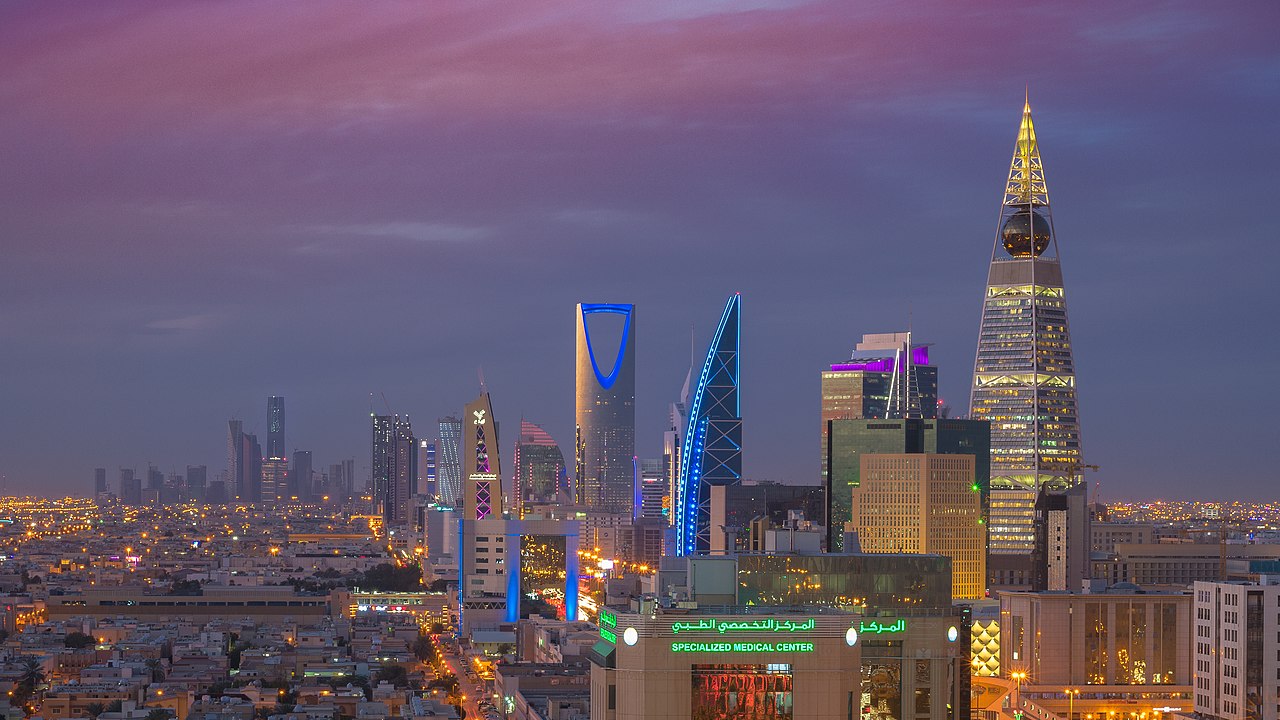
Introduction
Riyadh is the capital and largest city of Saudi Arabia. It is also the capital of the Riyadh Province and the centre of the Riyadh Governorate. Located on the eastern bank of Wadi Hanifa, the current form of the metropolis largely emerged in the 1950s as an offshoot of the 18th century walled town following the dismantling of its defensive fortifications. It is the largest city on the Arabian Peninsula, and is situated in the center of the Nafud desert, on the eastern part of the Najd plateau. The city sits at an average of 600 meters (2,000 ft) above sea level, and receives around 5 million tourists each year, making it the forty-ninth most visited city in the world and the 6th in the Middle East. Riyadh had a population of 7.0 million people in 2022, making it the most-populous city in Saudi Arabia, 3rd most populous in the Middle East, and the 38th most populous in Asia. The first mention of the city by the name Riyadh was in 1590, by an Arab chronicler. In 1745, Dahham ibn Dawwas, who was from the neighboring Manfuhah, seized control of the town. Dahham built a mudbrick palace and a wall around the town, and the best-known source of the name Riyadh is from this period, thought to be referring to the earlier oasis towns that predated the wall built by Ibn Dawwas. In 1744, Muhammad ibn Abd al-Wahhab formed an alliance with the Emir of Diriyah, Muhammad bin Saud, and they took Riyadh from Dahham. However their state, now known as the First Saudi state, collapsed in 1818. Turki ibn Abdullah founded the Second Saudi state in the early 19th century and made Riyadh his capital in 1825. However, his reign over the city was disrupted by a joint Ottoman–Rashidi alliance. Finally, in the early 20th century, Ibn Saud retrieved his ancestral rule in 1902 with the Emirate of Riyadh and consolidated his rule by 1926 with the final Saudi conquest of Hejaz, subsequently naming his kingdom 'Saudi Arabia' in September 1932 with Riyadh as the capital. The town was the administrative center of the government until 1938, when Ibn Saud moved to the Murabba Palace. In the 1950s, the walls were dismantled and Riyadh metropolis outgrew as an offshoot of the walled town. Riyadh is the political and administrative center of Saudi Arabia. The Consultative Assembly, the Council of Ministers, the king and the Supreme Judicial Council are all situated in the city. Alongside these four bodies that form the core of the legal system of Saudi Arabia, the headquarters of other major and minor governmental bodies are also located in Riyadh. Out of the 24 ministries of the Saudi government, 23 are headquartered in Riyadh, further reinforcing its status as the nation's administrative capital. The city hosts 114 foreign embassies, most of which are located in the Diplomatic Quarter in the western reaches of the city. Riyadh also holds economic significance, as it contains the headquarters of many banks and major companies, such as the Saudi National Bank, Alrajhi Bank, SABIC, Almarai, STC Group, and MBC Group, In addition to its strong local presence, Riyadh has also attracted major international investment. Global companies such as Lenovo, Google, Amazon, Samsung, and Philips have moved their regional headquarters to the city. In total, over 500 foreign companies have relocated their regional bases to Riyadh, reinforcing its growing status as a regional business hub, and Highway 65, known locally as the King Fahd Road, runs through some of these important centers in the city, including the King Abdullah Financial District, one of the world's largest financial districts, the Al-Faisaliah Tower and the Kingdom Center. Riyadh is one of the world's fastest-growing cities in population and is home to many expatriates. The city is divided into fifteen municipal districts, which are overseen by the Municipality of Riyadh, headed by the mayor, and the Royal Commission for Riyadh City which is chaired by the governor of the province, Faisal bin Bandar. As of July 2020, the mayor is Faisal bin Abdulaziz. Riyadh will host Expo 2030, becoming the second Arab city to host after Dubai in 2020. On the outskirts of Riyadh is Diriyah, one of the most historically important places in Saudi Arabia and original home of the ruling House of Saud and site of At-Turaif Palace, a UNESCO heritage site. Diriyah today is also one of Saudi Arabia’s flagship Vision 2030 projects. In the 18th century, Diriyah was the capital of the First Saudi State. Diriyah is often described as “where Saudi Arabia began.”

History & Origins
During the Pre-Islamic era, the city at the site of modern Riyadh was called Hajr, and was reportedly founded by the tribe of Banu Hanifa. Hajr served as the capital of the province of Al-Yamama, whose governors were responsible for most of central and eastern Arabia during the Umayyad Caliphate and Abbasid Caliphate eras. Al-Yamama broke away from the Abbasid in 866 and the area fell under the rule of the Banu Ukhaidhir, who moved the capital from Hajr to nearby Al-Kharj. The city then went into a long period of decline. In the 14th century, North African traveler Ibn Battuta wrote of his visit to Hajr, describing it as "the main city of Al-Yamama, and its name is Hajr". Ibn Battuta goes on to describe it as a city of canals and trees with most of its inhabitants belonging to the Banu Hanifa, and reports that he continued on with their leader to Mecca to perform the Hajj. Later on, Hajr broke up into several separate settlements and estates. The most notable of these were Migrin (or Muqrin) and Mi'kal, though the name Hajr continued to appear in local folk poetry. The earliest known reference to the area by the name Riyadh comes from a 17th-century chronicler reporting on an event from the year 1590. In 1737, Dahham ibn Dawwas, a refugee from neighboring Manfuhah, took control of Riyadh. Ibn Dawwas built a single wall to encircle the various oasis towns in the area, making them effectively a single fortress city. The name "Riyadh", meaning "gardens" refers to these earlier oasis towns.
Geography & Climate
Riyadh has a hot desert climate (Köppen Climate Classification BWh), with long, extremely hot summers and short, very mild winters. The average high temperature in July is 43.9 °C (111.0 °F). If not for its elevation Riyadh would experience an even hotter climate. The city experiences very little precipitation, especially during the summer, but receives a fair amount of rain in March and April. It is also known to have dust storms during which the dust can be so thick that visibility is under 10 m (33 ft). On 1 and 2 April 2015, a massive dust storm hit Riyadh, causing the suspension of classes in many schools in the area and the cancellation of hundreds of flights, both domestic and international.
Demographics & Culture
In 2022, the city had over 7 million people. The city had a population of 40,000 inhabitants in 1935 and 83,000 in 1949. The city has experienced very high rates of population growth, from 150,000 inhabitants in the 1960s to over seven million, according to the most recent sources. As of 2017, the population of Riyadh is composed of 64.19% Saudis, while non-Saudis account for 35.81% of the population. Indians are the largest minority population at 13.7%, followed by Pakistanis at 12.4%. The population is so high due to the doubled birth rates and the high economic growth. There was also an influx of immigrants.
In March 2019, the Royal Commission for Riyadh City launched Riyadh Art, a public art project aimed at transforming Riyadh into an art hub by giving artists the chance to display and implement their talent in public spaces.
Economy & Government
The capital of Saudi Arabia, Riyadh, was initially known for its availability of water and fertile land which made it ideal for farming dates and other crops, Wheat was also widely grown until the crops were infested with insects and mites. After Riyadh was designated as the capital in the mid-1900s, Riyadh became a manufacturing hub. Almost one-third of Saudi Arabia's factories are located in Riyadh, producing a range of products including machinery, equipment, metallurgical goods, chemicals, construction materials, food, textiles, furniture, and numerous publications.
Landmarks & Attractions
Riyadh features notable landmarks including government buildings, historical monuments, museums, and public spaces that reflect its role as Saudi Arabia's capital city.
Key Facts
- Riyadh is the capital of Saudi Arabia
- Population: approximately 7.0 million
- Elevation: 612 meters (2008 feet) above sea level
- Area: 1,798 km²
- Founded: 1746 AD
- Located in the Middle East region
- Capital and largest city of Saudi Arabia
Fun Facts
- Riyadh serves as the political, economic, and cultural center of Saudi Arabia
- Riyadh is an important city in the Middle East region
Quick Facts About Riyadh
- Country: Saudi Arabia
- Continent: Asia (Middle East)
- Country population: approximately 35.2 million
- Capital city status: Riyadh is the capital of Saudi Arabia, the seat of national government, and the location of foreign embassies, parliament, and the head of state's official residence.
Frequently Asked Questions
What is the capital of Saudi Arabia?
The capital of Saudi Arabia is Riyadh. Riyadh is the seat of national government, hosts most foreign embassies and consulates, and is typically where the head of state and parliament are located.
What continent is Riyadh in?
Riyadh, the capital of Saudi Arabia, is located in Asia, in the Middle East region. As Saudi Arabia's capital, Riyadh serves as the country's primary connection to the broader Asian political, economic, and cultural sphere.
Why is Riyadh the capital of Saudi Arabia?
Riyadh was chosen as the capital of Saudi Arabia for reasons that typically combine geography, history, and politics. Capital city selections often reflect a desire for centrality (being accessible from across the country), historical importance (being a longstanding seat of government or culture), or neutrality (being acceptable to multiple regions or ethnic groups within the country). The specific reasons for Riyadh's designation are detailed in the city's history above.
What is Riyadh known for?
As the capital of Saudi Arabia, Riyadh is best known for housing the country's central government institutions — parliament, presidential or royal residences, supreme court, and key ministries. It is also typically a major cultural and economic center within Saudi Arabia, hosting national museums, embassies, and signature monuments. The introduction and history sections above provide detailed coverage of the city's specific notable institutions and landmarks.
Related Pages
- Saudi Arabia Country Guide — full geography, climate, economy, and culture overview
- Flag of Saudi Arabia — meaning, history, and design of Saudi Arabia's national flag
