
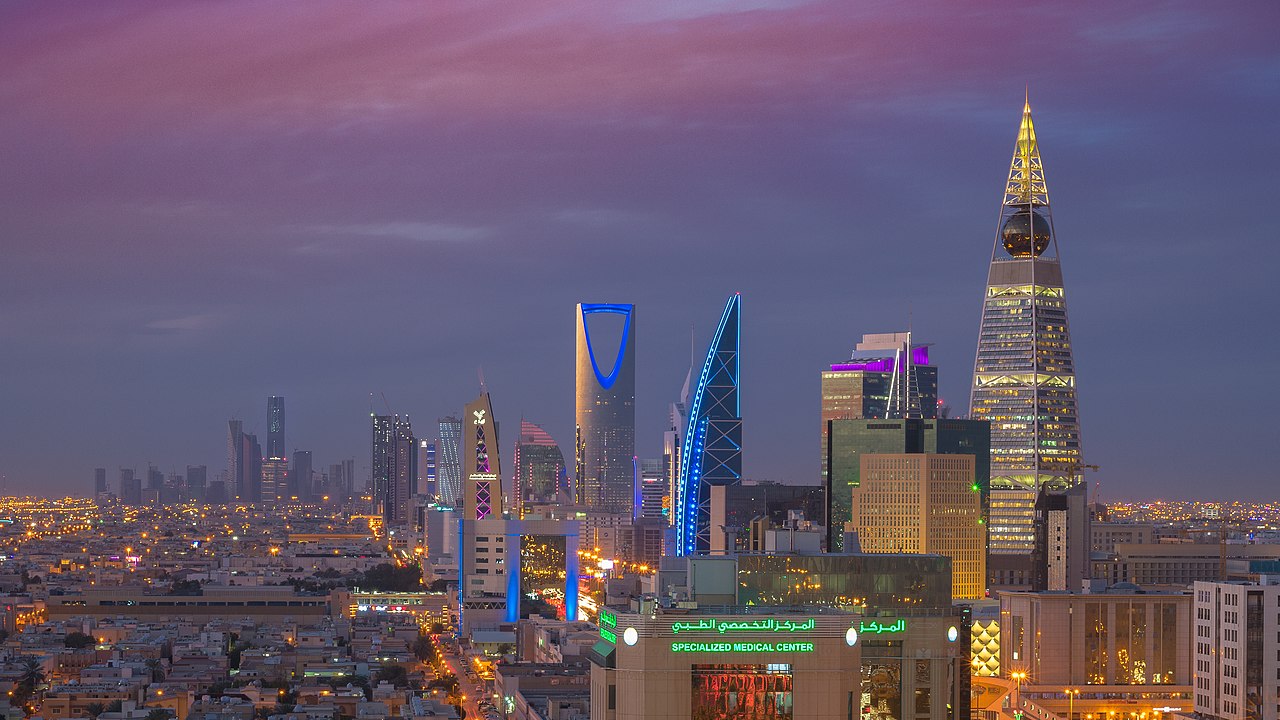
The economy of Saudi Arabia has a GDP of approximately $1.1 trillion (2024), making it the largest economy in the Middle East. It is anchored by oil production, petrochemicals, and a fast-growing tourism sector, with crude oil, refined petroleum, and petrochemicals as the leading exports. Its biggest trading partners are China (around 19% of exports), India (11%), and Japan (9%), and the Kingdom runs a trade surplus of roughly $100 billion.
Introduction
Saudi Arabia sits at the heart of the world's most important energy region, and for more than half a century its economic story has been written in barrels of crude oil. Today, however, the Kingdom is undergoing the most ambitious economic transformation in the Middle East. Through Vision 2030 — a comprehensive plan launched in 2016 — Riyadh is working to diversify beyond oil dependency, develop tourism and entertainment, and build entirely new technology-driven industries.
The result is an economy that is simultaneously one of the most petroleum-dependent on Earth and one of the most aggressively reformist. With a GDP per capita of roughly $30,436 and a sovereign wealth fund commanding over $930 billion, Saudi Arabia has the financial firepower to reshape itself — and the next decade will reveal how far that ambition can stretch.

GDP and Economic Overview
Saudi Arabia's economy has historically been dominated by petroleum, with oil revenue accounting for roughly 62% of government income. This concentration is both the source of the country's wealth and its central vulnerability: when global crude prices fall, the national budget feels the shock almost immediately. Vision 2030 was designed precisely to break this cycle by channelling oil profits into non-oil sectors that can sustain prosperity long after peak demand for petroleum has passed.
The Public Investment Fund (PIF), Saudi Arabia's sovereign wealth fund, manages over $930 billion in assets and is the primary vehicle for Vision 2030 investments. It functions less like a passive savings pool and more like a state-directed development engine, taking stakes in domestic giga-projects as well as international companies. Major projects include NEOM, a $500 billion futuristic city in the north-west; the Red Sea tourism project; and a string of entertainment mega-developments. In total, Vision 2030 represents a $3.3 trillion investment program — a figure that dwarfs almost any comparable national plan.
- Nominal GDP: $1.1 trillion (2024)
- GDP per capita: $30,436
- Oil revenue: ~62% of government revenue
- Vision 2030: $3.3 trillion investment program
- Currency: Saudi Riyal (SAR), pegged to the US dollar
The riyal's long-standing peg to the US dollar provides monetary stability and keeps oil revenues — priced in dollars — predictable, but it also ties Saudi interest-rate policy closely to decisions made in Washington. For deeper background on the country's geography and society, see our Saudi Arabia country guide.
Key Industries
Saudi Aramco remains the world's most profitable company, with oil production capacity of around 12.5 million barrels per day. Its scale is difficult to overstate: a single corporation underpins the fiscal foundation of an entire G20 nation. The petrochemical industry, led by SABIC, is one of the largest in the world, converting hydrocarbons into plastics, fertilisers, and industrial chemicals sold across global markets. Together these sectors generate the revenue that funds Vision 2030's diversification drive.
Tourism is a cornerstone of that drive. Saudi Arabia has opened to international tourists for the first time, introduced entertainment and tourist visas, and is investing billions in resorts, cultural destinations, and mega-events. The country hosted its first Formula 1 Grand Prix in 2021 and is developing The Line, a planned 170-kilometre linear city. Alongside tourism, a fintech and digital-payments ecosystem is expanding rapidly, supported by a young, highly connected population.
- Oil and gas: Saudi Aramco, the world's most valuable and profitable company
- Petrochemicals: SABIC, a major global producer of plastics and chemicals
- Tourism: a target of 100 million visits per year by 2030
- Entertainment: roughly $64 billion in planned investment
- Fintech: a fast-growing digital payments sector
International Trade and Exports
Saudi oil exports continue to dominate the Kingdom's trade. Crude oil alone accounts for more than $200 billion of annual export value, out of total exports of around $310 billion. China, India, Japan, and South Korea are the largest buyers, and Saudi Arabia's role as a swing producer within OPEC+ gives it outsized influence over global oil prices. By raising or trimming production, Riyadh can move markets in a way few other nations can match.
On the import side, the Kingdom buys vehicles, machinery, and food from a wide range of partners, reflecting an economy that exports raw energy but imports much of its manufactured and agricultural needs. Diversification efforts are visible in rising exports of petrochemicals and aluminium, the latter produced by the state-linked mining champion Ma'aden. The country has also invested heavily in food security, acquiring farmland abroad and developing domestic production. Much of this trade rests on the same hydrocarbon base described in our companion piece on the natural resources of Saudi Arabia.
- Total exports: ~$310 billion annually
- Top export: crude oil, $200+ billion
- Top imports: vehicles, machinery, and food
- Trade surplus: ~$100 billion
- Top partners: China (19%), India (11%), Japan (9%)
Employment and Workforce
Saudi Arabia's labour market is defined by its heavy reliance on foreign workers. Of a total labour force of around 16 million, roughly 9 million are expatriates — about 56% of all workers and the overwhelming majority of the private sector. To rebalance this, the government runs the Saudization (Nitaqat) programme, which mandates minimum quotas of Saudi nationals in private companies and steadily pushes employers to hire and train citizens.
Social reform has reshaped the workforce too. Female labour participation has nearly doubled, rising from 17% to 33% since 2017, after reforms including granting women the right to drive and relaxing guardianship requirements. Even so, Saudi unemployment stands at about 11.7%, and youth unemployment among nationals remains high at roughly 25% — a central target of Vision 2030's job-creation agenda.
How Saudi Arabia Compares to Similar Nations
Among the Gulf petro-states, Saudi Arabia is the giant. Its $1.1 trillion economy is several times larger than that of the United Arab Emirates, though the UAE has gone further in building non-oil hubs such as Dubai's logistics, tourism, and finance clusters — a model Riyadh is now racing to emulate at greater scale. Qatar, by contrast, is far smaller in total output but boasts a much higher GDP per capita, thanks to its enormous natural-gas wealth spread across a tiny population.
Compared with Russia, another energy superpower and fellow OPEC+ coordinator, Saudi Arabia is more dependent on a single commodity but enjoys lower production costs and deeper fiscal reserves through the PIF. And while diversifying democracies like Norway have used oil revenue to build a globally invested sovereign wealth fund for future generations, Saudi Arabia is deploying its fund more directly to transform its own domestic economy. The common thread is the universal challenge of all resource-rich states: converting finite hydrocarbon income into lasting, diversified growth.
Key Facts
- Largest Middle East economy: approximately $1.1 trillion GDP (2024)
- Most profitable company: Saudi Aramco, with ~12.5 million barrels/day capacity
- Vision 2030: a $3.3 trillion planned investment program
- Sovereign wealth fund: the PIF manages over $930 billion in assets
- Female workforce participation: doubled from 17% to 33% since 2017
- Foreign workers: about 56% of the total labour force
- Trade surplus: roughly $100 billion annually
Frequently Asked Questions
Why is Saudi Arabia's economy so dependent on oil?
Saudi Arabia holds some of the world's largest and cheapest-to-extract crude reserves, and oil revenue accounts for roughly 62% of government income. For decades this provided enormous wealth with little need to develop other sectors. Vision 2030 was created specifically to reduce that dependence before global demand for oil declines.
What is Vision 2030 and how is it funded?
Vision 2030 is a $3.3 trillion program launched in 2016 to diversify the economy into tourism, entertainment, technology, and renewable energy. It is funded largely through the Public Investment Fund, which manages over $930 billion in assets and bankrolls giga-projects such as NEOM and the Red Sea tourism development.
Who are Saudi Arabia's biggest trading partners?
The Kingdom's largest export partners are China (around 19%), India (11%), and Japan (9%), with South Korea also a major crude buyer. These exports, dominated by crude oil worth over $200 billion, help generate an annual trade surplus of roughly $100 billion.
Is Saudi Arabia's economy diversifying successfully?
Diversification is well under way, with rapid growth in tourism, entertainment, fintech, petrochemicals, and aluminium. Female workforce participation has doubled since 2017 and international visitors are rising toward a 100-million target. However, oil still funds most of the government and the transition will take years to fully reshape the economy.
