
The tallest building in Riyadh is the PIF Tower in the King Abdullah Financial District, which reaches 385 metres (1,263 feet) across 80 storeys and was completed in 2021. The far more famous Kingdom Centre, with its inverted arch and sky bridge, is only 302.3 metres — third-tallest in the city and fifth-tallest in Saudi Arabia.
Why Most Answers to This Question Are Wrong
Ask which building is tallest in Riyadh and you will usually be told the Kingdom Centre. That answer was correct between 2002 and roughly 2017, and it has calcified in guidebooks, quiz banks and search results ever since. It is now wrong by more than 80 metres.
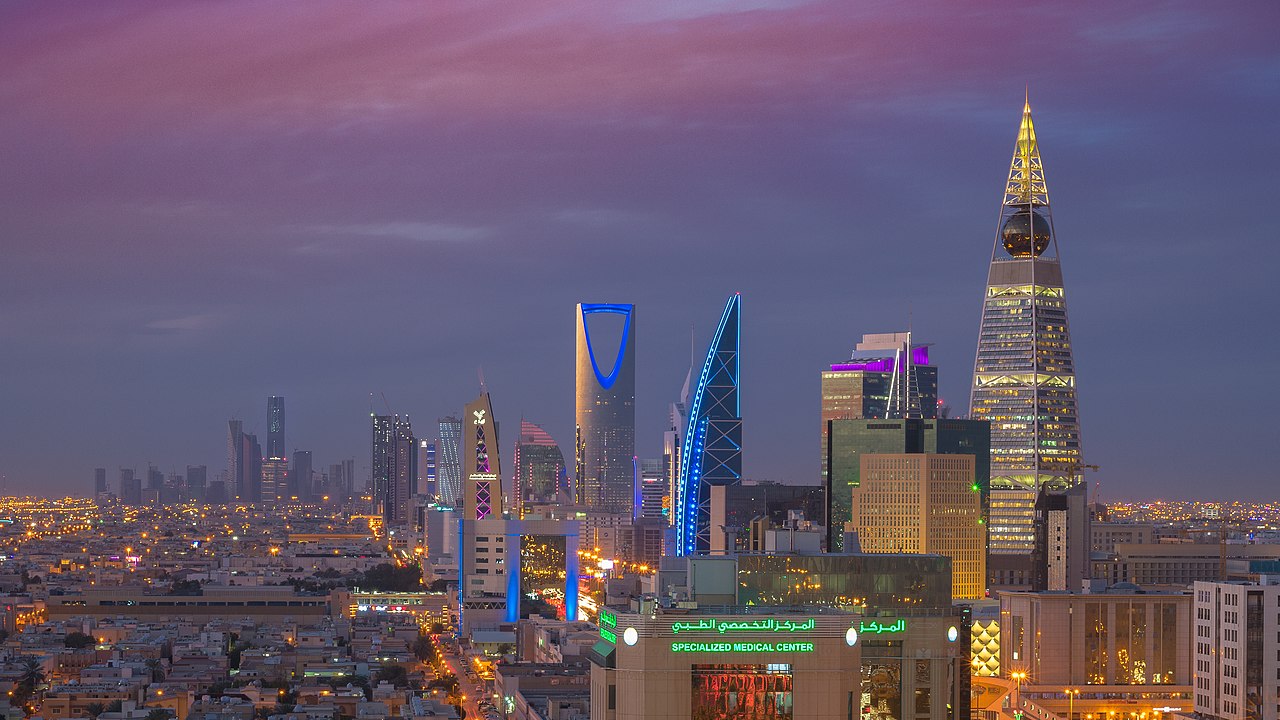
The confusion is understandable. The Kingdom Centre is instantly recognisable — a slab pierced by an inverted parabolic arch, lit at night, standing alone on Olaya Street. The PIF Tower is a plainer glass prism sitting inside a dense cluster of near-identical towers several kilometres to the northwest, in a district that only began filling with tenants in the 2020s. Visual fame and structural height have simply come apart.
Riyadh's ranking as it actually stands: PIF Tower at 385 metres, the Burj Rafal at 307.9 metres, the Kingdom Centre at 302.3 metres, the Capital Market Authority Tower at 285 metres, and Al Faisaliah Tower at 267 metres. Nationally, all of them sit below the Makkah Royal Clock Tower's 601 metres — for which see the guide to the tallest building in Mecca.
Inside King Abdullah Financial District
The PIF Tower takes its name from the Public Investment Fund, Saudi Arabia's sovereign wealth fund and the building's owner and principal occupant. It was designed by the American firm HOK with the Riyadh practice Omrania & Associates, and it is the anchor of the King Abdullah Financial District — usually abbreviated KAFD — a purpose-built financial quarter of roughly 1.6 million square metres containing more than 90 buildings.
KAFD was a difficult project. Ground was broken in 2010, the district was substantially structurally complete by the mid-2010s, and then it sat conspicuously empty for years while the office market failed to materialise. The PIF Tower's own construction ran about eleven years. The district only really came to life after 2021, when a government push to relocate regional corporate headquarters to Riyadh, plus the opening of the Riyadh Metro in December 2024, gave it both tenants and access. KAFD's own metro station, designed by Zaha Hadid Architects as a lattice-shelled interchange, has become one of the district's better-known structures in its own right.
Technically the tower is unremarkable in shape but well specified. It has an observation deck, double-height sky lobbies, a two-storey atrium, and a ThyssenKrupp TWIN elevator system that runs two independent cabs in a single shaft — a configuration that saves core area in a building this tall. It was designed to LEED Gold standard, which for a tower in a climate where summer highs routinely exceed 43°C is a meaningful constraint rather than a marketing line.
Building tall in Riyadh brings a specific set of constraints that Gulf coastal cities do not share. The city sits inland on limestone bedrock, which is excellent foundation material and removes the deep-piling problem that dominates construction in Jakarta or Dubai's reclaimed coast. What replaces it is thermal load. Summer air temperatures regularly exceed 43°C, glass facades on south and west elevations absorb enormous solar gain, and there is no sea breeze to help. The PIF Tower's response is a high-performance shaded curtain wall with a low solar heat gain coefficient, along with heat-recovery systems on the ventilation plant. Water is the other constraint: Riyadh has no natural surface water and depends on desalinated supply pumped roughly 400 kilometres uphill from the Gulf coast, which makes water recycling in large buildings an economic necessity rather than a green gesture.
The Kingdom Centre's Arch and Its Sky Bridge
The Kingdom Centre remains the more interesting building. Completed in 2002 for Prince Al-Waleed bin Talal, designed by Ellerbe Becket with Omrania, it rises 302.3 metres and is nominally 99 storeys — though only around 41 of those are occupied floors. The upper section of the tower is a hollow inverted arch, structurally there to carry the sky bridge and to give the building a silhouette rather than to hold offices.
That sky bridge spans 65 metres at roughly 300 metres above street level. It was lifted into place as a single 300-tonne assembly, and it functions purely as a public viewing platform. On a clear winter morning it offers a genuinely instructive view: the eye can follow Riyadh's growth outward across the flat Najd plateau in rings, from the mud-brick core near Al Masmak Fortress out through the mid-century grid to the ring roads and the far northern suburbs.
Below the tower sit a shopping mall, the Four Seasons hotel and apartments. The building won the 2002 Emporis Skyscraper Award, and for two decades it functioned as Riyadh's default visual shorthand, much as the Petronas towers do for Kuala Lumpur.
Al Faisaliah and the Rest of the Tall Ten
Al Faisaliah Tower deserves separate mention because it came first. Completed in 2000 to a Norman Foster design, it was the first true skyscraper built in Saudi Arabia. It tapers from a square base to a point, with a 24-metre glass globe suspended near the top housing a restaurant, and a golden ball finial above that. At 267 metres it is now only the fifth-tallest in the city, but it established that Riyadh would build vertically at all.
The rest of the upper tier is mostly residential and mixed-use rather than corporate:
- Burj Rafal — 307.9 m, 2014, a hotel and residential tower on King Fahd Road, and the city's second-tallest.
- Capital Market Authority Tower — 285 m, another KAFD building, and the district's second-tallest.
- Majdoul Tower — 265 m, completed 2020, distinctive for its twisting profile.
- Al Anoud Tower and Rafal Residences — both in the 200–250 m band, filling out the King Fahd Road corridor.
What this list shows is that Riyadh has no single downtown. Height is distributed across three corridors — Olaya, King Fahd Road and KAFD — separated by several kilometres of low-rise city. That is a direct consequence of the site: the Najd plateau at roughly 600 metres elevation imposes no topographic constraint whatsoever, so the city has been free to sprawl and to place its towers wherever land policy directed.
How Riyadh Measures Against Its Regional Rivals
Set beside the other Gulf capitals, Riyadh's skyline is tall but not extreme:
- Dubai — Burj Khalifa at 828 m, with more than twenty buildings above 300 m. Riyadh has three. Dubai built vertically as a deliberate tourism and branding strategy from the late 1990s; see the Dubai skyline breakdown for the contrast.
- Doha — a denser and more sharply defined cluster in West Bay, though its tallest, Aspire Tower, is only 300 m.
- Jeddah — currently modest, but home to Jeddah Tower, whose construction resumed in 2023 with a design target above 1,000 metres. If completed it will be the tallest building on Earth by a wide margin and will make the Riyadh–Jeddah comparison meaningless.
- Kuwait City — Al Hamra Tower at 412.6 m, which quietly exceeds anything in Riyadh.
The pattern across the Gulf is that height tracks branding budgets more than population. Riyadh, with roughly 7.7 million people, is the largest city in the group by some distance, yet it has fewer supertall buildings than Dubai, a city less than half its size.
What Vision 2030 Will Change
That may not last. Saudi Arabia's Vision 2030 programme has pushed an enormous volume of construction into Riyadh specifically, and the flagship is New Murabba, a development north of the city centre built around the Mukaab — a cube roughly 400 metres on every side, intended to be large enough to contain the Empire State Building several times over. It is not a tall building in the conventional sense but it would be one of the largest built structures in the world by volume.
Alongside it sit the Rise Tower project, a series of KAFD extensions, and the Sports Boulevard and King Salman Park schemes reshaping the city's horizontal geography. Riyadh has also committed to hosting Expo 2030 and the 2034 FIFA World Cup, both of which carry construction deadlines. It is reasonable to expect the answer to "what is the tallest building in Riyadh" to change again before 2035.
Reading the Skyline From Street Level
For anyone actually in the city, the practical orientation is straightforward. Olaya Street runs north–south and carries the Kingdom Centre and Al Faisaliah within about two kilometres of each other; they are the easiest pair to see together and the Kingdom Centre's sky bridge is the better of the two viewing decks. KAFD sits well to the northwest and is best reached on Metro Line 1 or 4, and it reads as a single mass of glass rather than as individual towers until you are inside it.
The clearest air is in winter, between December and February, when daytime highs sit in the low 20s Celsius and the dust that hangs over the plateau in summer largely settles. For the city's wider geography, history and climate, the Riyadh capital city guide covers the ground the towers sit on, and the Saudi Arabian flag has a design history rather more unusual than the skyline's.