
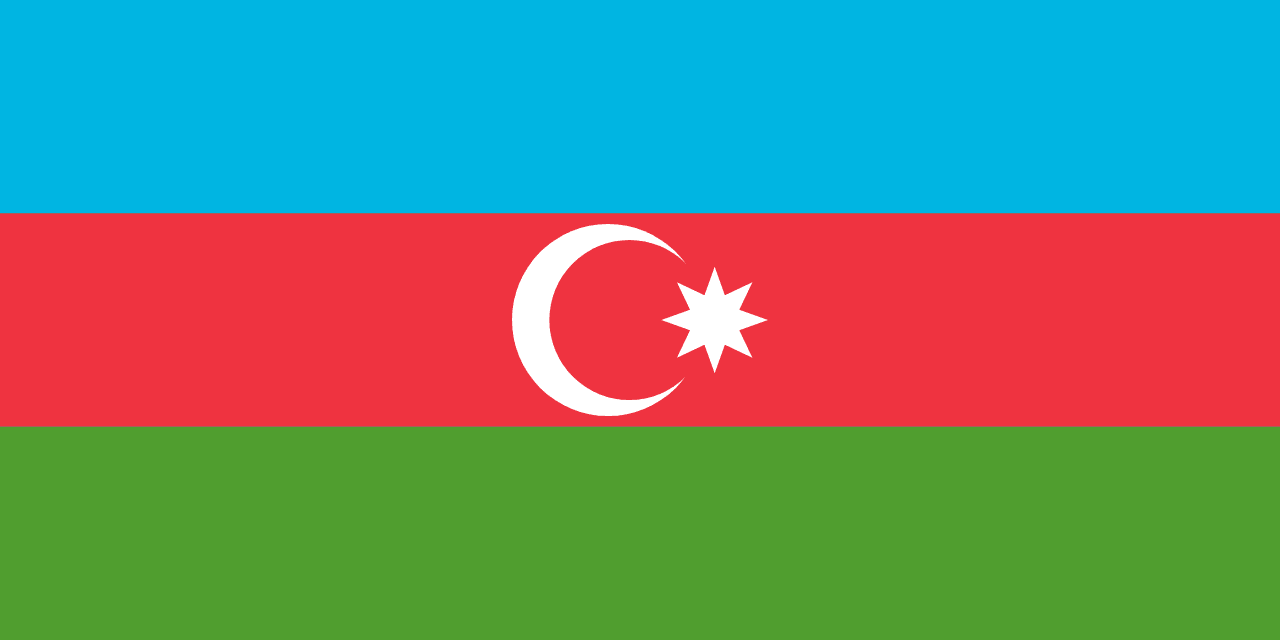
Stretched across the South Caucasus where Eastern Europe blurs into Western Asia, Azerbaijan flies a flag that announces its identity in three bold bands. A turquoise-tinged blue sits atop a fiery red, which rests over a deep green, and at the heart of the red stripe glows a white crescent moon beside an eight-pointed star. Locals affectionately call it the üçrəngli bayraq, or "tricolor flag," and it does far more than decorate government buildings. It compresses a story of Turkic kinship, modern ambition, and faith into a single rectangle of cloth. This article unpacks what each element means, how the design came to be, and why Azerbaijanis treat this banner with such fierce pride.
A Tricolor That Tells Three Stories
At a glance the flag of Azerbaijan reads as a clean horizontal triband, but each color carries a deliberate message. The top band of blue speaks to the nation's Turkic heritage, linking Azerbaijan to the broader family of Turkic peoples stretching across Central Asia and Anatolia. The central red band celebrates modernization and the drive toward progress, a forward-looking optimism that has defined the country's national outlook. The bottom band of green represents Islam, acknowledging the faith that shapes much of Azerbaijani cultural life. Together these three ideas, sometimes summarized as "Turkify, modernize, Islamize," reflect the intellectual currents that swirled through the region in the early twentieth century when the design first took form.
Reading the Design and Layout
The construction is precise and balanced. Three horizontal stripes of equal height divide the field evenly, with blue on top, red in the middle, and green at the bottom. Centered within the red band are two emblems rendered in white: a crescent moon opening toward the fly side, and an eight-pointed star floating just beside it. White was chosen for these emblems so they stand out sharply against the warm red ground, and the symmetry of the layout gives the whole design a sense of order and confidence.
The crescent and star are emblems long associated with the Islamic world and the wider Turkic sphere, yet here the star's particular geometry matters. Where many flags pair a crescent with a five-pointed star, Azerbaijan chose eight points, a deliberate detail that distinguishes its banner and ties directly to the symbolism explored below.
From the First Republic to Independence
The roots of this flag reach back to 1918, when the short-lived Azerbaijan Democratic Republic became the first secular democratic republic in the Muslim world. That fledgling state adopted a tricolor with the crescent and star, establishing the visual language Azerbaijanis would later reclaim. The republic was brief, absorbed into the Soviet Union within a couple of years, and for the decades that followed the red banners of the USSR flew over Baku instead.
When the Soviet grip loosened and Azerbaijan moved toward independence, the country looked back to that 1918 design as the authentic expression of its nationhood. The flag was restored and formally adopted in 1991, the year Azerbaijan reclaimed its sovereignty. Reviving the 1918 banner was a powerful statement: it skipped over the Soviet era entirely and reconnected the modern state with the democratic experiment that had been cut short more than seventy years earlier. For a fuller picture of the nation behind the flag, see our azerbaijan country guide.
How It Compares to Similar Flags
Azerbaijan's banner belongs to a recognizable family of flags that combine a crescent and star with bold colors, and casual observers sometimes confuse it with its neighbors. The most obvious cousin is the flag of Turkey, which also features a white crescent and star, though Turkey places its emblems on a solid red field with a five-pointed star, while Azerbaijan sets them on a multicolored tricolor with eight points. Turkmenistan and other Turkic nations likewise share crescent imagery, reflecting common heritage rather than copying.
The horizontal blue-red-green arrangement also invites comparison with various national tricolors, but the specific palette is distinctive. Few flags pair a sky-leaning blue with red and green in this exact order, and none combine that palette with an eight-pointed star. The result is a banner that signals membership in the Turkic and Islamic worlds while remaining unmistakably Azerbaijani. The eight points, in particular, function as a kind of fingerprint that no look-alike flag replicates.
A Symbol Woven Into National Identity
Few symbols command the reverence Azerbaijanis reserve for their flag. In Baku, the capital, one of the world's tallest flagpoles once raised an enormous version of the tricolor over the bay, and the surrounding plaza became a place of national gathering. The flag features in National Flag Day, observed each November, when citizens and officials honor the banner with ceremonies and public displays.
This devotion springs from the flag's layered meaning. Because it ties directly to the 1918 republic, it represents not just statehood but the idea of self-determination and continuity through hardship. To raise it is to affirm that Azerbaijan's identity survived foreign rule intact. That emotional weight explains why the design is taught in schools, displayed in homes, and defended as a matter of civic honor rather than mere decoration.
The Flag in Modern Azerbaijani Life
Today the tricolor appears everywhere ordinary and ceremonial life unfolds. It flies over the National Assembly and embassies abroad, drapes the shoulders of athletes representing the country at international competitions, and waves through stadiums during football matches and at events Azerbaijan hosts, from grand prix racing to musical contests. Citizens fly it on independence anniversaries and Flag Day, and it routinely fronts patriotic murals and public art across the country.
In the realm of sport especially, the flag has become a rallying emblem. When Azerbaijani competitors take the podium, the blue-red-green tricolor rising to the national anthem turns a private effort into a shared national moment. The same banner that once symbolized a brief 1918 dream now travels the globe on jerseys, fan scarves, and stadium seats.
Interesting Facts About the Flag
- The eight-pointed star is widely understood to represent eight Turkic peoples, reinforcing the flag's emphasis on shared Turkic identity.
- The current flag is essentially a revival of the banner used by the Azerbaijan Democratic Republic of 1918, the first secular democratic republic in the Muslim world.
- Although adopted in its modern form in 1991, the design predates Soviet rule by decades, making it a deliberate link to a pre-Soviet past.
- Azerbaijanis call the flag the üçrəngli bayraq, meaning "tricolor flag," a nickname that captures its most defining visual feature.
- The crescent and star are rendered in white specifically to contrast against the central red band, ensuring high visibility.
- Azerbaijan marks an annual National Flag Day, underscoring the banner's place in the civic calendar.
Frequently Asked Questions
When was the flag of Azerbaijan adopted?
The modern flag was adopted in 1991, the year Azerbaijan regained its independence. However, the design itself dates back to 1918, when the Azerbaijan Democratic Republic first flew a nearly identical tricolor. The 1991 adoption was effectively a restoration of that earlier banner rather than the creation of an entirely new one.
What do the colors of the Azerbaijani flag mean?
The flag uses three colors, each with its own meaning. Blue represents Azerbaijan's Turkic heritage, red stands for modernization and progress, and green symbolizes Islam. The white crescent and eight-pointed star at the center add layers of Islamic and Turkic symbolism on top of the tricolor field.
What continent is Azerbaijan on?
Azerbaijan sits in the South Caucasus, a region that straddles the boundary between Europe and Asia. It is most often grouped with Asia, though its location at this crossroads means it is frequently described as transcontinental, sharing cultural and geographic ties with both continents.
How does the Azerbaijani flag compare to the Turkish flag?
Both flags feature a white crescent and star, reflecting shared Turkic and Islamic heritage. The key differences are clear, though: Turkey's flag is a solid red field with a five-pointed star, while Azerbaijan's is a blue-red-green horizontal tricolor with an eight-pointed star. The eight points and the multicolored field make Azerbaijan's banner immediately distinguishable.
