

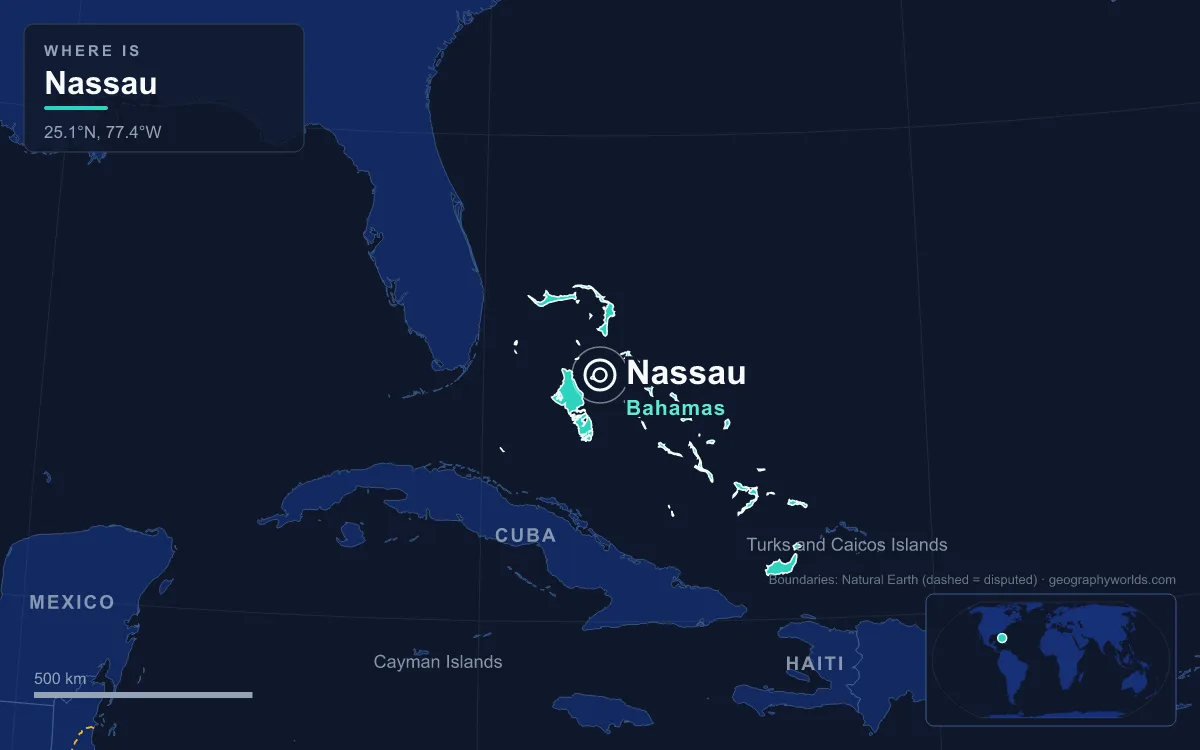
Nassau is the capital and largest city of the Bahamas. It lies on New Providence island, facing Paradise Island across Nassau Harbour, about 290 kilometres east-south-east of Miami. The city now covers almost all of New Providence, which had nearly 300,000 residents at the 2022 census. That is about three-quarters of all Bahamians, in a country of roughly 400,000. The city was named in 1695 for King William III, Prince of Orange-Nassau, and it holds the House of Assembly, the courts, the banks and the country's main port. Nassau was not built by any single group. Lucayans, Bermudian settlers, pirates, American Loyalists and the people they enslaved, Africans freed from slave ships, Greek sponge fishermen and Haitian migrants all shaped it. This guide follows them in the order they arrived.
From Lucayan Nema to the Flying Gang’s Pirate Republic, 1492–1718
The island's first people were the Lucayans, whose name meant "people of the islands." They called New Providence Nema, "middle-water." They had crossed from Cuba or Hispaniola by canoe some time between 500 and 800 CE. They were also the first Indigenous Americans Columbus met, in October 1492. Within a generation the Spanish had carried them off as forced labour to Hispaniola, and when the Spanish went looking for more in 1520 they could find only eleven in the whole archipelago. The islands stayed nearly empty for more than a century. Then English Puritans from Bermuda, the Eleutheran Adventurers, arrived in the late 1640s. They brought with them the first Africans in the Bahamas, freed slaves from Bermuda.
New Providence was settled in 1666. By 1670 more than 900 people lived at Charles Town, named for Charles II. The settlement lived partly by privateering against the Spanish, who burned it to the ground in 1684. Governor Nicholas Trott rebuilt it in 1695 and renamed it Nassau. The name ultimately comes from the town of Nassau in Germany. Spanish and French raids in 1703 left the colony without a governor for fifteen years, and the pirates moved in. The Governor of Bermuda reported more than 1,000 pirates in Nassau, against only about a hundred townspeople. The harbour could hold around 500 vessels but was too shallow for warships. Benjamin Hornigold and his rival Henry Jennings led what was called a pirate republic. It played host to the self-styled Flying Gang, and pirates who spent time there included Charles Vane, "Calico Jack" Rackham, Anne Bonny, Mary Read and Edward Teach, better known as Blackbeard.
In 1718 George I sent Woodes Rogers, a former privateer, as royal governor. He granted the King's Pardon to pirates who surrendered, rebuilt the fort and restored trade. The first official census, taken in 1722, found a population that was 74 percent European and 26 percent African. The next century would reverse those proportions.
Loyalists and the 600 Enslaved Workers Who Cut the Queen’s Staircase
The American Revolution brought Nassau its biggest change. The town was fought over throughout the war. On 3 and 4 March 1776, Continental Marines under Esek Hopkins staged their first amphibious raid there, then occupied the town for two weeks and seized its military supplies. Spain captured it in May 1782. In April 1783 an American Loyalist, Andrew Deveaux, retook it for Britain. After the war the Crown resettled some 7,300 Loyalists, together with the people they enslaved, in the Bahamas. The refugees who arrived from East Florida alone included 1,033 Europeans and 2,214 people of African descent. On New Providence they cleared the bush for plantations such as Clifton and Tusculum. In Nassau they soon outnumbered the older inhabitants and became a political force.
On the plantations, enslaved Africans soon outnumbered the planters, and in town the building went on. Lord Dunmore governed the colony from 1787 to 1796. He built Fort Charlotte and, on Bennet's Hill, the highest point in Nassau, Fort Fincastle. In 1793 and 1794 about 600 enslaved labourers cut a stairway and road through solid limestone to link the fort with the town below. It was later named the Queen's Staircase after Queen Victoria. It has 65 steps, originally 66, and rises 31 metres. Tour guides often say the steps stand for the years of Victoria's reign, but she reigned for just under 64.

Many of those enslaved people came from the Gullah region of South Carolina. Linguists see a strong link between their Gullah speech and Bahamian Creole, known locally simply as "dialect". It runs along a continuum: the fullest creole speech is concentrated on islands settled earlier, while less creolised varieties are more common in Nassau.
Liberated Africans Over the Hill: Grants Town, Bain Town and Adelaide
After Britain banned the slave trade in 1807, the Royal Navy began stopping slave ships at sea. Thousands of the Africans it freed were landed in the Bahamas. On New Providence they were settled in villages built for them. Adelaide, in the south-west, was founded in 1831 by the governor, Sir James Carmichael-Smyth, around a church that the freed people built themselves. Gambier was another. From 1818 the colony also freed slaves brought in from outside the British West Indies. When the American slave ships Comet (1830) and Encomium (1834) were wrecked off Abaco, officials in Nassau freed the people aboard. In November 1841, enslaved people on the US brig Creole rebelled and forced the ship into Nassau, and 128 of them chose to stay as free people. Between 1830 and 1842, 447 people held by Americans gained their freedom this way. Slavery in the colony itself ended on 1 August 1834.
The town divided along lines of colour. Black Nassauvians lived mostly "Over-the-Hill" in Grants Town and Bain Town, south of the old town, while most white residents lived along the northern coastal ridges. Until the late 20th century Over-the-Hill was the most populous part of the city. Its streets gave Nassau its best-known festival, Junkanoo. In the early hours of 26 December and 1 January, groups in crepe-paper and cardboard costumes parade through the city to goatskin drums, cowbells and whistles. The costumes take all year to make, and judges award cash prizes at the end.

Political power stayed on the waterfront for more than a century after emancipation. The white oligarchy that dominated the colony was known as the Bay Street Boys. In the 1950s they formed the United Bahamian Party, which governed from 1958 to 1967, helped by gerrymandered seats. Unrest over low wages in Nassau turned into a full-scale riot in June 1942. The Black-majority Progressive Liberal Party took power in 1967 under Lynden Pindling, who was born in Nassau in 1930 to a Jamaican father. As a boy he delivered groceries from his father's East Street shop, a job once done by his neighbour Sidney Poitier. Pindling became the first Black premier. On 10 July 1973 he received the independence documents from Prince Charles, and he served as prime minister until 1992.
Greek Spongers, Haitian Creole and Migrants From the Family Islands
From the 1880s a smaller migration arrived from the Aegean. Greek sponge divers came to work the Bahamian sponge beds, and families from Kalymnos followed as bakers, restaurant owners and shoemakers. When disease killed off the sponge beds, the Greek Bahamians turned to restaurants, hotels, shops and furniture making. At one time they owned nearly every restaurant in downtown Nassau. The Greek Orthodox Church of the Annunciation on West Street, built in 1932, is still the centre of a community that makes up less than 2 percent of the population.

The largest recent arrivals have come from Haiti. Tourism and offshore banking grew quickly after independence, and the Bahamas became a magnet for Haitian migrants. Estimates put the Haitian community at about 80,000. Haitian Creole, a French-based language, is spoken by Haitians and their descendants, who make up roughly a quarter of the population by some counts. Since late 2014 the government has deported Haitian migrants without legal status. The country they come from is covered in our Haiti country guide.
Nassau also keeps drawing Bahamians from the other islands. Waves of migration from the Family Islands, as the outer islands are called, have swelled the capital and emptied smaller settlements. Since the 1960s the government has built low-cost housing estates such as Yellow Elder, Elizabeth Estates and Pinewood Gardens on the city's outer ring. Much of the work these residents find is in tourism, the latest of several trades that brought outsiders through the port. During the American Civil War, Nassau was a base for blockade runners trading with the Confederate ports. In the 1920s and 1930s it did well out of Prohibition in the United States. Today Lynden Pindling International Airport, 16 kilometres west of the centre, has daily flights to Canada, Britain, the United States and the Caribbean. The United States banned travel to Cuba in 1963, and American visitors turned to Nassau instead. Hog Island became Paradise Island in 1962 and was joined to the city by bridge in 1966. Its Atlantis resort employs more than 6,000 Bahamians, the largest employer outside government. Baha Mar on Cable Beach added more than 2,000 hotel rooms in 2017. Downtown, the rebuilt Straw Market reopened in 2011 after a 2001 fire, and UNESCO has named Nassau a Creative City of Crafts and Folk Art. For the rest of the archipelago, from Grand Bahama to Inagua, see our Bahamas country guide.
Quick Facts About Nassau
- Country: Bahamas
- Continent: North America (Caribbean)
- Country population: approximately 405 thousand
- Capital city status: Nassau is the capital of Bahamas, the seat of national government, and the location of foreign embassies, parliament, and the head of state's official residence.
Frequently Asked Questions
What is the capital of Bahamas?
The capital of Bahamas is Nassau. Nassau is the seat of national government, hosts most foreign embassies and consulates, and is typically where the head of state and parliament are located.
What continent is Nassau in?
Nassau, the capital of Bahamas, is located in North America, in the Caribbean region. As Bahamas's capital, Nassau serves as the country's primary connection to the broader North American political, economic, and cultural sphere.
Why is Nassau the capital of Bahamas?
Nassau was chosen as the capital of Bahamas for reasons that typically combine geography, history, and politics. Capital city selections often reflect a desire for centrality (being accessible from across the country), historical importance (being a longstanding seat of government or culture), or neutrality (being acceptable to multiple regions or ethnic groups within the country). The specific reasons for Nassau's designation are detailed in the city's history above.
What is Nassau known for?
As the capital of Bahamas, Nassau is best known for housing the country's central government institutions — parliament, presidential or royal residences, supreme court, and key ministries. It is also typically a major cultural and economic center within Bahamas, hosting national museums, embassies, and signature monuments. The introduction and history sections above provide detailed coverage of the city's specific notable institutions and landmarks.
Related Pages
- Bahamas Country Guide — full geography, climate, economy, and culture overview
- Flag of Bahamas — meaning, history, and design of Bahamas's national flag