

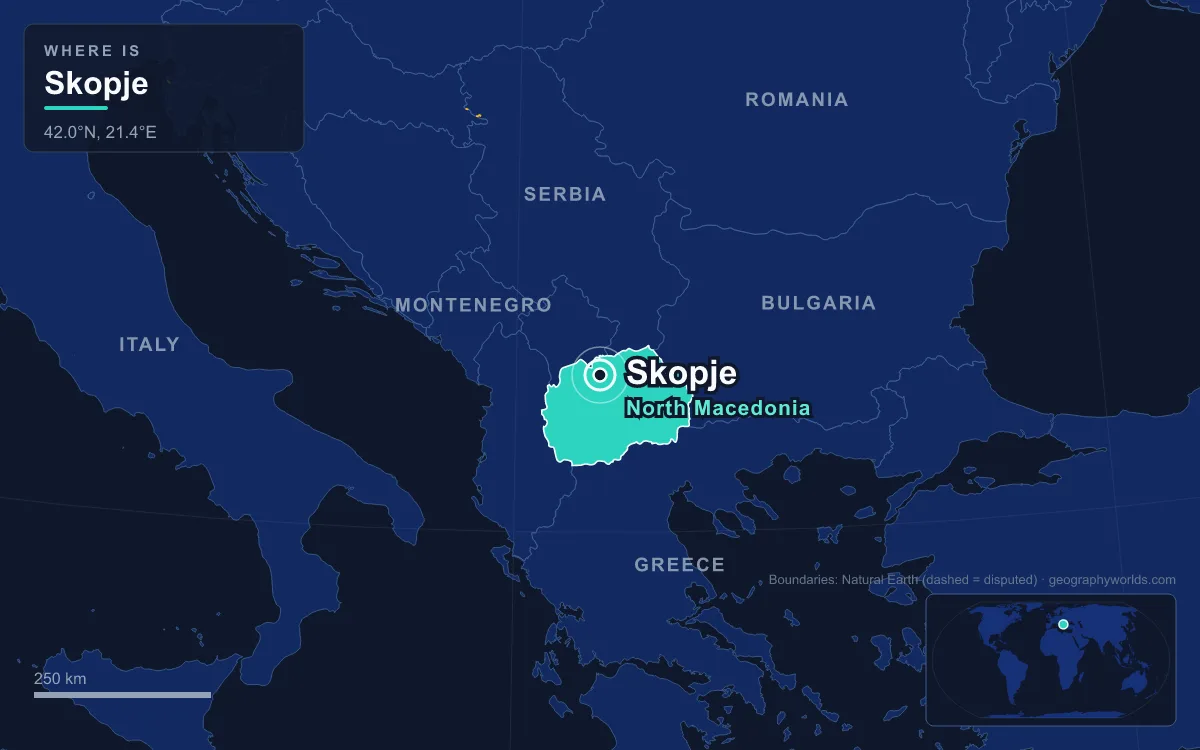
Skopje is the capital and largest city of North Macedonia, with 526,502 people at the 2021 census, about 29% of the country's 1,836,713 residents. It lies in the north of the country, in the Skopje Valley on the Vardar River, at about 245 metres above sea level and close to the borders with Kosovo and Serbia. Its defining trait is that it has been made a capital again and again, by Romans, Bulgarian tsars, a Serbian emperor, Ottoman governors and Yugoslav planners, and that most of what stands today was rebuilt after an earthquake flattened about 80% of it on 26 July 1963.
Scupi, Tsar Samuel and Dušan’s Coronation
Skopje's first claim to rule came from the Romans. The site had been settled since the Chalcolithic, and during the Iron Age a town called Scupi rose on Zajčev Rid hill, about 5 kilometres west of today's fortress, in the land of the Dardani. Under Emperor Domitian (AD 81–96) it became a colony of legionary veterans, Colonia Flavia Scupinorum, and after the province was divided in AD 86 it became a seat of government within Moesia Superior. At its peak Scupi covered 40 hectares inside a 3.5-metre-wide wall, with a theatre, baths and a large basilica.
An earthquake destroyed Scupi in 518. Justinian I rebuilt the town on a more defensible site, the rocky promontory where Skopje Fortress stands today, beside the Vardar. That move fixed the city's position for the next 1,500 years: on a crossing of the river, halfway between the Danube and the Aegean, and today roughly midway between Belgrade and Athens.
The strategic site kept attracting rulers. Skopje was the Bulgarian capital from 972 to 992, and Tsar Samuel held it from 976 until 1004, when its governor surrendered it to Byzantine Emperor Basil II. In 1282 the Serbian King Stefan Milutin captured it, and under Nemanjić rule the town spread beyond the fortress walls, with merchants from Venice and Dubrovnik opening shops. Stefan Dušan made it the capital of the Serbian Empire, and in 1346 he was crowned Emperor of the Serbs and Greeks in Skopje. After his empire broke up, the city passed to the Ottomans in 1392.
Losing Out to Bitola, Then Winning the Kosovo Vilayet (1392–1912)
The Ottomans stayed for over 520 years, and for much of that time Skopje was not the leading city of the region. Its golden age came first. Between 1451 and 1469 Sultan Mehmed II built the Stone Bridge over the Vardar on Roman foundations, 214 metres long on 12 semicircular arches, and the Old Bazaar grew up on the north bank with its caravanserais, mosques and baths. Around 1650 Skopje had between 30,000 and 60,000 inhabitants and over 10,000 houses, one of the few large cities in what would become Yugoslavia.

Then came collapse. In 1689, during the Great Turkish War, Habsburg troops under General Silvio Piccolomini took a city already weakened by cholera and burned it for two days. The rebel leader Petar Karposh was later impaled on the Stone Bridge. Plague, emigration and disorder followed, and by about 1836 French officers estimated Skopje's population at only around 10,000. At that point it was smaller than two other towns in present-day North Macedonia: Štip, with 15,000–20,000, and Bitola, with 40,000. Bitola, the Ottoman Monastir, was also the last capital of Ottoman Rumelia, from 1836 to 1867, and was known as the City of Consuls for its many European consulates.
The railway reversed the order. The Skopje–Salonica line opened in 1873, with a station built south of the Vardar on land that had never been urbanised, and trade began to move there. In 1877 Skopje was chosen as capital of the new Kosovo Vilayet, which covered present-day Kosovo, northwestern Macedonia and the Sanjak of Novi Pazar. By 1905 it had 32,000 inhabitants, just ahead of Prizren with 30,000, making it the largest city of the province.
From Serbian Skoplje to the Vardar Banovina (1912–1941)
The Balkan Wars ended Ottoman rule. Serbian forces entered Skopje on 26 October 1912, a day after the Ottoman garrison left, and the city was annexed to the Kingdom of Serbia and officially renamed Skoplje. During the fighting a Serb irregular force razed the Albanian quarter, and 725 Muslim families left the city in January 1913. Bulgaria occupied it from October 1915 until French forces took it by surprise on 29 September 1918, after which it passed to the Kingdom of Serbs, Croats and Slovenes, later Yugoslavia.
Yugoslavia gave Skopje a regional capital's role again. In 1931 it was made the seat of the Vardar Banovina, one of the new provinces of the kingdom. Wealthy Serbs built mansions and businesses, and the city grew from 41,066 people in 1921 to 64,807 in 1931 and about 80,000 in 1941, when it had 45 factories. The new railway station, begun in 1937 and opened in 1940 with classical and Byzantine touches, dates from this period.
ASNOM and the Capital of Socialist Macedonia (1944–1963)
The decision that made Skopje a national capital was taken elsewhere. On 2 August 1944, the Anti-fascist Assembly for the National Liberation of Macedonia, ASNOM, met clandestinely at the St. Prohor Pčinjski Monastery, now in Serbia, and proclaimed a Macedonian state within Yugoslavia, with Macedonian as its official language. The date was chosen to match the Ilinden Uprising of 1903.
At that moment Skopje was still under Bulgarian occupation. German troops had seized it on 8 April 1941 and handed it to Bulgaria two weeks later, and in 1943 all of the city's roughly 4,000 Jews were deported to Treblinka, where almost all were killed. On 13 November 1944 units of the Bulgarian People's Army, Bulgaria having switched sides, and Yugoslav Partisans captured the city, and it became the capital of the new Macedonian federal unit. With standard Macedonian now official, the Serbian Skoplje became Skopje.
Being a republic capital brought institutions that no other Macedonian town could match: a university, a national library, a philharmonic orchestra and the Macedonian Academy of Sciences and Arts. It also brought Yugoslav policies that favoured industry, and with them steady growth.
26 July 1963: Rebuilding a Capital from Rubble
At 5:17 in the morning of 26 July 1963, a magnitude 6.1 earthquake struck the Vardar valley. It lasted about 20 seconds, killed 1,070 people, injured more than 3,000, and destroyed about 80% of the city. More than 200,000 people were left homeless. The Skopje valley sits on an active fault zone and had been hit before, in 518 and 1555.
The response showed what a capital was worth. Within days, 35 nations asked the UN General Assembly to put relief for Skopje on its agenda, and help arrived from 78 countries. Because Yugoslavia was non-aligned, American and Soviet troops stationed in the city could meet openly in the middle of the Cold War; John F. Kennedy sent personnel, prefabricated houses and tent cities, and Nikita Khrushchev visited in person.

Reconstruction was led by the Polish planner Adolf Ciborowski, who had worked on postwar Warsaw, and the centre was redrawn to plans by the Japanese architect Kenzo Tange, who also designed the new railway station. The Vardar's banks became parks, high-rises went up between new boulevards, and neighbourhoods were kept at low density in case of future quakes. Karpoš was built west of the centre in the 1970s and Aerodrom, planned for 80,000 people, rose on the old airport in the 1980s. The Old Bazaar was restored with low buildings around it so as not to block views of the fortress, and the university and the Academy were moved to the north bank to bring communities closer. One-third of the old railway station was kept and has housed the city museum since 1970. The rebuilt city grew fast, to 408,100 people by 1981.
Independent Capital: 1991, Ohrid, Prespa and Skopje 2014
On 8 September 1991 a referendum approved independence from Yugoslavia with 96% of the vote on a 76% turnout, although most ethnic Albanians boycotted it, and independence was declared on Macedonia Square by the country's first president, Kiro Gligorov. Skopje had been a republic capital for almost half a century; now it was a state capital.
The next two treaties shaped what that capital looks like. The Ohrid Framework Agreement of 13 August 2001 ended an armed conflict with Albanian insurgents, and the 2004 law that followed divided the City of Skopje into 10 municipalities and added mostly Albanian Saraj. Albanians now make up more than 20% of the city's population, and Albanian became the second official language of the city administration. The Prespa Agreement with Greece, in force from 12 February 2019, changed the country's name to North Macedonia; the capital kept its own.
The most visible change was Skopje 2014, a government project announced in 2010 that built 136 structures between 2010 and 2014, including neoclassical buildings, bridges and dozens of statues, at a cost reported at over US$700 million. Its backers said it would give the modernist post-earthquake city a monumental look fit for a national capital. Critics objected to the cost and to its historicist style, and many in the Albanian community felt unrepresented, prompting their own projects, including a new square over the boulevard between the centre and the Old Bazaar.
The weight of the capital is plain in the numbers. The Skopje Statistical Region produces 45.5% of national GDP, and the city hosts the stock exchange, the national bank and most banks and telecom firms. The price of that concentration shows in winter, when particulate levels regularly exceed twelve times the WHO limit. For the country around it, see our North Macedonia country guide; for the capital of Kosovo, once part of the vilayet governed from Skopje, Pristina; and for the region it sits at the centre of, what the Balkans are.
Quick Facts About Skopje
- Country: North Macedonia
- Continent: Europe (Southern Europe)
- Country population: approximately 1.8 million
- Capital city status: Skopje is the capital of North Macedonia, the seat of national government, and the location of foreign embassies, parliament, and the head of state's official residence.
Frequently Asked Questions
What is the capital of North Macedonia?
The capital of North Macedonia is Skopje. Skopje is the seat of national government, hosts most foreign embassies and consulates, and is typically where the head of state and parliament are located.
What continent is Skopje in?
Skopje, the capital of North Macedonia, is located in Europe, in the Southern Europe region. As North Macedonia's capital, Skopje serves as the country's primary connection to the broader Europen political, economic, and cultural sphere.
Why is Skopje the capital of North Macedonia?
Skopje was chosen as the capital of North Macedonia for reasons that typically combine geography, history, and politics. Capital city selections often reflect a desire for centrality (being accessible from across the country), historical importance (being a longstanding seat of government or culture), or neutrality (being acceptable to multiple regions or ethnic groups within the country). The specific reasons for Skopje's designation are detailed in the city's history above.
What is Skopje known for?
As the capital of North Macedonia, Skopje is best known for housing the country's central government institutions — parliament, presidential or royal residences, supreme court, and key ministries. It is also typically a major cultural and economic center within North Macedonia, hosting national museums, embassies, and signature monuments. The introduction and history sections above provide detailed coverage of the city's specific notable institutions and landmarks.
Related Pages
- North Macedonia Country Guide — full geography, climate, economy, and culture overview
- Flag of North Macedonia — meaning, history, and design of North Macedonia's national flag