

Few national flags announce themselves with quite as much confidence as Namibia's. Where many countries settle for two or three colors arranged in tidy horizontal bands, Namibia chose a bold diagonal sweep, a golden sun, and a palette that runs from deep blue to fiery red to vivid green. The result is one of the most colorful flags flown anywhere in the world, and it tells the story of a young nation that earned its independence after a long struggle and wanted a banner equal to the moment.
Hoisted for the very first time at midnight on the day Namibia became a sovereign state, the flag is barely older than many of the people who salute it. Yet in a few short decades it has become inseparable from Namibian identity, a unifying emblem in a country that stretches from the Atlantic coast across the Namib Desert and the Kalahari to the Zambezi.
A Burst of Color and Its Meaning
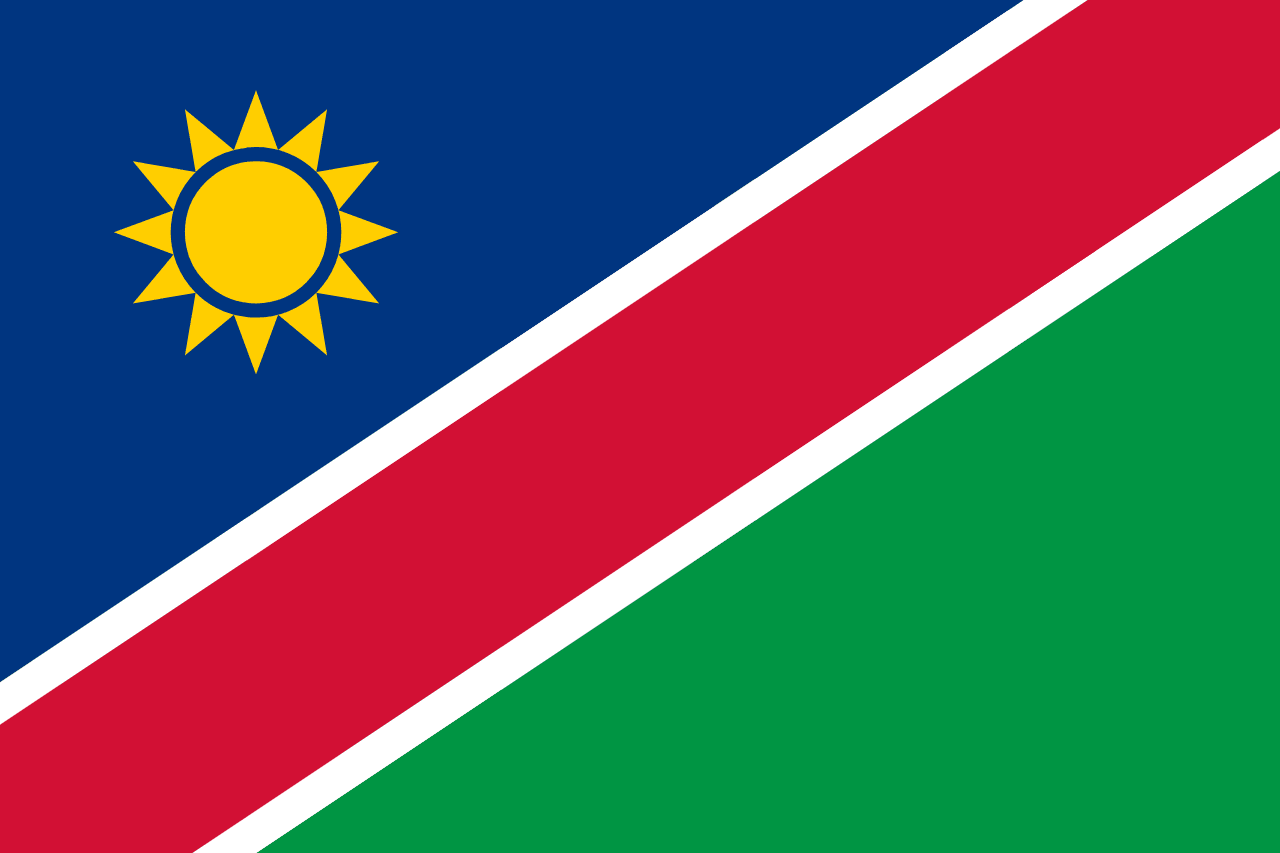
Namibia's flag carries five colors, each chosen to speak to a different part of the land and its people. Blue represents the clear Namibian sky and the cold waters of the Atlantic Ocean that wash the country's western shore, along with the rain and rivers so precious in an arid land. Red stands for the heroism of Namibia's people and their determination to build a future of equality, prosperity, and shared purpose.
Green symbolizes the country's vegetation and agricultural resources, a hopeful nod to growth in a nation where green land is hard-won. A broad white stripe separates the colored fields, signaling peace and the unity that binds the country together. Finally, a brilliant golden yellow sun blazes near the upper hoist, representing life, energy, and the warmth that sustains the people and the desert landscape alike.
Taken together, the colors do more than decorate. They compress a whole national outlook into cloth: the natural wealth of sea and soil, the courage that won freedom, and the peaceful coexistence the country aspires to maintain.
How the Design Is Put Together
The flag's most distinctive feature is its geometry. A wide white-edged red band runs diagonally from the lower hoist to the upper fly, slicing the rectangle into two triangles. The upper triangle, against the staff, is blue; the lower triangle, toward the fly, is green. The diagonal arrangement gives the flag a sense of forward motion that horizontal stripes simply cannot match.
In the blue triangle sits a golden sun with twelve straight rays, an emblem of life and energy radiating across the sky-blue field. The sun's central disc and the bright rays give the flag a focal point that reads clearly from a distance, whether it is snapping on a coastal breeze in Walvis Bay or hanging still in the windless heat of the interior. The combination of strong diagonal, crisp white fimbriation, and the radiant sun makes the design instantly recognizable and difficult to confuse with any other.
From Liberation Struggle to National Banner
Namibia's flag was born out of one of Africa's longer independence stories. The territory spent decades under South African administration, and the road to self-rule was marked by a sustained liberation movement before sovereignty finally arrived. When independence came in 1990, the new state needed a flag that honored that struggle while welcoming all Namibians into a shared future.
The chosen design deliberately blended the colors associated with SWAPO, the movement central to the liberation cause, with fresh national symbols that belonged to the whole country rather than any single party. The blue, red, and green echo that political heritage, while the white bands and the golden sun were added as inclusive emblems of peace and life. In this way the flag managed a delicate balance: it remembered where the nation had come from without locking the future to a single faction. Since its first raising it has remained unchanged, a sign of the consensus it was designed to capture.
A Symbol of Unity and Identity
For a country forged from many communities, languages, and traditions, a flag that everyone can claim is no small thing. Namibia's banner does precisely that work. It appears on government buildings and schools, on official documents, and at the ceremonies that mark the rhythm of national life. Children grow up recognizing its diagonal and its sun long before they can explain the politics behind the colors.
The flag also travels well beyond Namibia's borders. It flies at embassies, at international summits, and wherever Namibians gather abroad. For travelers curious about the land behind the banner, the wider story of the country's deserts, wildlife, and people is well worth exploring in this namibia country guide, which sets the flag in its broader geographic and cultural context.
The Flag in Modern Namibian Life
Today the flag is woven into the everyday and the ceremonial alike. Independence Day, marked each year in late March, brings the most visible displays, with the banner raised in town squares and stadiums across the country. Sporting fixtures are another stage: Namibian rugby and football supporters wave it proudly, and its colors turn up on jerseys, face paint, and scarves whenever national teams compete.
Beyond holidays and matches, the flag has a quieter civic presence. It greets visitors at border posts and airports, flutters above police stations and courts, and stands behind officials at public events. Its colors have even seeped into design and branding, a shorthand for "Namibian" that needs no words. For a banner only a few decades old, it has achieved a remarkable density of meaning.
Interesting Facts About Namibia's Flag
- It is one of the most colorful national flags in the world, using five distinct colors where most flags rely on just two or three.
- The golden sun in the blue triangle has twelve rays and symbolizes life and energy.
- The flag's diagonal layout, rather than horizontal or vertical stripes, gives it a strong sense of movement.
- It blends the colors of the liberation movement with new national emblems, balancing heritage and inclusivity.
- The flag has flown unchanged since the country's first day of independence in 1990.
- White edging around the red diagonal stands for peace and unity among Namibia's diverse communities.
Frequently Asked Questions
When was the flag of Namibia adopted?
The flag was adopted in 1990, the year Namibia achieved independence. It was raised for the first time as the new nation became sovereign and has remained unchanged ever since, making it a relatively young flag among the world's national banners.
What do the colors of the Namibian flag mean?
Blue represents the sky and the Atlantic Ocean as well as rain and rivers; red stands for the heroism of the people and their resolve to build a shared future; green symbolizes vegetation and agricultural resources; white signifies peace and unity; and the golden sun represents life and energy.
What continent is Namibia on?
Namibia is located in southern Africa, on the continent of Africa. It sits along the Atlantic coast, bordered by Angola, Zambia, Botswana, and South Africa, with the Namib Desert running down much of its western edge.
How does the Namibian flag compare to similar flags?
Its diagonal red band and corner sun make it hard to mistake for other national flags. While several African flags share the red, green, and blue family of colors tied to liberation movements, Namibia's distinctive diagonal layout and twelve-rayed golden sun give it a wholly individual look.