

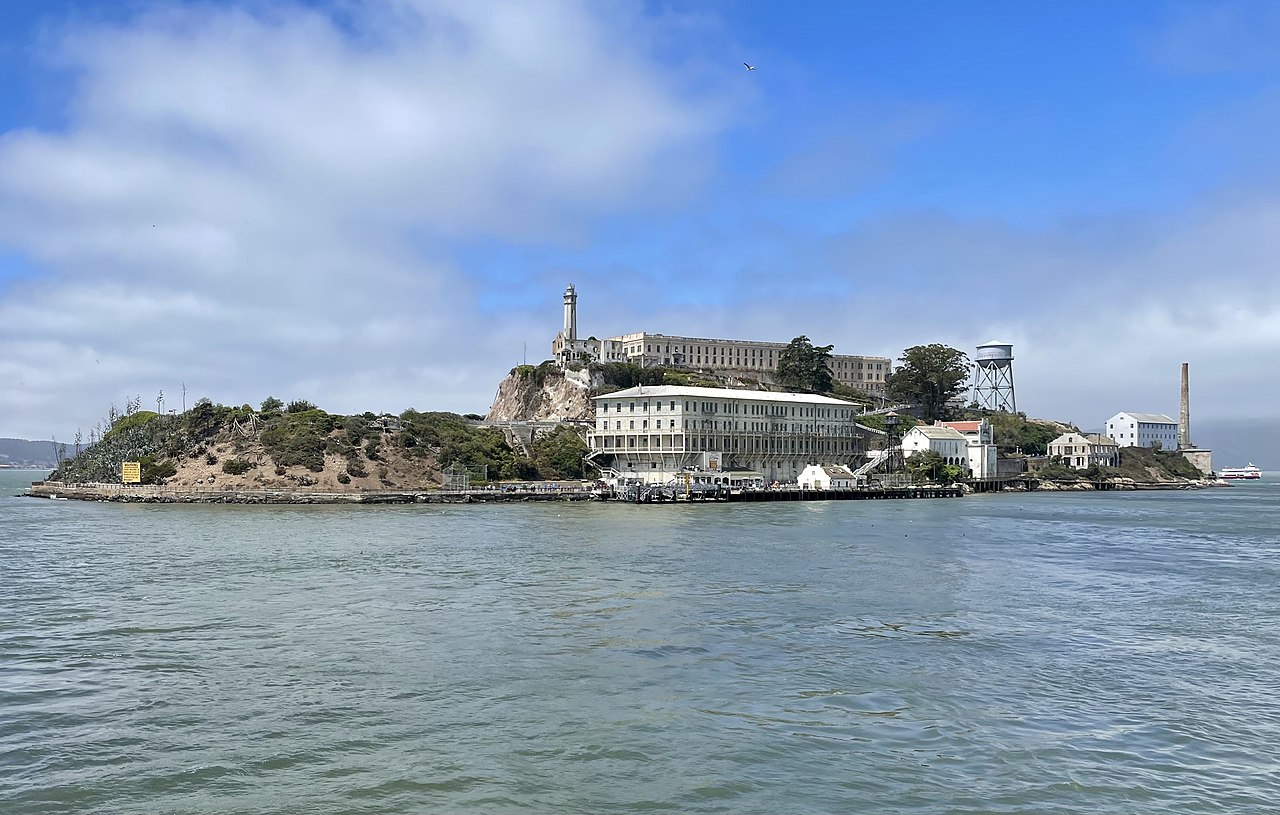
Alcatraz Island is a 9-hectare (22-acre) rocky island in San Francisco Bay, located 2.4 kilometers (1.5 miles) offshore from Fisherman's Wharf in San Francisco, California. The island is most famous for its former federal penitentiary, which operated from 1934 to 1963 and housed some of America's most notorious criminals, including Al Capone, Robert "Birdman" Stroud, and George "Machine Gun" Kelly.
Introduction
Located at coordinates 37.8267°N, 122.4233°W, Alcatraz sits in the center of the bay, surrounded by the cold, swift currents of the Golden Gate. The island's name derives from the Spanish "Isla de los Alcatraces" (Island of the Pelicans), given by Spanish explorer Juan Manuel de Ayala in 1775. Today it is part of the Golden Gate National Recreation Area and attracts approximately 1.7 million visitors annually.
Geography & Environment
- Coordinates: 37.8267°N, 122.4233°W
- Area: 9 hectares (22 acres)
- Distance from Shore: 2.4 km (1.5 miles)
- Water Temperature: 9–15°C (48–59°F)
Alcatraz is a natural sandstone island composed of sedimentary rock, rising to a maximum elevation of 40 meters (130 feet) above sea level. The island is surrounded by strong tidal currents that can reach 4 to 5 knots (7–9 km/h), and the water temperature ranges from 9 to 15 degrees Celsius year-round. These conditions — cold water, powerful currents, and distance from shore — made the island seem escape-proof as a prison.
Despite its barren appearance, Alcatraz supports a thriving ecosystem. The island is one of the most important seabird nesting colonies on the Pacific Coast, with thousands of western gulls, Brandt's cormorants, black-crowned night herons, and other species breeding there annually. The island's gardens, originally planted by military families and prison inmates, have been restored and contain unusual plant species from around the world.
Military & Prison History
- Military Fortress: 1850s–1933
- Federal Penitentiary: 1934–1963
- Famous Inmates: Al Capone, Robert Stroud, George Kelly
- Escape Attempts: 14 known attempts, none confirmed successful
Alcatraz's military history predates its prison era. The US Army built the first permanent lighthouse on the Pacific Coast on Alcatraz in 1854 and fortified the island with 105 cannons during the Civil War era, making it the most heavily armed military position west of the Mississippi. The army used the island as a military prison from the 1860s through 1933.
The Federal Bureau of Prisons converted Alcatraz into a maximum-security penitentiary in 1934, designed to hold the most dangerous and escape-prone inmates in the federal system. During its 29 years of operation, 36 men made 14 escape attempts. Officially, none succeeded — most were recaptured, and several drowned. The most famous attempt, by Frank Morris and brothers John and Clarence Anglin in June 1962, remains officially unsolved; their bodies were never found.
Native American Occupation
- Occupation Period: November 20, 1969 – June 11, 1971
- Organizers: Indians of All Tribes
- Duration: 19 months
- Legacy: Catalyzed federal Indian policy reforms
On November 20, 1969, a group of 89 Native Americans calling themselves "Indians of All Tribes" occupied Alcatraz Island, claiming it under an 1868 Sioux treaty provision that granted Indigenous peoples the right to claim unused federal land. The occupation lasted 19 months and drew international attention to Native American civil rights issues, including broken treaties and inadequate education and healthcare.
Though the occupiers were eventually removed by federal marshals on June 11, 1971, the Alcatraz occupation is widely credited with catalyzing significant changes in federal Indian policy. President Nixon ended the policy of Indian termination, and the occupation inspired subsequent Native American activism across the country. Graffiti from the occupation, including "Indians Welcome" and "Home of the Free Indian Land," remains visible on the island today.
Visitor Information
- Annual Visitors: ~1.7 million
- Ferry Duration: ~15 minutes from Pier 33
- Tours: Audio tour narrated by former inmates and guards
- Advance Booking: Recommended weeks to months ahead
Alcatraz is one of the most popular historic sites in the United States, attracting approximately 1.7 million visitors annually. Ferry service departs from Pier 33 (Alcatraz Landing) in San Francisco, with the crossing taking about 15 minutes. The award-winning audio tour features recordings of actual former inmates and correctional officers describing life on the island.
Tickets frequently sell out weeks or months in advance, especially for night tours, which offer a more atmospheric experience as the cellhouse empties and fog rolls in through the Golden Gate. The island tour includes the main cellhouse, recreation yard, lighthouse, and gardens. Rangers and volunteers provide talks on the island's military history, prison era, and the Native American occupation.
Key Facts
- Alcatraz Island covers 9 hectares and sits 2.4 km offshore in San Francisco Bay.
- The federal penitentiary operated from 1934 to 1963.
- Of 36 men who attempted 14 escapes, none are officially confirmed to have succeeded.
- The 1969–1971 Native American occupation lasted 19 months and influenced federal policy.
- Approximately 1.7 million people visit Alcatraz annually.
Fun Facts
- Al Capone played banjo in the prison band and practiced in the shower room, where the acoustics were best.
- The water around Alcatraz is not shark-infested — great white sharks are rarely seen inside the bay.
- Thousands of athletes swim from Alcatraz to shore annually in organized events, covering the 2.4 km in 30–60 minutes.
- The island's gardens include plants from all over the world, originally brought by military families and tended by prison inmates.
Final Thoughts
Alcatraz Island is a geographic and historical landmark where layers of military, penal, and civil rights history converge in the middle of one of the world's most beautiful bays. Its isolation, its stories, and its wildlife make it one of the most compelling destinations in the American park system.
Test Your Knowledge!
Think you know American landmarks? Try our interactive geography games!
Play Geography Games →