

The California Gold Rush began on January 24, 1848, when James W. Marshall discovered gold in the tailrace of a sawmill he was building for John Sutter on the American River at Coloma, in the western foothills of the Sierra Nevada. Within two years, an estimated 300,000 people from around the world had descended on California — the largest mass migration to a single destination in American history up to that time.
Introduction
The Gold Rush transformed California from a sparsely populated Mexican province into a booming American state in just two years. San Francisco grew from a village of 200 to a city of 36,000 in less than two years. The Sierra Nevada foothills were carved into a landscape of mines, flumes, and tailings. The Gold Rush reshaped the geography, demographics, and ecology of the American West on a scale and at a speed never seen before.
Gold Country Geography
- Location: Western foothills of the Sierra Nevada
- Gold Belt: 150 miles long, 50 miles wide
- Elevation Range: 500–5,000 feet
- Key Rivers: American, Yuba, Feather, Stanislaus, Tuolumne
California's "Gold Country" or "Mother Lode" region stretches approximately 150 miles along the western foothills of the Sierra Nevada, from Mariposa County in the south to Plumas County in the north. The gold-bearing quartz veins formed millions of years ago when tectonic forces thrust molten rock through older metamorphic formations. Erosion carried gold particles into river gravels, creating the placer deposits that triggered the rush.
The richest placer deposits were found in the beds and banks of rivers draining the western Sierra: the American, Yuba, Feather, Stanislaus, Tuolumne, and Merced Rivers. The foothills terrain, between 500 and 5,000 feet in elevation, was covered in oak woodlands and grasslands with hot, dry summers and mild, wet winters. This landscape was rapidly transformed as miners stripped vegetation, diverted rivers, and excavated hillsides in pursuit of gold.
Routes to California
- Overland Trail: 2,000+ miles from Missouri, 4–6 months
- Cape Horn Route: 13,000 miles by sea, 5–8 months
- Panama Route: By sea to Panama, overland, then sea again, 6–8 weeks
- Pacific Route: From China, Australia, and Latin America by ship
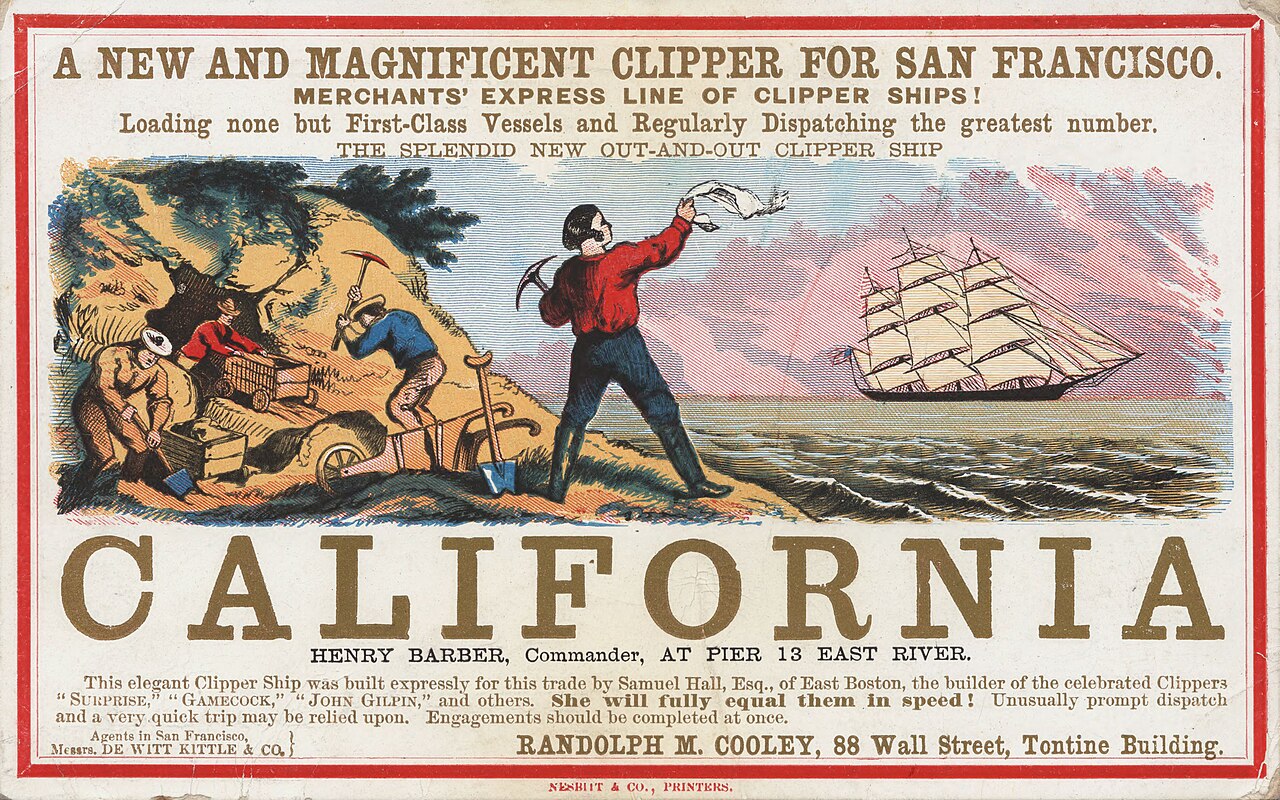
The geography of getting to California was as challenging as mining itself. The overland route from Missouri crossed the Great Plains, Rocky Mountains, Great Basin, and Sierra Nevada — a 2,000-mile journey taking four to six months. Emigrants on this route faced the same dangers as Oregon Trail travelers: river crossings, desert crossings, and mountain passes that could be closed by snow as early as October.
The sea route around Cape Horn, the southern tip of South America, covered 13,000 miles and took five to eight months. The Panama route was faster — travelers sailed to the Isthmus of Panama, crossed the 50-mile jungle by mule and canoe, then boarded another ship to San Francisco. This route took six to eight weeks but exposed travelers to malaria and yellow fever. Thousands also came by ship from China, Australia, Chile, and Mexico, making the Gold Rush a truly global migration event.
Mining Methods & Environmental Impact
- Placer Mining: Panning and sluicing river gravels
- Hydraulic Mining: High-pressure water cannons blasted hillsides
- Hard Rock Mining: Tunnel mining into quartz veins
- Environmental Destruction: Rivers choked with sediment, forests stripped
Mining methods evolved rapidly and grew increasingly destructive. Early miners used simple pans and sluice boxes to wash gold from river gravels — a labor-intensive process that could yield $10 to $50 per day in the early months. As surface deposits were exhausted, miners turned to hydraulic mining, using high-pressure water cannons called "monitors" to blast entire hillsides into sluices. A single hydraulic operation could move 100,000 cubic yards of earth per day.
The environmental damage was catastrophic. Hydraulic mining operations at sites like Malakoff Diggins in Nevada County washed millions of cubic yards of debris into rivers, raising riverbeds by 25 feet, flooding downstream farms, and choking San Francisco Bay with sediment. The Sawyer Decision of 1884 banned hydraulic mining debris from entering navigable waterways — one of the first environmental protection rulings in American history. By then, an estimated 1.5 billion cubic yards of earth had been displaced.
Demographic Transformation
- California Population (1848): ~14,000 non-Native
- California Population (1852): ~250,000
- International Miners: Chinese, Mexican, Chilean, French, Australian
- Native American Decline: From ~150,000 to ~30,000 by 1870
The Gold Rush produced the most rapid demographic transformation of any region in American history. California's non-Native population exploded from roughly 14,000 in early 1848 to over 250,000 by 1852. San Francisco, the primary entry point, grew from a hamlet to a major city in months. Sacramento, Stockton, and Marysville sprang up as supply centers for the mining regions.
The Gold Rush was remarkably international. Miners came from China (over 25,000 by 1852), Mexico, Chile, Australia, France, Germany, and dozens of other countries. This diversity made California one of the most cosmopolitan places on Earth, but it also produced violent racial conflicts. Chinese miners were subjected to discriminatory taxes and violence. California's Native American population suffered catastrophically — from an estimated 150,000 in 1848 to roughly 30,000 by 1870, decimated by disease, displacement, and outright genocide.
Economic & Geographic Legacy
- Gold Extracted: Over $2 billion (1848–1855 dollars)
- California Statehood: September 9, 1850 — just 2 years after gold discovery
- San Francisco: Became the financial capital of the West
- Agricultural Transition: Mining regions became farmland by 1870s
The Gold Rush extracted an estimated $2 billion worth of gold between 1848 and 1855 (approximately $70 billion in 2024 dollars). This wealth financed California's rapid development and established San Francisco as the financial capital of the American West — a position it holds to this day. The city's banking industry, built on mining wealth, eventually evolved into the financial infrastructure that would fund the technology industry a century later.
California achieved statehood on September 9, 1850 — just two years after gold was discovered — leapfrogging the usual territorial phase entirely. As mining declined in the late 1850s, miners turned to agriculture, and the foothills and valleys of California's interior became some of the most productive farmland in the world. The Gold Rush established California's pattern of rapid, resource-driven growth — a pattern that would repeat with oil, agriculture, defense, and technology in subsequent eras.
Key Facts
- Gold was discovered at Sutter's Mill on January 24, 1848.
- An estimated 300,000 people migrated to California during the Gold Rush.
- The Mother Lode gold belt stretched 150 miles along the Sierra Nevada foothills.
- California's non-Native population grew from 14,000 to 250,000 in just 4 years.
- California became a state in 1850, just 2 years after the gold discovery.
Fun Facts
- The famous Gold Rush phrase "Eureka!" (meaning "I have found it!") became California's state motto.
- Levi Strauss moved to San Francisco during the Gold Rush and began selling durable work pants — the origin of blue jeans.
- Some of the most successful Gold Rush entrepreneurs made their fortunes selling supplies to miners, not mining themselves.
- The Gold Rush produced more millionaires per capita than any event in American history up to that time.
Final Thoughts
The California Gold Rush was one of the most transformative geographic events in American history. In just a few years, it populated an entire state, devastated pristine landscapes, displaced Indigenous peoples, and established California as the economic and cultural powerhouse of the American West. Its geographic legacy — from the scarred foothills of the Sierra Nevada to the skyline of San Francisco — remains visible across the state today.
Test Your Knowledge!
Think you know American history's geographic impact? Try our interactive geography quiz!
Play Geography Games →