

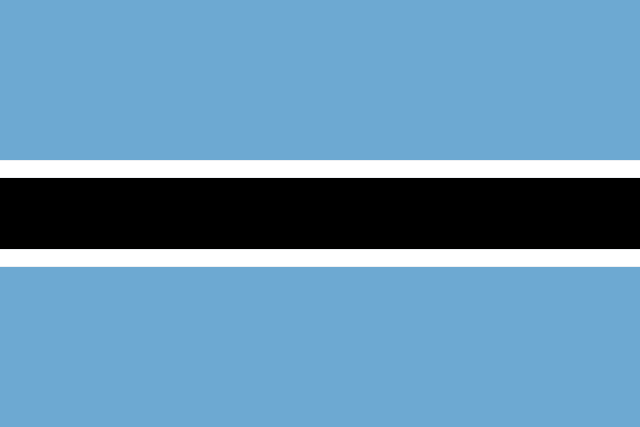
Among the flags that rose over a newly independent Africa in the 1960s, the banner of Botswana stands out for what it deliberately leaves out. While contemporaries reached for the bold red, gold, and green of the Pan-African palette, Botswana chose a cool sweep of light blue cut by a single black-and-white stripe. The result feels almost serene, yet every element was chosen with intent. To understand it is to understand how a young nation in the heart of the Kalahari decided to tell its own story rather than borrow someone else's.
A Flag Born With a Nation
Botswana adopted its flag on 30 September 1966, the same day the country gained independence from Britain and shed its old name, the Bechuanaland Protectorate. The flag was not a later revision; it arrived at the moment a sovereign Botswana came into being, raised for the first time as the colonial standard came down at midnight. From its opening day, it was inseparable from the idea of the country itself.
Before 1966, the territory had no distinctive flag of its own in the modern sense. As a British protectorate rather than a full colony, Bechuanaland was generally represented by the British Union Flag and colonial badges. That absence gave the designers of 1966 a clean slate, free to build a symbol entirely around the new nation's hopes rather than preserving any colonial emblem.
That founding context shaped a quiet but pointed decision. The leaders of the new state chose colours that avoided the red, green, and gold favoured across the continent. The choice was a statement of distinct identity and a reflection of the nation's measured character. It was a flag designed not to shout, but to last.
What the Colours Mean
The flag uses only three colours, and each carries a clear message:
- Light blue dominates the field and represents water, and specifically rain. In a country where much of the land is semi-arid and the Kalahari Desert stretches for vast distances, rain is not a casual symbol. It is the difference between abundance and hardship.
- Black forms the central stripe and, with white, speaks to racial harmony and the peaceful coexistence of the country's peoples.
- White borders the black stripe on both sides, reinforcing that message of unity and balance.
The pairing of black and white is read as harmony between people of different backgrounds living together, a value the founders wove into the national emblem rather than treating it as an afterthought. Some interpretations add a further layer, linking the alternating bands to the stripes of the zebra, an animal native to Botswana that appears as a supporter on the national coat of arms. In that reading, the colours are at once a social ideal and a nod to the natural world.
The Design and Layout
The composition is elegantly simple. A field of light blue fills the flag, and across its centre runs a black horizontal stripe bordered above and below by thinner bands of white. There is no emblem, coat of arms, star, or text, which gives it a clean, instantly recognisable look.
The flag is flown in a proportion of two by three. The central band is the visual anchor: the black stripe and its two white borders together occupy the middle third of the flag's height, with the blue field filling the upper and lower thirds. The human message sits in the centre, framed by the sky and the promise of rain.
The horizontal banding gives the flag a calm, grounded feel. It rewards a second glance: what looks at first like pure minimalism is in fact a tightly packed bundle of meaning. Because it relies on proportion and colour alone, it suffers none of the rendering problems that plague more complicated flags.
Why It Avoids the Pan-African Palette
One of the most discussed features of Botswana's flag is its conscious distance from the Pan-African colours. Across the 1960s, many African nations adopted red, gold, and green to signal solidarity with a shared struggle. Botswana went a different way.
This was not a rejection of African identity but an assertion of a specific national one. The design ties the flag to Botswana's own circumstances: the centrality of water in a dry land, and the goal of a society where communities share equal standing. The decision also carried a subtle political message. Botswana shared long borders with apartheid South Africa and white-ruled Rhodesia, and a flag whose central image was the peaceful unity of black and white citizens was a quiet contrast to its neighbours.
How It Compares to Other Flags
Set Botswana's flag beside its African contemporaries and the difference is immediate. The flags of Ghana, Mali, Cameroon, and Guinea all draw on the red, gold, and green tradition, while Botswana's palette has more in common with flags built around water and sky.
The colour scheme is genuinely rare among the world's flags. Light blue paired with a black-and-white central band is a combination almost unique to Botswana, which is part of why the flag is so seldom confused with any other. There is no look-alike that trips up quiz-takers the way some near-identical European tricolours do.
Rain, Identity, and the Word "Pula"
To appreciate why a desert nation would place water at the centre of its flag, you need only know the national motto: Pula, the Setswana word for rain. The same word serves as the name of the national currency and a common cry of celebration, shouted at the end of speeches and gatherings much as other peoples might cry "long live the nation." Rain is woven so deeply into the language that it functions as both a blessing and a greeting.
Seen in that light, the broad blue field is not merely decorative. It is the flag making the same wish that citizens make to one another: let there be rain, let there be life, let there be prosperity. Readers curious about how this connection plays out across the landscape and culture can explore our botswana country guide for the wider picture.
The Flag in Modern Life
Today the flag flies over government buildings, schools, and border posts, and appears on national holidays, most notably Independence Day on 30 September, when celebrations spill into the streets of Gaborone. It accompanies the country's athletes at international events, raised for the sprinters and runners who have brought Botswana onto Olympic and world-championship podiums.
Because its design is so clean, it reproduces well at every scale, from a lapel pin to a stadium-sized banner. Schoolchildren learn its meaning early, and the flag features in civic education as a compact lesson in the nation's values. For many citizens, the blue, black, and white together is shorthand for the ideals the country embodies: stability, unity, and gratitude for the rains. In a region that has seen coups, name changes, and redesigned banners, Botswana's steady blue marks its long record of uninterrupted democratic government.
Quick Facts
- Adopted on 30 September 1966, the day of independence.
- Uses three colours in a two-by-three proportion: light blue, black, and white.
- Light blue represents water and rain; black and white represent racial harmony.
- Deliberately avoids the Pan-African colours red, gold, and green.
- The national motto, Pula, means rain and is also the name of the currency.
- Botswana is located in Southern Africa, in the heart of the continent's interior.
Frequently Asked Questions
When was the flag of Botswana adopted?
The flag was adopted in 1966, the same year Botswana gained independence from Britain, and has remained unchanged ever since, making it as old as the modern nation itself.
What do the colours of the flag mean?
The light blue represents water, and particularly rain, which is precious in a largely arid country. The black stripe bordered by white symbolises racial harmony and national unity.
Why does Botswana's flag not use Pan-African colours?
Unlike many African nations that adopted red, gold, and green in the 1960s, Botswana deliberately chose blue, black, and white. The decision reflected a desire to express a distinct national identity rooted in the country's own environment and social ideals.
What continent is Botswana on, and how does its flag compare to others?
Botswana is in Southern Africa. Its flag is unusual on the continent for its calm blue field and avoidance of Pan-African colours. The horizontal black-and-white central stripe gives it a look that is hard to confuse with any other national flag.
Has the flag of Botswana ever changed since independence?
No. The flag has flown unchanged since 30 September 1966, with the same colours, proportions, and central stripe. That continuity is unusual in the region and has come to symbolise the country's reputation for stability.