
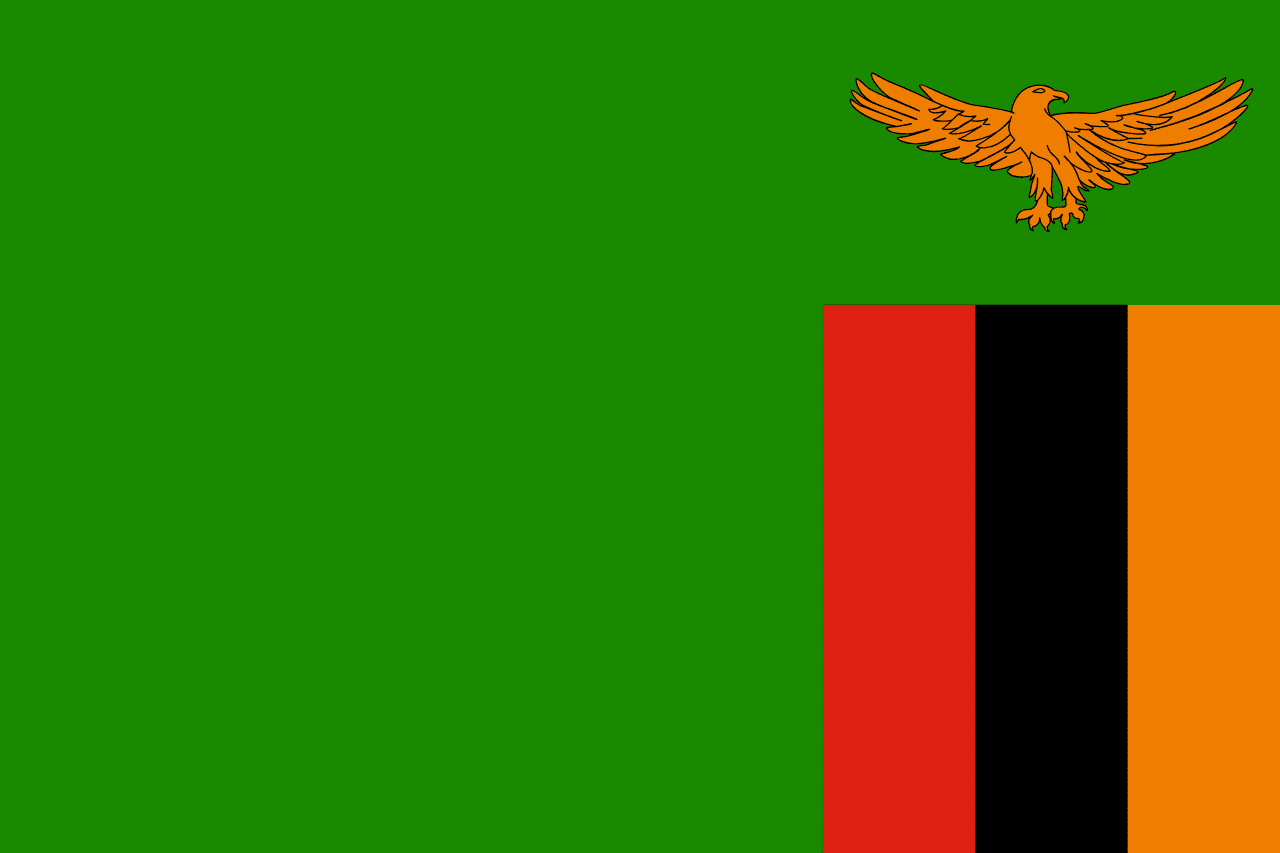
Few national flags lead with green the way Zambia's does. While most countries reserve their largest expanse of cloth for blue, red, or white, Zambia chose a deep, leafy green as the backdrop for everything else, then tucked its boldest symbols into a single corner. The result feels both calm and assertive: a verdant field, a tight cluster of vertical stripes, and a soaring orange eagle frozen mid-flight above them. Adopted in 1964, the year of independence, it remains one of Africa's most distinctive and immediately recognizable flags.
A Flag Built Around the Corner, Not the Center
The layout is what surprises people first. Instead of dividing the cloth into equal bands or placing a central emblem, Zambia's designers anchored all the detail in the bottom-right portion, the part flag specialists call the fly. There, three vertical stripes of red, black, and orange stand side by side, and floating just above them is the eagle, rendered in orange with wings spread wide. The rest of the flag, by far the larger area, is left as an unbroken green field.
This off-center composition is deliberate and unusual. It gives the flag a sense of openness, almost as if the eagle has the whole sky to itself, while the green dominates the eye and the stripes and eagle provide a concentrated burst of color and meaning. Few flags trust empty space the way this one does.
There is also a practical logic to the arrangement. Because the eye-catching detail sits at the fly rather than the hoist, the symbols stay visible when the flag streams from a pole, where the hoist edge is partly obscured by folds. The stripes follow a fixed order, with red nearest the cluster's inner edge, black in the middle, and orange at the outer edge, a small grammar that keeps every official Zambian flag looking identical.
What the Four Colors Stand For
Zambia uses four colors, and each carries a specific national idea rather than a vague sentiment:
- Green represents the country's nature, its land, forests, and agricultural richness.
- Red stands for the struggle for freedom, honoring the sacrifices made on the road to independence.
- Black represents the people of Zambia themselves.
- Orange symbolizes the nation's mineral wealth, a nod to the copper that has long shaped its economy.
That orange is worth pausing on. Many African flags draw from the pan-African palette of red, black, green, and gold, but Zambia's choice of a warm copper-orange rather than a bright gold makes the connection to its mining heritage feel more literal. Copper is so central to the national story that the region along the border with the Democratic Republic of the Congo is simply called the Copperbelt, and for decades the metal was the country's economic engine. It is a hue you rarely see on other national flags, which adds to the banner's individuality.
The Eagle and Where It Comes From
The eagle above the stripes is not a generic decorative bird. It is drawn from Zambia's national coat of arms, so the flag and the country's official seal share the same heraldic creature. Depicted in orange with its wings raised, it represents the people's ability to rise above their problems, as well as freedom itself.
The bird in question is the African fish eagle, which also happens to be Zambia's national bird. Anyone who has spent time near the Zambezi River or the country's great lakes knows its piercing, far-carrying call, a sound so iconic that it is sometimes described as the voice of Africa. Putting this eagle on the flag ties the symbol to a living animal Zambians actually see and hear, not just an abstract emblem.
The choice carries a quiet political message too. A bird with raised wings is poised to climb, and that upward energy mirrored the optimism of a nation taking control of its future in 1964. For a country emerging from colonial rule, an emblem of flight rather than dominance struck a hopeful note that has aged well.
Independence and the Birth of the Design
The flag came into being at a pivotal moment. In 1964 the territory then known as Northern Rhodesia became the independent Republic of Zambia, and a new flag was needed to mark the break from colonial rule. The design adopted that year fixed the green field, the red-black-orange stripes, and the soaring eagle as the young nation's visual identity from its first day of sovereignty.
Before independence, the territory had no flag of its own in the modern sense. As a British protectorate, Northern Rhodesia was represented by a colonial ensign, a dark blue field bearing the Union Jack alongside a badge showing an eagle above a wavy bar that stood for the Victoria Falls. Echoes of that imagery survived the transition, since the new republic kept an eagle as its central living symbol, but replacing imperial blue with home-grown green was a clear statement of a fresh start. Because the colors encode the nation's founding values, the flag functioned almost like a compact constitution in cloth. In 1996 the official green was lightened slightly, but the design's essence stayed constant. To explore how that independence-era identity continues to shape the nation today, the zambia country guide offers a wider view of the country's geography, culture, and history.
How It Compares to Related Flags
At a glance, Zambia's banner belongs to the broad family of African flags that lean on red, black, and green, colors associated with liberation movements across the continent. Yet very few flags resemble it closely. Most pan-African designs arrange their colors as horizontal or diagonal bands that fill the whole flag, as in Kenya, Malawi, or South Africa. Zambia does the opposite, leaving the bulk of the cloth a single quiet color and crowding the symbolism into one corner. Its copper-orange in place of the usual gold sets it apart, and the realistic fish eagle distinguishes it from the stylized stars, suns, and abstract birds favored elsewhere, leaving a flag that signals its liberation heritage yet remains impossible to confuse with any other.
A Symbol Woven Into Daily Life
In Zambia the flag is more than a government insignia. It appears at Independence Day celebrations every 24 October, on official buildings, at schools, and across the kit and banners of national sports teams. When Zambia's footballers, nicknamed the Chipolopolo or "Copper Bullets" after that mineral wealth, take the field, crowds wave the colors as shorthand for collective pride.
The flag also turns up in everyday commercial and cultural settings, from bunting strung across markets to logos and merchandise that borrow its palette. The combination of green, red, black, and orange has become a visual signature, so legible that even a stripe of those four colors reads as Zambian without the eagle present.
Quick Facts Worth Knowing
- The flag was adopted in 1964, the same year Zambia became independent.
- It uses four colors, green, red, black, and orange, an unusually rich palette.
- The eagle is taken directly from the national coat of arms and is the African fish eagle, the national bird.
- All the detail sits in the fly (lower right), leaving most of the flag plain green.
Frequently Asked Questions
When was the flag of Zambia adopted?
Zambia adopted its national flag in 1964, the year the country gained independence and became the Republic of Zambia, and the design has represented the nation ever since.
What do the colors of the Zambian flag mean?
The flag uses four colors with specific meanings: green for the country's nature and land, red for the struggle for freedom, black for the people of Zambia, and orange for the nation's mineral wealth. The orange eagle additionally represents freedom and rising above difficulties.
What is the bird on the Zambian flag?
It is an eagle taken from Zambia's national coat of arms, shown in orange with outstretched wings. The bird is the African fish eagle, also the national bird, a familiar sight near the country's rivers and lakes.
Why are the eagle and stripes in the corner instead of the center?
The off-center placement is deliberate. Anchoring the symbols in the fly leaves a large open green field and keeps the eagle and stripes visible when the flag streams from a pole, where the hoist edge tends to be hidden by folds. It also gives the eagle a sense of open sky to rise into.
What continent is Zambia on, and is its flag similar to others?
Zambia is in southern Africa. Its flag shares the broadly pan-African colors of red, black, and green, but its off-center layout, copper-toned orange, and soaring eagle make it stand apart from neighboring flags rather than resembling any one closely.
