
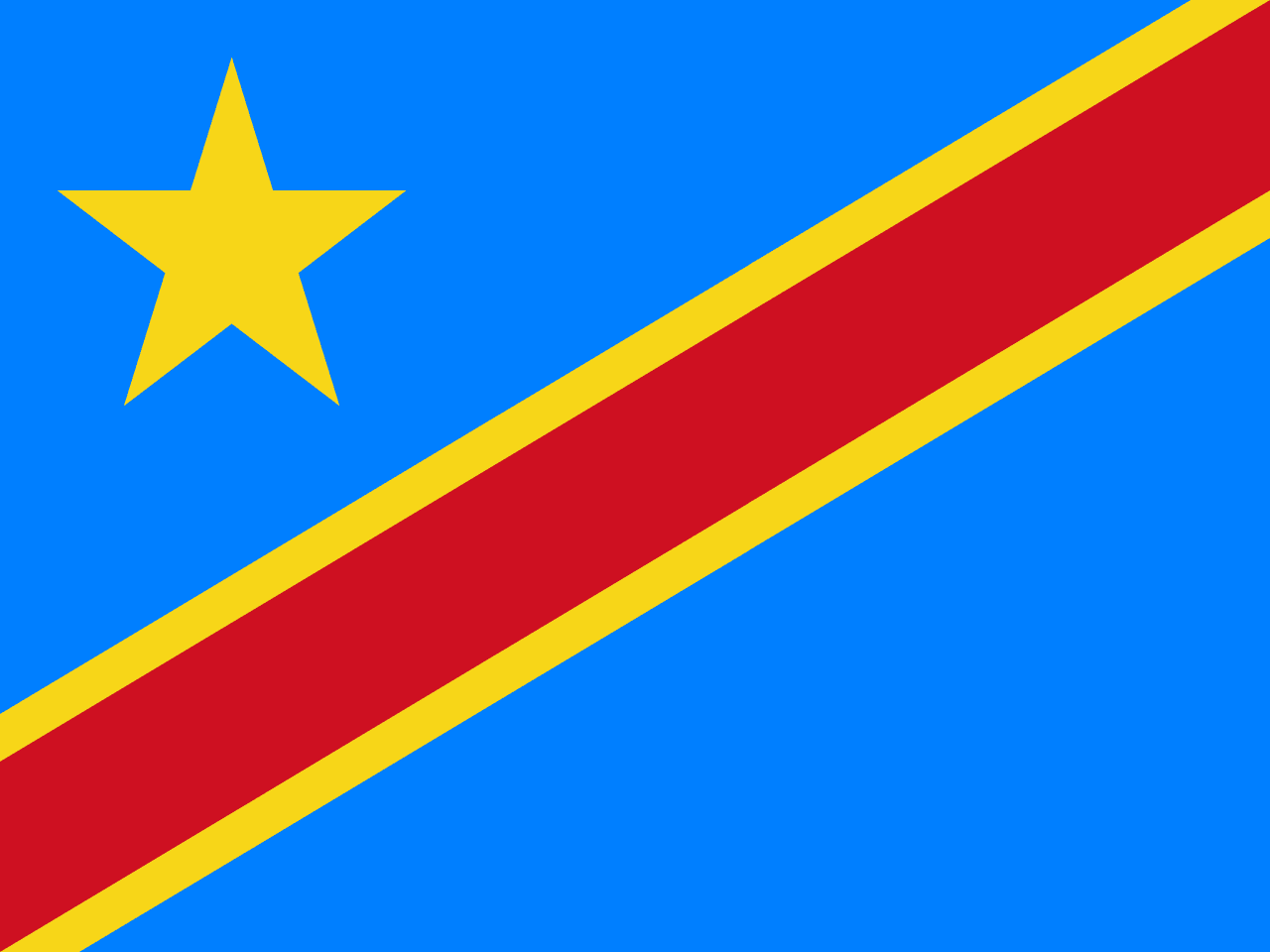
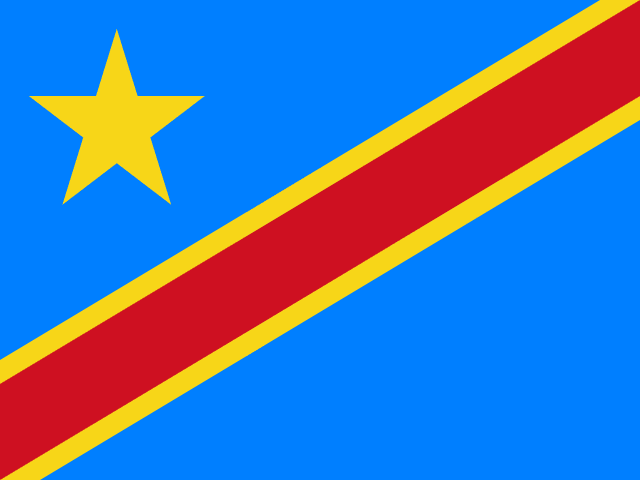
Few flags carry as much political memory as the one flying over the Democratic Republic of the Congo. Its sky-blue field, slashed by a bold red stripe edged in yellow and anchored by a single golden star, is at once striking and quietly loaded with history. To a casual observer it reads as a clean, modern design; to anyone who knows the country's turbulent past, it is also a deliberate act of remembrance, reaching back across decades of upheaval to reclaim a symbol that had been swept aside.
Adopted in 2006, the current flag is not entirely new. It revives a design that served the nation in its early independence years, restoring a visual identity that many Congolese associate with hope and self-determination.
The Colors and What They Stand For
The flag works with three colors, each assigned a clear meaning that speaks to the nation's character and its history. The dominant sky blue represents peace, a hopeful and forward-looking choice for a country that has known long stretches of conflict. Against that calm backdrop runs a diagonal stripe of red, standing for the blood of the martyrs who died in the struggle for the nation's freedom and survival.
The red stripe is bordered on both sides by thin lines of yellow, a color that symbolizes the country's wealth, an apt reference for a land famous for its mineral riches and natural abundance. In the upper hoist corner sits a five-pointed yellow star, representing the unity of the nation and its bright future. The palette tells a compact story: peace as the goal, sacrifice as the cost, prosperity as the promise, and unity as the binding thread. Unusually, each color is kept separate and given a distinct civic role rather than leaning on a generic Pan-African or Pan-Arab palette where the meanings blur together.
Design and Layout
The composition is built around contrast and movement. A red diagonal band sweeps across the sky-blue field from the lower hoist toward the upper fly, giving the flag a sense of energy that a simple horizontal tricolor would lack, while the yellow fimbriations framing the red keep the colors from bleeding into one another. The lone yellow star sits in the canton, the upper corner nearest the flagpole, balancing the diagonal. It is a clean, geometric arrangement that reads clearly whether seen on a government building in Kinshasa, stitched onto a sports jersey, or printed small on a passport.
A Flag That Kept Changing
The story behind this design is a story of a nation searching for itself. The Democratic Republic of the Congo has changed its flag more than almost any other country since independence, and each change mirrored a shift in power or ideology. The current flag is, in fact, a return to a design used during the 1963 to 1971 period, a deliberate reach back to an earlier chapter of the republic's life.
The roots run deeper still. At independence from Belgium in 1960, the young republic flew a blue field with a single large yellow star, inherited in spirit from the colonial-era banner. As the state stabilized in the early 1960s, the diagonal red stripe edged in yellow was added, producing the layout that would later be revived. Each revision tried to translate rapid political change into a single piece of cloth.
During the long era when the country was renamed Zaire, the national flag was entirely different, dominated by green and featuring an arm holding a torch. That emblem belonged to the one-party state of the time and projected a message of revolutionary vigilance rather than calm and unity. When that period ended and the nation reclaimed the name Democratic Republic of the Congo, the visual identity shifted again. The 2006 adoption settled on the blue, red, and yellow scheme, though a lighter shade of blue was chosen than in the earlier version, softening the tone while preserving the link to the past. For a fuller account of the country itself, its geography, and its people, see our democratic republic of the congo country guide.
How It Compares to Related Flags
The most important comparison is with the country's neighbor across the river, the Republic of the Congo (Congo-Brazzaville). The two are routinely confused, yet their flags differ sharply. Congo-Brazzaville uses a diagonal yellow band dividing a green upper triangle from a red lower triangle, a classic Pan-African palette with no star. The Democratic Republic of the Congo, by contrast, builds its diagonal around red rather than yellow, sits everything on a pale blue field, and adds a lone star in the canton.
The blue field also sets this flag apart from the many African banners built on the green-gold-red Pan-African colors. Among the world's roughly two hundred national flags, very few combine a sky-blue field, a fimbriated diagonal, and a corner star, which is precisely why this one stays memorable.
Cultural Significance and National Identity
For many Congolese, the flag's revival in 2006 was about more than aesthetics. It coincided with a moment when the country was working to leave behind years of instability and rebuild a sense of shared national purpose, declaring continuity with the founding ideals of independence rather than the decades that followed. The single star carries particular weight here: in a vast country of enormous ethnic and linguistic diversity, its symbol of unity is not a hollow gesture but an aspiration that speaks to the daily challenge of holding a sprawling nation together.
The Flag in Modern Life
Today the flag is woven into public life, flying over ministries, schools, and embassies. Independence Day on the 30th of June, marking the end of Belgian rule in 1960, is the high point of its civic calendar, when the colors fill official parades and neighborhood gatherings alike. On the international stage, it is most visible draped over the shoulders of supporters and athletes, particularly during football matches, where the national team, the Leopards, carries the colors with fierce pride. Tournaments such as the Africa Cup of Nations turn whole streets into seas of sky blue and red.
The colors also turn up in everyday expressions of belonging, from murals and clothing to local branding, and recur in the visual language of the country's famously vibrant music and fashion scenes. Because the design is so distinctive, it stays legible even when reproduced informally or at small scale.
Interesting Facts
- The current flag was adopted in 2006 and revives a design first used between 1963 and 1971.
- It is one of relatively few national flags built around a diagonal stripe rather than horizontal or vertical bands.
- The blue shade was deliberately lightened compared to the older version, giving the flag its characteristic sky-blue tone.
- During the Zaire era, the country flew a completely different flag featuring a green field and a torch-bearing arm.
- The country has changed its national flag more times since independence than most nations.
- The thin yellow lines edging the red stripe are called fimbriations, a vexillological term for a narrow color border between two larger areas.
Frequently Asked Questions
When was the current flag adopted?
The present flag was adopted in 2006. Rather than being an entirely fresh creation, it restored a design that the country had used during the 1963 to 1971 period, signaling a deliberate connection to the early years of independence.
What do the colors of the flag mean?
The sky blue stands for peace, the red represents the blood of the nation's martyrs, and the yellow symbolizes the country's wealth. The yellow five-pointed star represents national unity and a hopeful future.
What continent is the Democratic Republic of the Congo on?
The Democratic Republic of the Congo is located in central Africa. It is one of the largest countries on the African continent by area and sits across the Equator, giving it an enormous and varied landscape.
How does it compare to similar flags?
The diagonal red stripe bordered in yellow makes this flag distinctive, and it should not be confused with the flag of the neighboring Republic of the Congo, which uses a different diagonal arrangement of green, yellow, and red. The single star and sky-blue field set the Democratic Republic of the Congo's banner apart at a glance.
Why has the flag changed so many times?
Each redesign tracked a major political shift, from independence in 1960 through the early republic, the Zaire era under one-party rule, and the return to the name Democratic Republic of the Congo. The 2006 flag was chosen partly to break with the recent past and reconnect with the symbolism of the founding years, which is why it revives an older design rather than inventing a wholly new one.