

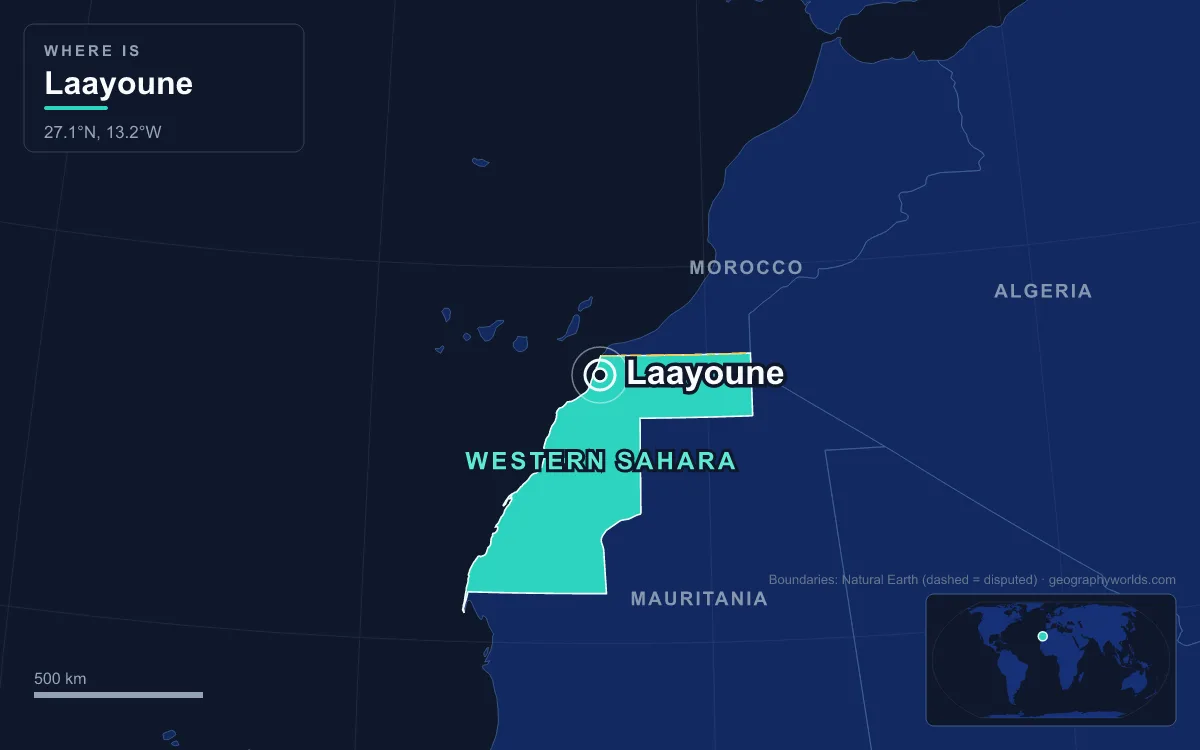
The city usually named as the capital of Western Sahara is Laayoune (El Aaiún in Spanish), the territory’s largest city, with 262,791 people counted in Morocco’s 2024 census. Its status depends on who you ask. Morocco controls the city and runs it as the capital of its Laâyoune-Sakia El Hamra region. The Sahrawi Arab Democratic Republic (SADR), proclaimed by the Polisario Front, claims Laayoune as its capital but does not control it, so it uses Tifariti as a temporary capital and runs most day-to-day business from the Sahrawi refugee camps near Tindouf in Algeria. The United Nations lists Western Sahara as a non-self-governing territory and the city remains under the supervision of its peacekeeping mission, MINURSO. Laayoune stands just south of the dry bed of the Saguia el-Hamra, a short way inland from the Atlantic. It is a young city, founded as a Spanish army post in 1938, and almost everything about it, from the phosphate trade to its water supply, is tied up in that unresolved dispute.
Antonio de Oro’s 1938 Outpost Beside the Springs
The name comes from Hassaniya Arabic, the local dialect: Layoun can be read as “the springs”, a reference to the oases that supplied water here long before any town existed. Laayoune and El Aaiún are simply the French and Spanish ways of spelling it. For centuries the Saguia el-Hamra, an intermittent river that is dry for most of the year, ran through country used by nomadic Sahrawi herders rather than by settled towns.
Spain had held a coastal foothold in the region since founding Villa Cisneros, today’s Dakhla, in 1884, but only subdued the interior in 1934. In 1938 Captain Antonio de Oro chose the site of Laayoune for a small military post, for two reasons: the water, and a position on the banks of the Saguia el-Hamra that gave easy communication with the harbours of Tarfaya and Boujdour. The post quickly outgrew its role. In 1958 Spain merged its northern district, Saguia el-Hamra, with Río de Oro in the south to form the province of Spanish Sahara, and Laayoune became its administrative capital, under the Governor General of Spanish West Africa. The old lower town that the Spanish built still lies near the riverbed.
The 1975 Madrid Accords and the Two Claims on Laayoune
By the early 1970s Spain was under United Nations pressure to decolonise, while Morocco and Mauritania both claimed the territory. In October 1975 the International Court of Justice advised that neither country’s historical ties amounted to sovereignty and that the people of the territory had a right to self-determination. On 6 November 1975 Morocco launched the Green March, in which about 350,000 unarmed Moroccans crossed into the territory. Eight days later, on 14 November, Spain, Morocco and Mauritania signed the Madrid Accords, which transferred Spain’s powers to a temporary tripartite administration and led to the territory’s partition, Morocco taking the northern two-thirds, including Laayoune, and Mauritania the southern third. The Polisario Front was not a party. Spain informed the UN on 26 February 1976 that it had ended its presence, and the next day the Polisario proclaimed the SADR at Bir Lehlou.
War followed. Mauritania withdrew its claim in 1979, and Morocco secured control of the major cities, including Laayoune, and most of the territory’s resources. A UN-brokered ceasefire in 1991 created MINURSO to organise a referendum on independence or integration, but the vote, first scheduled for 1992, has never been held, largely because of disputes over who is eligible to vote. Today Morocco controls about 70% of Western Sahara behind the Berm, a 2,700-kilometre sand wall lined with land mines, and the Polisario holds the rest. The SADR moved its temporary capital from Bir Lehlou to Tifariti in 2008.
Consulates Since 2019 and the 2025 Security Council Vote
The dispute is also written on Laayoune’s streets through its consulates. On 18 December 2019 the Comoros became the first country to open a consulate in the city in support of Morocco’s position, and Gabon, São Tomé and Príncipe, the Central African Republic, Ivory Coast, Burundi, Eswatini, Zambia, the United Arab Emirates and Bahrain followed. The SADR, for its part, is a full member of the African Union. In 2025 the UN Security Council endorsed negotiations on the basis of Morocco’s autonomy proposal; the Polisario continues to seek independence.
A 1954 Spanish Cathedral in a Muslim City
The Sahrawis are Sunni Muslims of the Maliki school, and their Islam traditionally functioned without mosques at all, an adaptation to a life spent moving between pastures. Yet Laayoune’s best-known religious building is a Catholic church. The St. Francis of Assisi Cathedral was built in 1954, during the Spanish period, to a design by Diego Méndez, the architect behind the Valley of the Fallen monument near El Escorial in Spain. It is the cathedral of the Apostolic Prefecture of Western Sahara and is run by the Oblates of Mary Immaculate.

Its congregation is tiny: members of the small Spanish community that stayed on after 1975, and staff from the MINURSO mission. The building is a reminder of how short the Spanish era was. Spain spent less than four decades in Laayoune, and its administration was gone barely three months after the Madrid Accords were signed.
Bou Craa Phosphate, the Conveyor and the Port at El Marsa
Laayoune’s economy rests on two resources: phosphate rock and fish. The first is mined at Bou Craa, southeast of the city, on a deposit estimated at more than 1.7 billion tonnes. The Spanish discovery of that deposit gave the young town a growth spurt, and mining by the company Phosboucraa began in 1972. The site now belongs to a subsidiary of Morocco’s state-owned OCP Group. Workers at the mines were among the early recruits of the Sahrawi nationalist movements, and during the war Polisario raids disabled the transport system several times, so mining stopped in 1976 and only resumed, at a reduced scale, in July 1982.
Today Bou Craa produces around 3 million tonnes of phosphate a year, about 10% of Morocco’s output. The ore reaches the sea on an automated conveyor belt roughly 100 kilometres long, described as the longest in the world, running to the port of El Marsa on the coast near Laayoune. Dust blown off the belt shows up in satellite images.

The same port handles the other trade. The Atlantic waters off Western Sahara are rich fishing grounds, and fishing employs about two-thirds of the territory’s workforce. The European Union’s fishing agreements with Morocco cover these waters, which has made them part of the legal dispute: in a legal opinion published in February 2010, the European Parliament’s own Legal Service argued that European vessels fishing there under the agreement were in breach of international law.
From Zemla in 1970 to Gdeim Izik in 2010
Two moments of protest mark the city’s modern history. On 17 June 1970, members of the Movement for the Liberation of Saguia el Hamra and Wadi el Dhahab gathered in the Zemla district of El Aaiún to read a petition to the Spanish governor-general. When police moved to arrest the leaders, the crowd threw stones and the Spanish Legion opened fire; accounts of the dead range from 2 to 11. The movement’s founder, Muhammad Bassiri, disappeared after his arrest, and the crackdown pushed Sahrawi nationalists toward armed struggle; the Polisario Front was founded three years later.
Forty years on, on the night of 9 October 2010, Sahrawis pitched a protest camp of traditional tents at Gdeim Izik, about 12 kilometres southeast of the city, against what they described as discrimination, poverty and rights abuses. By early November around 5,000 people lived there. Moroccan security forces dismantled the camp on 8 November, and rioting spread into Laayoune. Moroccan authorities and the Polisario give very different accounts of the violence, and of the deaths during the camp’s final weeks.
Desert Rain, Desalinated Water and Hassan I Airport
For the city’s residents, the most basic fact is the climate. Laayoune has a hot desert climate moderated by the cool Canary Current offshore, with an average annual temperature just over 21 °C. Average highs run from 22.7 °C in January to 31 °C in August, and the record high is 47 °C. Rain barely registers: the 1991–2020 average is 48.2 millimetres a year, and almost nothing falls between April and September.
With so little rain, the springs that gave Laayoune its name could never supply a city of a quarter of a million, and it now depends on a desalination plant. That growth is recent. Since 1975 large numbers of Moroccans have moved to Laayoune and now outnumber the Sahrawis, many of whom have given up nomadic herding. The city urbanises faster than Morocco as a whole, yet on most human-development indicators it lags behind southern Morocco.
Everyday connections reflect the territory’s unusual status. Hassan I Airport (IATA code EUN), run by Morocco’s state airport company, appears in Morocco’s aeronautical publications as GMML and in Spain’s as GSAI. A French school linked to the Alliance française opened in 2018 alongside the Spanish government’s Colegio Español La Paz, and the local football club, Jeunesse Massira, plays in Morocco’s second division at the Stade Sheikh Mohamed Laghdaf.
Laayoune is the answer to the capital question, but only with a footnote attached. For the wider background on the territory, see our Western Sahara country guide; for the desert that surrounds the city, our overview of Sahara Desert geography; and for the capital of the state that administers Laayoune, our walk through Rabat, Morocco’s capital.
Quick Facts About Laayoune
- Country: Western Sahara
- Continent: Africa (North Africa)
- Country population: approximately 611 thousand
- Capital city status: Laayoune is the capital of Western Sahara, the seat of national government, and the location of foreign embassies, parliament, and the head of state's official residence.
Frequently Asked Questions
What is the capital of Western Sahara?
The capital of Western Sahara is Laayoune. Laayoune is the seat of national government, hosts most foreign embassies and consulates, and is typically where the head of state and parliament are located.
What continent is Laayoune in?
Laayoune, the capital of Western Sahara, is located in Africa, in the North Africa region. As Western Sahara's capital, Laayoune serves as the country's primary connection to the broader African political, economic, and cultural sphere.
Why is Laayoune the capital of Western Sahara?
Laayoune was chosen as the capital of Western Sahara for reasons that typically combine geography, history, and politics. Capital city selections often reflect a desire for centrality (being accessible from across the country), historical importance (being a longstanding seat of government or culture), or neutrality (being acceptable to multiple regions or ethnic groups within the country). The specific reasons for Laayoune's designation are detailed in the city's history above.
What is Laayoune known for?
As the capital of Western Sahara, Laayoune is best known for housing the country's central government institutions — parliament, presidential or royal residences, supreme court, and key ministries. It is also typically a major cultural and economic center within Western Sahara, hosting national museums, embassies, and signature monuments. The introduction and history sections above provide detailed coverage of the city's specific notable institutions and landmarks.
Related Pages
- Western Sahara Country Guide — full geography, climate, economy, and culture overview
- Flag of Western Sahara — meaning, history, and design of Western Sahara's national flag