
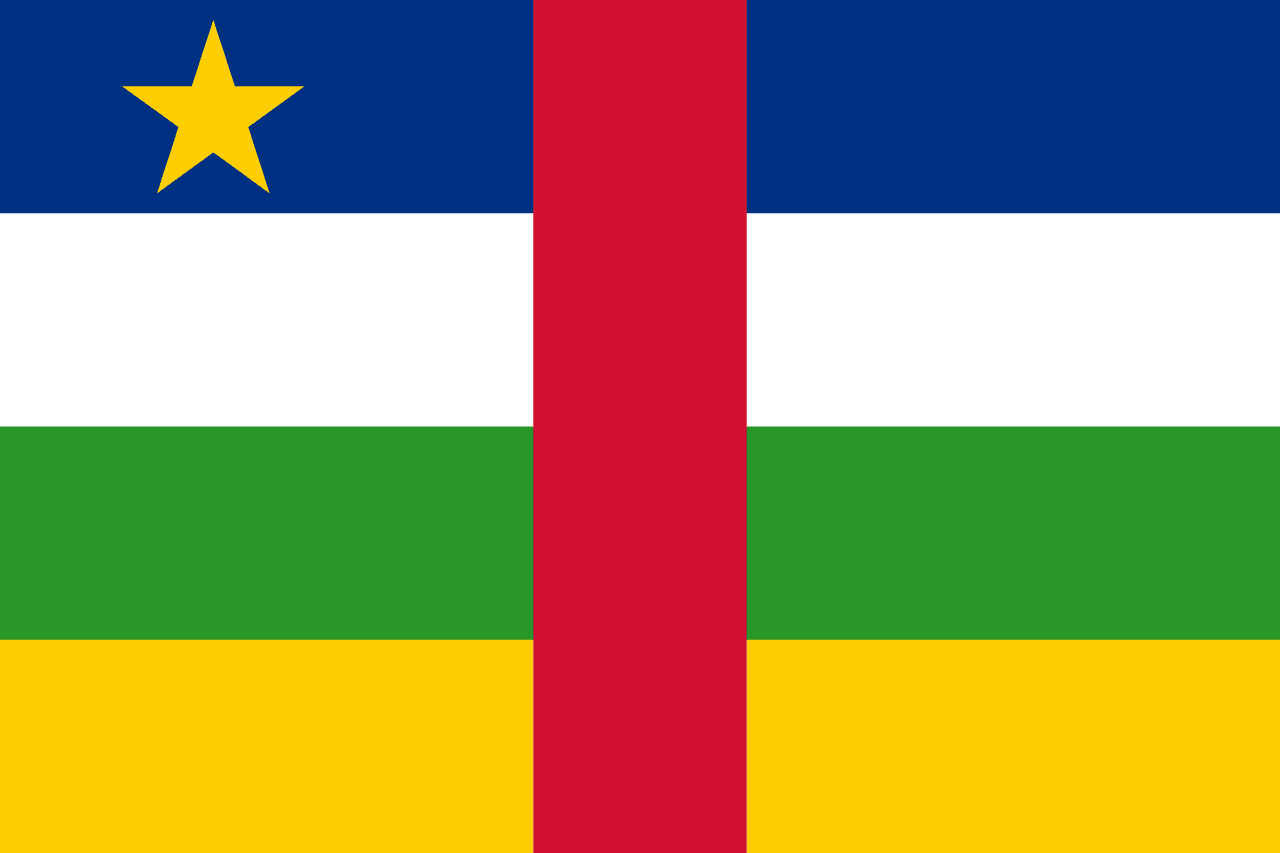
Few national flags attempt to do quite as much as the flag of the Central African Republic. Most countries pick a small palette and commit to it, but this landlocked nation in the heart of the continent chose to stitch together two very different visual traditions in a single rectangle. The result is a banner that reads almost like a thesis statement: four horizontal bands crossed by a bold vertical stripe, with a lone star tucked into the upper corner. Adopted in 1958, it has flown over the country through colonial transition, full independence, and decades of turbulent modern history, yet its core design has never changed.
A Flag Built From Two Worlds
The most striking thing about this design is its deliberate fusion. The Central African Republic emerged from French colonial rule, and its founders wanted a flag that acknowledged both that European heritage and the wider movement for African unity that was sweeping the continent in the late 1950s. So instead of choosing one tradition over the other, the flag combines the colors of the French tricolor with the classic Pan-African palette. Blue, white, and red nod to France; green, yellow, and red belong to the broader Pan-African family of symbols. Red sits at the intersection of both schemes, which is part of why it was given such a prominent role in the layout.
This is not an accidental clash of leftover colors. It was a conscious decision to express a complicated identity honestly, rather than pretending the country's past and its aspirations could be neatly separated.
The Colors and What They Carry
The flag uses five colors in total: blue, white, green, yellow, and red. Each was chosen to speak to a particular idea, and together they tell a layered story about the nation.
- Blue recalls the sky and is often associated with the French connection, standing for freedom and dignity.
- White represents peace and purity, the shared aspiration of a young country.
- Green evokes the forests and natural wealth of the land, a value at the center of Pan-African symbolism.
- Yellow signals hope, tolerance, and the warmth of the sun.
- Red honors the blood shared by all people and binds the European and African color families together.
The single yellow star in the upper hoist is the flag's emotional anchor. It stands for independence and the forward path of the nation, a small but pointed reminder that this banner was designed for a country stepping into self-determination.
How the Design Is Arranged
The construction is genuinely unusual among world flags. Four equal horizontal stripes run across the field, from top to bottom in the order blue, white, green, and yellow. Then a single vertical red band cuts straight down the center, crossing all four horizontal stripes at a right angle. That intersecting layout is the flag's signature feature, and it is what makes the design instantly recognizable once you know what to look for.
The five-pointed yellow star sits in the canton, the upper corner nearest the flagpole. Its placement against the blue stripe gives it strong contrast and ensures it remains visible even when the flag is folded or seen from a distance. The crossing of horizontal and vertical bands is rare in vexillology, and it gives the Central African Republic one of the more distinctive flags on the continent.
The Man Behind the Banner
The flag is the work of Barthelemy Boganda, the founding figure of the modern Central African state and one of the most important political leaders in the country's history. Boganda designed the flag in 1958, during the period when the territory was moving toward autonomy within the French Community and, ultimately, full independence. His vision for the design reflected his broader politics: he believed in reconciliation across racial and colonial lines, and the flag's blending of French and African color traditions mirrors that conviction.
Boganda did not live to see the country he helped shape mature, but his flag endured. That a single design has survived intact through so many changes in government is a testament to how deeply it captured the founding idea of the nation. To understand the land this banner represents, it helps to read more in our central african republic country guide.
Cultural Weight and National Identity
For a country that has experienced significant political instability, the flag has served as one of the few constant national symbols. It appears on government buildings, official documents, currency, and the uniforms of state institutions. Because it predates so many of the upheavals the country has faced, it functions almost as a thread of continuity, a reminder of the original promise of the state rather than any single regime.
The flag's dual heritage also resonates with the country's lived reality. The Central African Republic sits at a cultural crossroads, with French as an official language alongside Sango, and the banner's blend of influences reflects that everyday mixture of traditions. The star, in particular, remains a touchstone in patriotic language about independence and the country's right to chart its own future.
The Flag in Modern Life
Today the flag is raised on national holidays, most prominently on Independence Day, when it features in ceremonies, parades, and public celebrations. It accompanies the national team at international sporting events, where the distinctive crossed-stripe pattern stands out among the rows of more conventional tricolors. Diplomats fly it at embassies and at the United Nations, where it represents the country on the world stage. In schools and civic life it serves the familiar role of any national flag: a focal point for shared identity and a quiet daily presence in public spaces.
Quick Facts Worth Knowing
- The Central African Republic is located in Central Africa, a landlocked country near the geographic center of the continent.
- The flag deliberately merges the French tricolor colors with the Pan-African palette, a rare combination among world flags.
- Red was given the central vertical band partly because it is shared by both the French and Pan-African color schemes.
- The crossing of four horizontal stripes by one vertical stripe is an uncommon design choice in vexillology.
- The flag has remained unchanged since its adoption in 1958, despite major political turbulence.
Frequently Asked Questions
When was the flag of the Central African Republic adopted?
The flag was adopted in 1958, as the territory moved toward autonomy and then full independence. It has been used continuously ever since, with no changes to its design.
What do the colors of the flag mean?
The flag uses blue, white, green, yellow, and red. These combine the colors of the French tricolor with the Pan-African palette, expressing both the country's colonial heritage and its place in the wider movement for African unity. The yellow star represents independence.
Who designed the flag?
The flag was designed by Barthelemy Boganda, the founding leader of the modern Central African Republic. He created it in 1958, and its blending of French and African color traditions reflects his belief in reconciliation across colonial divides.
How does it compare to other flags?
It is unusually distinctive. While many flags use either French-inspired colors or the Pan-African scheme, the Central African Republic combines both. The crossing of four horizontal stripes by a central vertical red band also sets it apart from the simpler horizontal or vertical layouts seen on most national flags.
