
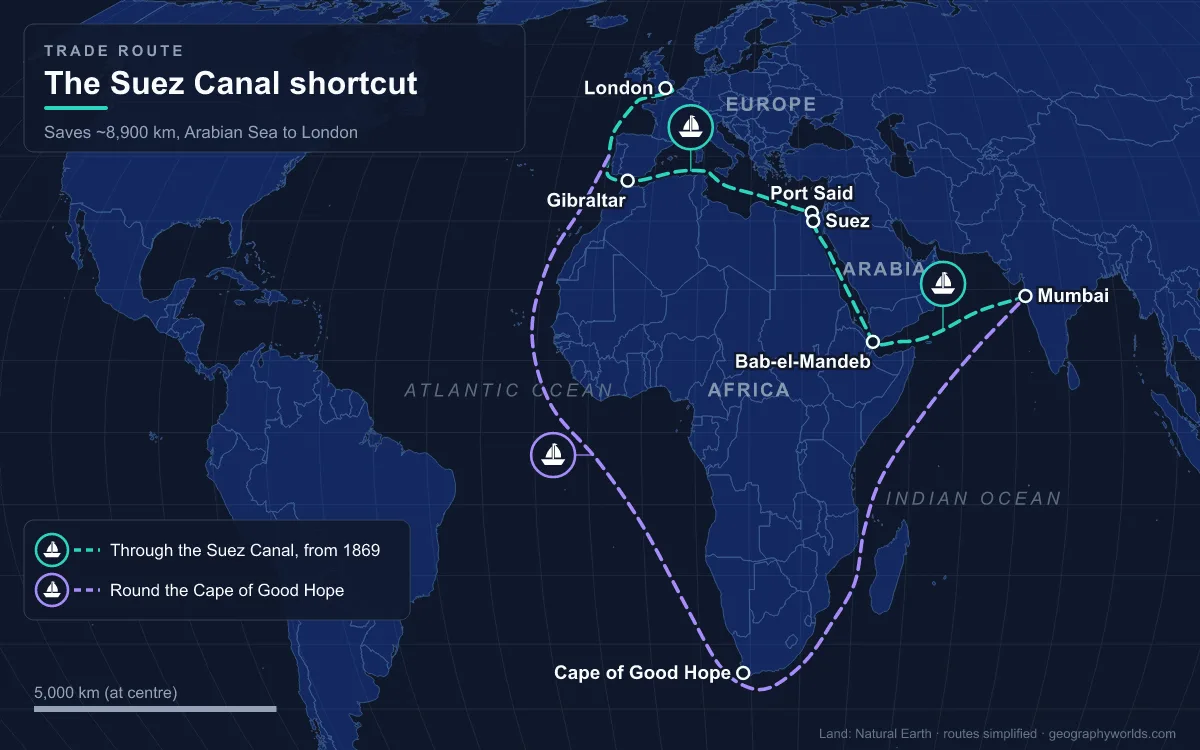
The Suez Canal is a 193.3-kilometre sea-level waterway across Egypt’s Isthmus of Suez that links the Mediterranean at Port Said with the Red Sea at Suez, giving ships a direct route between Europe and Asia without sailing round Africa. Opened on 17 November 1869 after ten years of construction, it shortened the voyage from the Arabian Sea to London by about 8,900 km. In 2021 more than 20,600 vessels passed through it, an average of 56 a day, and in the financial year to June 2023 it earned a record $9.4 billion for Egypt. Its history is a sequence of closures and crises, from the 1956 Suez Crisis and the eight-year shutdown after 1967 to the Ever Given grounding in 2021 and the Houthi attacks on Red Sea shipping that began in November 2023.
The Canal of the Pharaohs and Darius I, c. 1850 BCE to 767 CE
Long before de Lesseps, Egyptian rulers dug canals from the Nile to the Red Sea through the Wadi Tumilat, a dry valley east of the Delta. Greek and Roman writers credited a king they called Sesostris, probably Senusret II or Senusret III of the Twelfth Dynasty, with the first attempt in the 19th century BCE. Necho II (610–595 BCE) restarted the project; Herodotus was told 120,000 men died on it, a figure modern historians regard as exaggerated, and Necho never finished it.
The first fully working canal was completed by the Persian king Darius I (522–486 BCE), who had conquered Egypt. He set up granite stelae along its course, one near Kabret, recording that ships went “from Egypt through this canal to Persia”. Ptolemy II Philadelphus reopened it in 270 or 269 BCE, the Roman emperor Trajan re-dug it as the Amnis Traianus, and after the Arab conquest of 641 Amr ibn al-As restored it to carry grain to Medina. The Abbasid caliph al-Mansur is said to have ordered it closed in 767 to cut supplies to his opponents in Arabia; the Fatimid caliph al-Hakim is claimed to have repaired it around 1000, but it soon silted up again.
Ferdinand de Lesseps and the Corvée Years, 1854–1869
Napoleon’s engineers found remains of the ancient canal in 1799, but it was a survey by Paul-Adrien Bourdaloue in 1846 that showed there was no practical difference in level between the Mediterranean and the Red Sea, so a canal without locks was possible. In 1854 and 1856 the French diplomat Ferdinand de Lesseps obtained concessions from Sa’id Pasha, ruler of Egypt, to form a company that would build the canal and operate it for 99 years after opening. The Compagnie de Suez was founded in 1858 and sold its shares mainly in France, while Britain, fearing a threat to its route to India round the Cape, opposed the project throughout.
Digging began in 1859. Until 1864 the work relied on corvée, the forced labour of Egyptian peasants. Some sources estimate that more than 30,000 people were working at any one time and over 1.5 million in total, and tens of thousands are said to have died, many from cholera. The figures are contested: Gamal Abdel Nasser cited 120,000 deaths in his 1956 nationalisation speech, while the company’s chief medical officer reported a death rate no higher than 2.49 per thousand in 1866. The company also built new towns along the line: Ismailia in 1862, Port Tewfik in 1867 and Port Said in 1869.

The opening ceremonies began at Port Said on the evening of 15 November 1869. On the morning of 17 November a procession of ships led by the French imperial yacht L’Aigle, carrying Empress Eugénie, entered the channel at Port Said, with the Austrian emperor Franz Joseph I among the guests of Khedive Isma’il Pasha. The convoy celebrated at Ismailia on the 18th and reached Suez after setting off again on the 19th. Remaining works were not finished until 1871, and traffic in the first two years fell below expectations.
Isma’il’s Shares and the British Canal Zone, 1875–1954
The canal transformed trade routes: a steamship from Marseille to Bombay saved 31 days, and Mediterranean ports such as Trieste grew rapidly. It also helped ruin its Egyptian sponsor. Unable to pay his bank debts, Isma’il Pasha sold Egypt’s 44% shareholding to the British government in 1875 for £4 million, though French investors still held the majority. Unrest in Egypt led Britain to invade in 1882, and from then the canal was effectively under British protection.
The Convention of Constantinople, signed on 29 October 1888, declared the canal a neutral zone and was read as guaranteeing passage to all ships in war and peace. In practice Britain closed it to its enemies when it chose: in the First World War it barred ships of the Central Powers, and in the Second it kept the canal closed to Axis shipping. British troops repelled an Ottoman attack in 1915, and the Anglo-Egyptian Treaty of 1936 kept British control. After 1945 Britain maintained some 70,000 troops in the Suez Canal Zone. Egypt repudiated the 1936 treaty in 1951, and in October 1954 Britain agreed to withdraw its forces within 20 months.
Nasser’s 1956 Nationalisation and the Yellow Fleet, 1956–1975
When the United States and Britain withdrew their offer to help fund the Aswan High Dam, President Gamal Abdel Nasser nationalised the canal on 26 July 1956 in a speech at Alexandria, using the name “de Lesseps” as the code word for Egyptian forces to take over the company’s offices. He intended canal revenue to pay for the dam. Under the secret Protocol of Sèvres, Israel invaded Sinai on 29 October, and Britain and France then landed forces, officially to separate the combatants. Pressure from the United States, the Soviet Union and the United Nations forced them to withdraw, and Canada’s Lester B. Pearson proposed the first UN peacekeeping force. Ships sunk on Nasser’s orders blocked the channel, and it was not fully reopened to shipping until 24 April 1957, after clearance with UN help.
A far longer closure followed the Six-Day War. Egypt blocked the canal on 5 June 1967, and Israeli forces occupied the whole east bank. Fifteen cargo ships from eight countries, including West Germany, Sweden, Poland and the United States, were trapped in the Great Bitter Lake. Coated in desert sand, they became known as the Yellow Fleet. Egyptian forces crossed the canal at the start of the October 1973 war, US and British naval operations, Nimbus Moon and Rheostat, cleared mines and wrecks in 1974–75, and the canal reopened on 5 June 1975, exactly eight years after it closed. By then only two of the stranded ships could move under their own power.
The New Suez Canal of 2015 and the Ever Given in 2021
For most of its life the canal was a single lane with passing places, and ships still transit in convoys, two southbound and one northbound each day, at about 8 knots to protect the banks. In 2014 President Abdel Fattah el-Sisi ordered a parallel channel along the Ballah Bypass, 35 km long, to allow two-way traffic in the middle section. Branded the New Suez Canal and funded by investment certificates sold only to Egyptians, it cost about LE 59.4 billion ($9 billion), took a year to build and opened on 6 August 2015. The aim was to raise capacity from 49 to 97 ships a day.
The southern section remained single-lane, and that is where the canal’s most famous blockage happened. On 23 March 2021 the Ever Given, a 400-metre, 20,000 TEU container ship operated by Taiwan’s Evergreen Marine on a voyage from Tanjung Pelepas in Malaysia to Rotterdam, was pushed off course by strong winds and wedged itself across the channel.
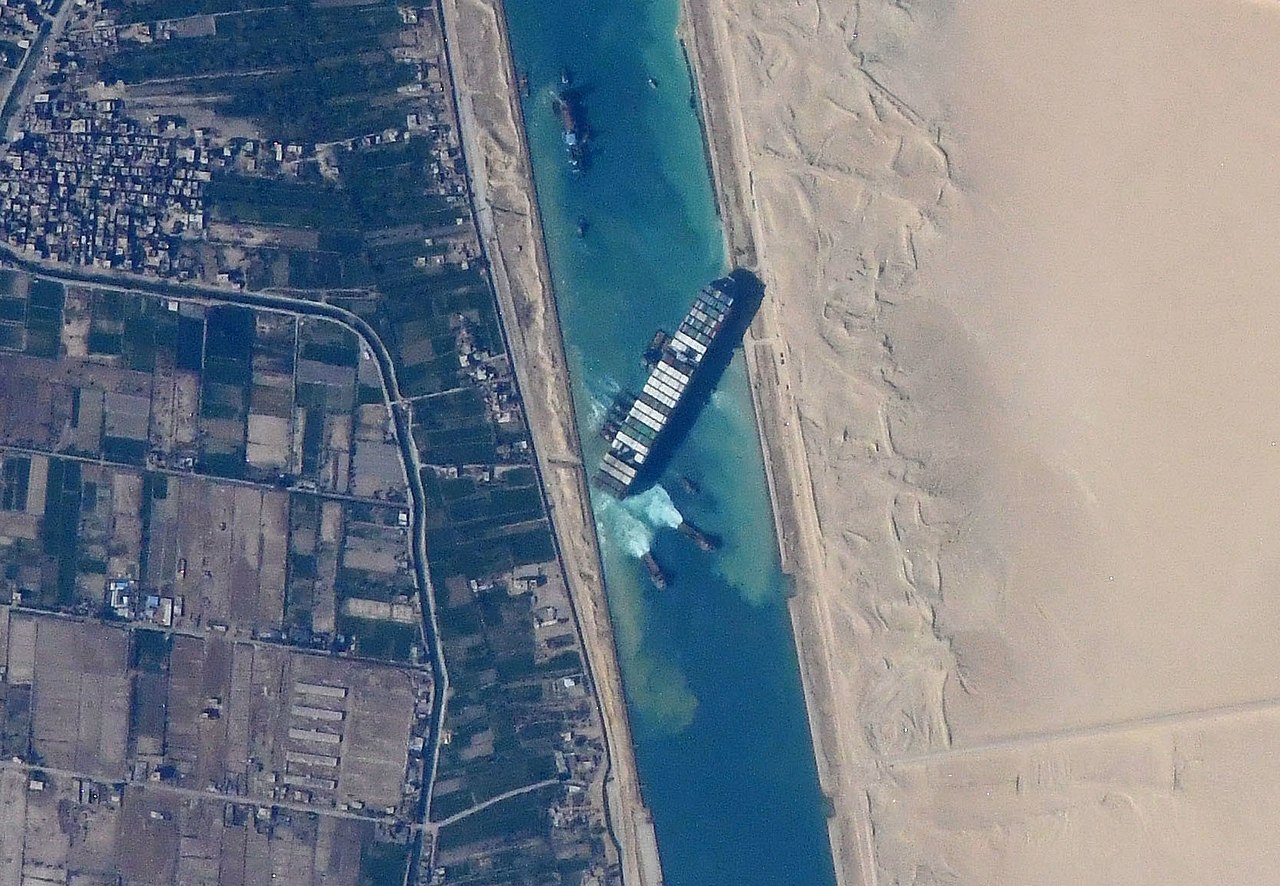
Salvage teams freed the ship on 29 March after six days, and a backlog of about 450 vessels cleared within days. The Suez Canal Authority impounded the Ever Given on 13 April, demanding more than $916 million in compensation. It cut the claim to $600 million in May and accepted a final settlement of $540 million, and the ship sailed on 7 July 2021. The year still set records: the SCA reported $6.3 billion in revenue for 2021 from 20,649 transits, and Egypt accelerated plans to extend the second channel further south.
Houthi Attacks and the Cape of Good Hope Diversion, 2023–2024
The record did not last. On 19 November 2023, shortly after the start of the Gaza war, Yemen’s Houthi movement began attacking merchant ships it linked to Israel in the southern Red Sea near the Bab-el-Mandeb strait, the canal’s southern gateway. By February 2024 some 40 vessels had been attacked. MSC, Maersk, CMA CGM, COSCO, Hapag-Lloyd and Evergreen suspended Red Sea sailings, as did the oil companies BP and Shell, and more than 2,000 ships had rerouted round the Cape of Good Hope by March 2024, adding roughly ten days to an Asia–Europe voyage.
The effect on the canal was immediate. UNCTAD found 42% fewer cargo ships transiting between December 2023 and February 2024 than a year earlier, and monthly transits fell from 2,068 in November 2023 to about 877 in October 2024. President Sisi put Egypt’s losses at $800 million a month. Daily traffic through Bab-el-Mandeb, about 75 ships before November 2023, has remained near 31 a day since January 2024. The Houthis paused their attacks after the Gaza ceasefire of 10 October 2025 and resumed missile attacks on Israel on 28 March 2026; shipping traffic was still well below pre-war levels in May 2026.
The diversion repeated, in reverse, the choice that shippers faced before 1869, and the canal’s fortunes now depend on security at the far end of the Red Sea. The alternative route is laid out in our guide to the Cape of Good Hope, and the canal’s American counterpart is measured against it in our Suez Canal vs Panama Canal comparison.