

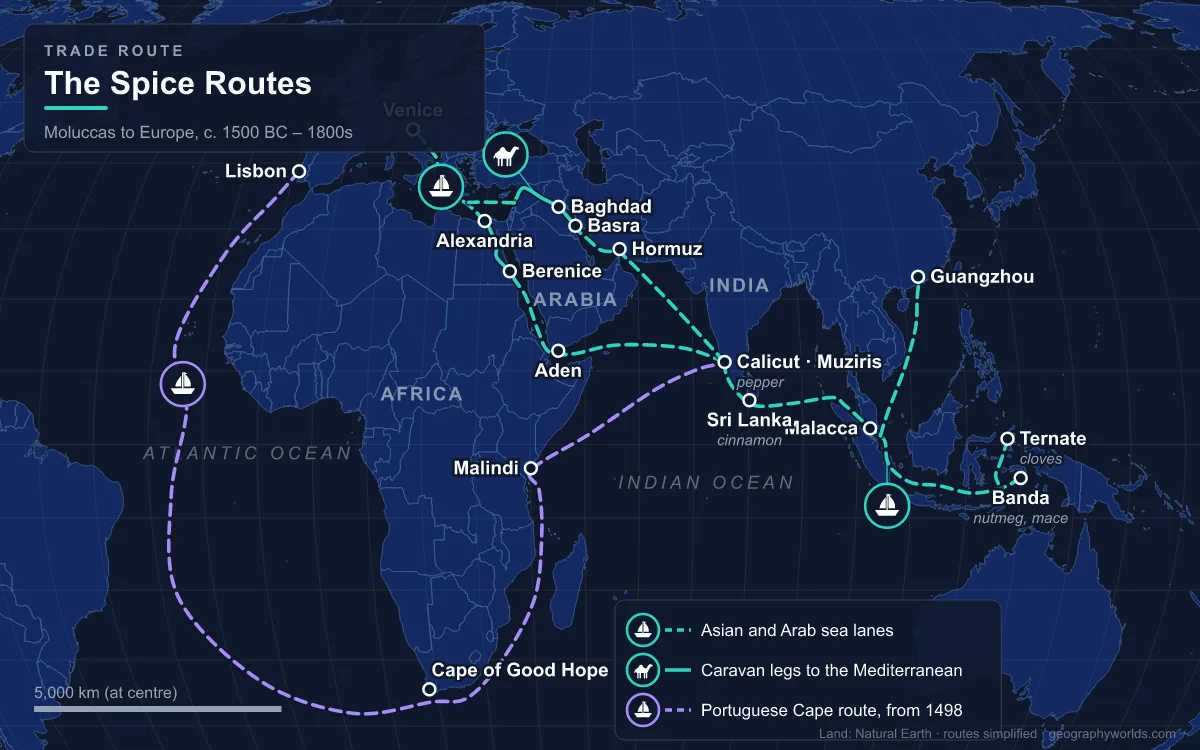
The spice routes were the sea and land lanes that carried cloves, nutmeg, mace, cinnamon and black pepper from the Maluku (Molucca) Islands, Sri Lanka and India's Malabar Coast to China, Arabia, Egypt and Europe, in use from about 1500 BC until the 19th century. At their widest, in the early 16th century, a single Portuguese network ran from the Moluccas through Malacca, Kerala and Sri Lanka around the Cape of Good Hope to Lisbon, while from 1565 Spanish galleons linked Manila to Acapulco and on to Seville. Control of these lanes passed from Austronesian sailors to Indian, Arab and Venetian merchants and then to European crown fleets and chartered companies, and the struggle for them helped launch European colonial empires in Asia.
1500 BC to 600 BC: Austronesian Outriggers Reach Sri Lanka and South India
The first true maritime trade network in the Indian Ocean was built by Austronesian peoples of island Southeast Asia, the ancestors of today's Indonesians and Filipinos. Between roughly 1500 BC and 600 BC they sailed catamarans and outrigger boats to Sri Lanka and South India, carrying cloves and nutmeg, which then grew only in the Moluccas, along with coconuts, sandalwood, bananas and sugarcane. The exchange left traces in language: the Tamil word paṭavu, the Telugu paḍava and the Kannada paḍahu, all meaning "ship", derive from a Proto-Hesperonesian word for sailboat that also gave Javanese perahu.
The same sailors pushed west on the Indian Ocean winds with cinnamon and cassia to East Africa, and by the first half of the first millennium AD the network had carried settlers as far as Madagascar.
2nd Century BC to 3rd Century AD: Ptolemaic and Roman Ships at Muziris
For centuries Indian and Arab middlemen controlled the sea leg from India, while South Arabian kingdoms such as Saba, Qataban and Hadhramaut and, further north, the Nabataeans of Petra controlled the caravans that carried goods overland to Gaza. That changed in the late 2nd century BC, when Greek sailors from Ptolemaic Egypt learned to cross the open sea from the Gulf of Aden to India's west coast on the monsoon winds, a technique credited in Greek sources to Eudoxus of Cyzicus and to a navigator named Hippalus.
After Rome annexed Egypt in 30 BC the traffic grew sharply. The geographer Strabo, who travelled up the Nile with the prefect Aelius Gallus, reported that as many as 120 ships a year were sailing from the Red Sea port of Myos Hormos to India, where under the Ptolemies only a few had dared the voyage. Pliny the Elder complained that India, China and Arabia drained 100 million sesterces a year from the empire. The main Roman ports on the Egyptian Red Sea coast were Arsinoe (near modern Suez), Myos Hormos and Berenice, from which goods went overland to the Nile and downriver to Alexandria.
The Indian end of this trade was Muziris, near the mouth of the Periyar River in the Chera country of the Malabar Coast. Pliny called it the first emporium of India, and the Tamil poem Akananuru describes the ships of the Yavanas (Greeks) arriving with gold and leaving with pepper. A 2nd-century papyrus records a cargo loan between merchants of Alexandria and Muziris. The port's exact site is still argued over: excavations at Pattanam in Kerala since 2007 have persuaded some archaeologists, while others favour the Kodungallur area.
7th to 15th Centuries: Basra, Calicut and the Venetian Monopoly
Roman demand faded after the fall of the Western Empire, but the lanes did not close. From the 7th and 8th centuries, after the rise of Islam, Arab sailors, many descended from seafarers of Yemen and Oman, dominated the western Indian Ocean. Under the Abbasid Caliphate merchants sailed from Basra and returned to sell their cargoes in Baghdad, the world of the Sinbad tales, while Alexandria, Damietta, Aden and Siraf served as entry ports for goods from India and China. Moluccan cloves and Banda nutmeg moved west through Indian emporia such as Kozhikode (Calicut) and through Sri Lanka, then on to Hormuz in the Persian Gulf or Jeddah on the Red Sea. Their exact source stayed a trade secret; the first unambiguous Arab reference to the Moluccas comes only in 14th- and 15th-century navigational works.
At the European end, the maritime republics of Venice, Genoa, Pisa, Amalfi, Ancona and Ragusa held the trade with the Levant and Egypt from the 8th to the 15th century and distributed spices across Europe. In the east, the port of Malacca, founded around 1400 by Parameswara, rose into the main transshipment point between the Indian Ocean and the South China Sea. The Ming treasure fleets of Admiral Zheng He, which made seven voyages between 1405 and 1433, called there on their way to Calicut. The Portuguese apothecary Tomé Pires, posted to Malacca in 1512 and writing his Suma Oriental there and in India up to 1515, wrote that whoever was lord of Malacca had his hand on the throat of Venice.
1498 to 1580: Manuel I, Albuquerque and the Portuguese Cape Route
Portugal set out to bypass both the Venetians and the Egyptian middlemen by going around Africa. Bartolomeu Dias rounded the Cape of Good Hope in 1488. Under orders from Manuel I, Vasco da Gama left Lisbon on 8 July 1497 with four ships and about 170 men, took on a Gujarati pilot at Malindi in East Africa, and anchored at Kappadu near Calicut on 20 May 1498. Asked what had brought them, his men answered that they had come for Christians and spices. The Zamorin of Calicut was unimpressed by the gifts Manuel had sent and insisted that da Gama pay customs in gold like any other trader.

Portugal then took the route by force. Afonso de Albuquerque captured Malacca in 1511 and, from 1507 to 1515, tried to block the old Arab routes by seizing bases at the mouth of the Persian Gulf and the entrance to the Red Sea. Having learned in Malacca where the nutmeg came from, he sent António de Abreu east, and in early 1512 Abreu's ships became the first European vessels to reach the Banda Islands. By the early 16th century Portugal controlled a chain of routes linking three oceans, from the Moluccas through Malacca, Kerala and Sri Lanka to Lisbon. Between 1497 and 1650 there were 1,033 sailings from Lisbon on this Carreira da Índia, the "India Run". Spain contested the clove islands after the Magellan–Elcano voyage reached them in 1521, until the Treaty of Zaragoza in 1529 left the Moluccas to Portugal in exchange for 350,000 gold ducats paid to Charles V.
1602 to 1667: Jan Pieterszoon Coen, Banda Neira and the VOC
The Portuguese never fully controlled the Bandas; after a failed attempt to build a fort on Neira in 1529 they mostly bought nutmeg in Malacca. The Dutch were more ruthless. The Vereenigde Oostindische Compagnie (VOC), founded on 20 March 1602 with a 21-year monopoly on Asian trade, built Fort Nassau on Banda Neira after 1609 and Fort Belgica above it from 1611. The English held out on the small islands of Ai and Run, buying nutmeg at higher prices.
In 1621 the governor-general Jan Pieterszoon Coen, who had founded the company's capital at Batavia (Jakarta) in 1619, landed troops on Banda Neira and Lontar. The orang kaya, the merchant elite who governed the islands, were forced to sign a treaty that could not be kept, and alleged breaches became the pretext for a massacre. Japanese mercenaries in Dutch service beheaded about forty orang kaya. Of a population usually estimated at 13,000 to 15,000 before the conquest, only about a thousand Bandanese are thought to have remained, as forced labourers. Others fled to the Seram Laut islands and Kei Besar, and some were shipped to Batavia as slaves. Coen split the islands' roughly half a million nutmeg trees into 68 plots of about 1.2 hectares, worked by enslaved people brought from elsewhere. On Run, which was harder to police, the VOC destroyed every nutmeg tree. Under the Treaty of Breda in 1667, England gave up its claim to Run, which is often summarised as the deal that left Manhattan to the English.
The monopoly paid. Between 1602 and 1796 the VOC sent 4,785 ships to Asia and paid dividends averaging about 18 percent of capital for almost two centuries. Cloves were harder to corner than nutmeg because the trees grew across many islands, including Ternate, Tidore, Bacan, Makian and Moti, beyond the company's policing.
1770 to 1815: Pierre Poivre, Mauritius and the End of the Monopolies
The monopolies ended through smuggled seedlings rather than battles. Pierre Poivre, the French intendant of Mauritius and Réunion from 1766 to 1772, had already carried nutmeg plants there in the 1750s. In 1770 a French India Company clerk and two sailors acting on his instructions took clove seedlings from Ternate to Mauritius and the Seychelles, and from there cloves spread to French Guiana, Martinique and Saint-Domingue. After seizing the Banda Islands in August 1810, during the Napoleonic Wars, the British dug up nutmeg trees and replanted them in Ceylon and other colonies, which largely destroyed the islands' value to the Dutch. The VOC itself, weakened by smuggling, corruption and administrative costs, went bankrupt and was formally dissolved in 1799. On the Pacific side, the Manila galleons, which had carried Asian goods to Acapulco since 1565, made their last runs in 1815, six years before Mexico won its independence from Spain.

After 1815: What the Spice Lanes Left Behind
The Banda Islands were the world's only source of nutmeg and mace until the mid-19th century. Today they are a district of Indonesia's Maluku province with 20,924 people at the 2020 census, and Fort Belgica, rebuilt several times, is one of the largest surviving European forts in Indonesia. Cloves, once confined to a handful of small Moluccan islands, are now grown mainly in Indonesia, Madagascar, Tanzania, Sri Lanka and the Comoros; Indonesia is the largest producer but exports only about 10 to 15 percent of its crop.
The cultural traces run deeper. Indian merchants brought spice mixtures to the Malay world, while Southeast Asian crops and coconut-milk cooking took root in South India and Sri Lanka. Islam reached maritime Southeast Asia in the 10th century along these lanes, and Malacca became a centre for spreading it. The colonial pepper trade also reshaped labour and caste on Kerala's Malabar Coast.
To see which plants these ships were chasing and where each one first grew, read our guide to the geographic origins of spices; for the wider sea network that carried silk and porcelain alongside pepper, see the Maritime Silk Road, and for the chokepoint Tomé Pires wrote about, our guide to the Strait of Malacca.