
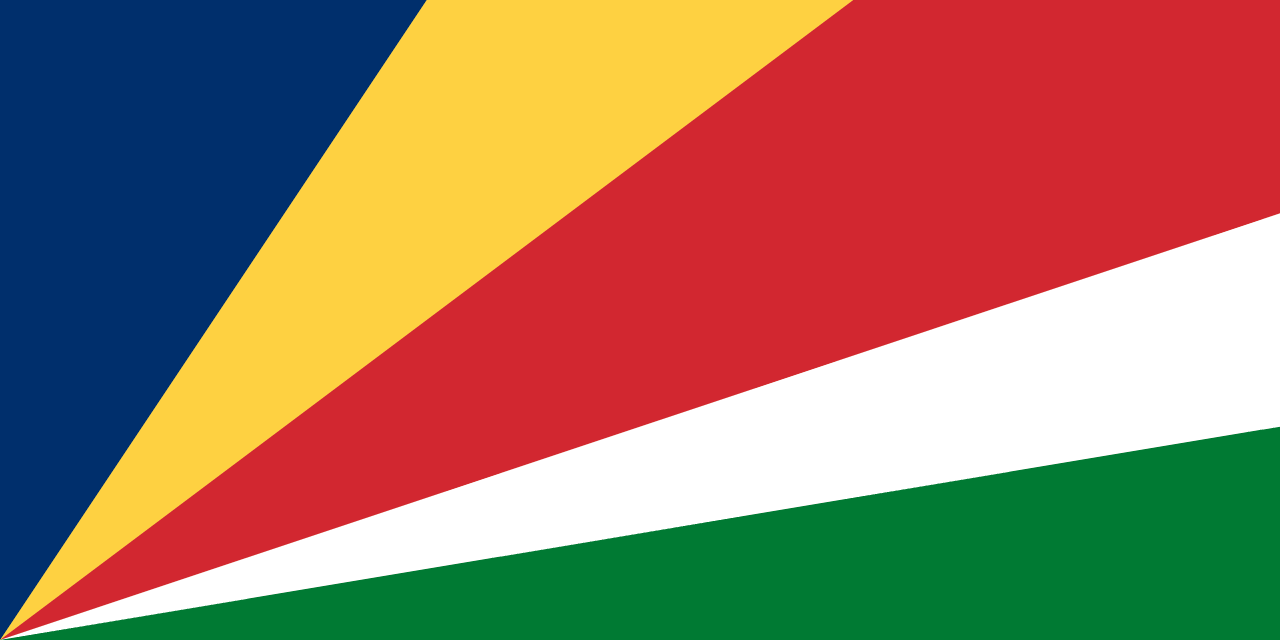

Few national flags break the rules of design as boldly as the flag of Seychelles. Where most countries settle for tidy horizontal stripes or a central emblem, this Indian Ocean archipelago chose something that looks like a sunburst caught mid-explosion: five vivid bands fanning out from a single corner. The result is one of the most instantly recognizable flags in the world, a banner that seems to be in motion even when it hangs perfectly still. Adopted in 1996, it carries the optimism of a young nation that had already changed its flag twice since independence and finally landed on a design that felt unmistakably its own.
A Burst of Five Colors
The Seychelles flag uses five colors, and that abundance is part of what makes it stand out. Reading the bands from the upper hoist around to the bottom, you encounter blue, yellow, red, white, and green. Most flags work with two or three hues; packing five into one design risks looking chaotic, yet here the radiating geometry keeps everything legible and balanced.
Each color carries a deliberate meaning. The blue evokes the sky and the surrounding sea that defines life on a scattered island nation. The yellow stands for the sun that gives light and warmth across the equatorial archipelago. The red represents the people themselves and their determination to work together for the future. The white speaks to social justice and harmony, while the green symbolizes the land and the natural environment that Seychellois are famous for protecting. Together they tell a compact story of place, people, and the values a small republic wants to live by.
Reading the Radiating Design
The layout is the flag's signature feature. The five oblique bands all originate from the lower hoist corner and sweep outward toward the top and the fly edge, widening as they go. This diagonal, radiating arrangement gives the impression of rays of light beaming from a single source, which fits the imagery of a sun rising over the ocean. It also conveys energy and forward momentum, a deliberate visual metaphor for a country moving dynamically into a new era.
Unlike flags built on perfectly horizontal or vertical divisions, the Seychelles design has no neat repeating rhythm; the angled bands fan across the field so that the eye is naturally pulled from the bottom corner outward. Because the bands originate from a point rather than running edge to edge, the flag reads almost like a graphic logo, which is one reason it translates so well to merchandise, sports kits, and digital icons. The proportions are typically a 1:2 ratio, the same shape used by many Commonwealth nations.
From Independence to the Modern Banner
The current design is the third flag Seychelles has flown since it became independent from Britain in 1976. The first independence-era flag combined red, white, and blue elements reflecting the political coalition of the time. After a change of government in 1977, the country adopted a second flag with diagonal waves of red and green separated by white, signaling a new political direction.
The third and present flag arrived in 1996, following political reforms that reintroduced multiparty democracy. Rather than picking a single party's palette, the new design folded in colors associated with the major political movements alongside the natural symbolism of sun, sea, and land. In that sense the radiating bands were a gesture of reconciliation, gathering different threads of the nation's identity into one outward-facing burst. It has flown over the islands ever since, making it the longest-serving of the three post-independence designs.
How It Compares to Other Flags
Because the Seychelles flag uses such an unusual structure, it rarely gets confused with anyone else's, which is exactly the opposite problem most multicolored flags face. Compare it to the many tricolors of the world, where slight reorderings of red, white, and blue create endless look-alikes, and the radiating bands feel refreshingly singular. There is no other widely recognized national flag built on rays emanating from a corner.
That said, the color vocabulary overlaps with several other nations. The combination of red, yellow, and green appears across many African flags as a Pan-African motif, and Seychelles shares its blue-and-green coastal symbolism with other small island states. What sets it apart is the geometry: while a flag like that of the Republic of the Congo also uses diagonal division, it splits the field into simple triangles, not a fan of five rays. The Seychelles banner is, quite literally, in a category of its own. If you want broader context on the islands behind the flag, the seychelles country guide rounds out the geography and culture.
A Symbol of National Identity
For a country of fewer than a million people spread across more than a hundred granite and coral islands, a strong shared symbol matters. The flag's outward-radiating design has been embraced as an emblem of unity and optimism, the idea that a small nation can project itself confidently onto a much larger world stage. Its colors deliberately avoid favoring any one political faction, so the flag functions as common ground rather than a partisan banner.
The flag also reinforces the environmental identity that Seychelles cultivates internationally. With green standing for the land and blue for the surrounding waters, the design quietly underscores the country's reputation as a guardian of biodiversity, from its rare native palms to the marine reserves that ring its islands. Citizens encounter the flag on government buildings, currency, passports, and official seals, where its bright geometry stands in for the republic itself.
The Flag in Everyday and Civic Life
On Independence Day and National Day celebrations, the radiating bands appear everywhere, from official ceremonies to street decorations and school events. Because the design is so graphic, it adapts easily to bunting, face paint, and souvenirs. International sporting events give the flag another stage: Seychellois athletes carry it at the Olympics, Commonwealth Games, and regional Indian Ocean Island Games, where its distinctive shape is easy to pick out in a crowded parade of nations.
Tourism, the lifeblood of the islands' economy, has helped make the flag familiar far beyond Seychelles itself. Travelers returning home often recognize the sunburst design from resorts, boats, and airport branding long before they could place the country on a map. In diplomatic settings the flag flies alongside those of much larger states, its energetic geometry ensuring it never blends quietly into the background.
Quick Facts Worth Knowing
- The flag has been in use since 1996 and is the third national flag since independence in 1976.
- It is one of the few national flags to use five separate colors in its main field.
- All five bands radiate from the single lower hoist corner, a layout almost unique among world flags.
- The colors map to sky and sea, sun, people, harmony and justice, and the land.
- Seychelles lies off the east coast of Africa and is counted as an African nation.
- The design intentionally blends political and natural symbolism as a gesture of unity.
Frequently Asked Questions
When was the Seychelles flag adopted?
The current flag was adopted in 1996, after political reforms that restored multiparty democracy. It replaced two earlier post-independence flags, making it the third national flag Seychelles has flown since gaining independence in 1976.
What do the colors of the Seychelles flag mean?
The five colors each carry meaning: blue represents the sky and sea, yellow the sun, red the people and their work toward unity, white social justice and harmony, and green the land and natural environment. Together they capture the islands' geography and the values of the republic.
Who designed the Seychelles flag and why is it shaped that way?
The 1996 flag was created to reflect national reconciliation, combining colors linked to the country's major political movements with natural symbolism. The radiating band design suggests rays of sunlight and a nation moving dynamically into the future, which is why the colors fan out from a single corner rather than forming ordinary stripes.
What continent is Seychelles on, and how does its flag compare to others?
Seychelles is an island nation in the Indian Ocean off the east coast of Africa and is considered part of the African continent. While it shares colors like red, yellow, and green with many African flags, its corner-radiating layout is essentially unique, so it is rarely mistaken for any other national flag.