
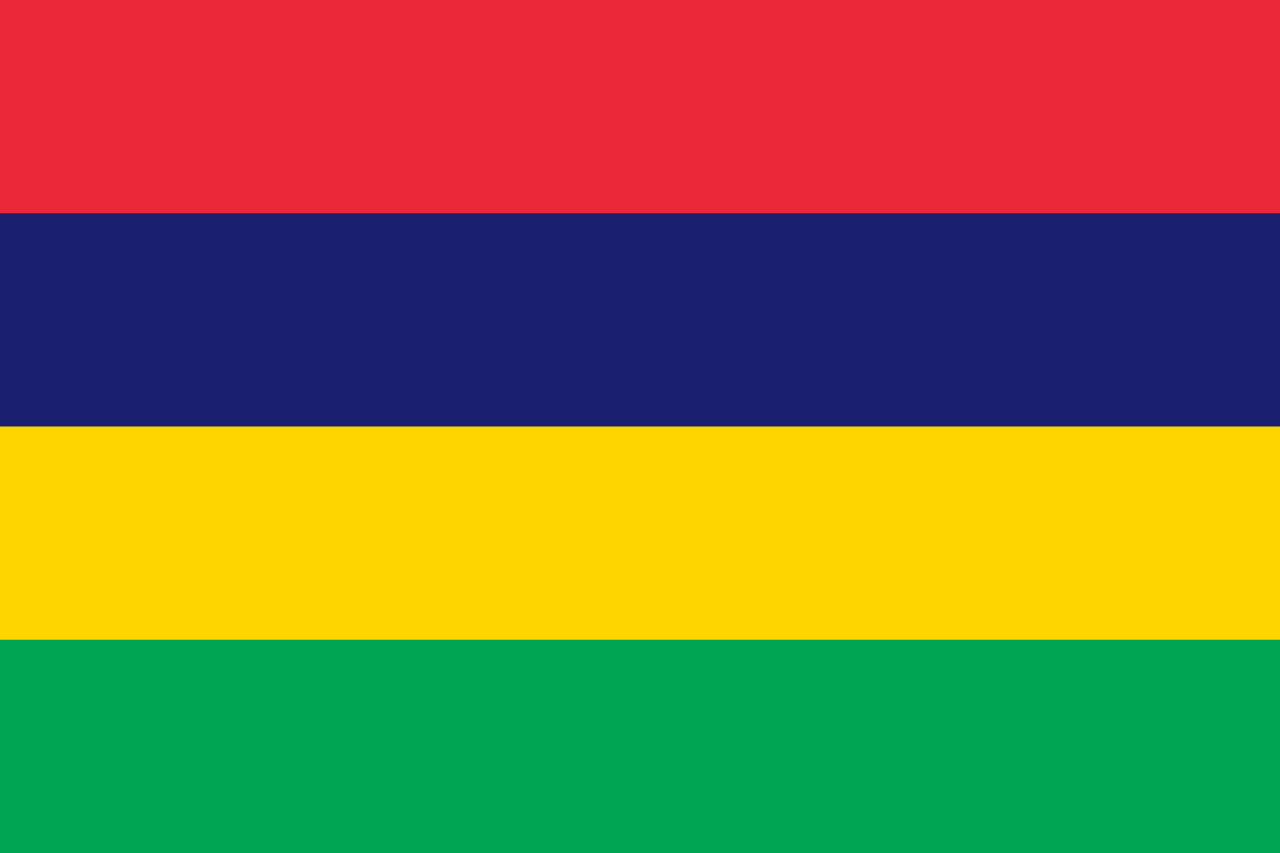
Among the world's national banners, few are as instantly recognizable for their structure as the flag of Mauritius. Four bold horizontal stripes of red, blue, yellow, and green stack one atop the other in equal measure, a design so direct and so distinctive that it stands almost alone in the global community of flags. Raised for the first time when this Indian Ocean island became independent in 1968, the banner has come to be known affectionately as Les Quatre Bandes, French for "the four bands." It is a flag that says a great deal with very little, packing the story of a young nation into a tidy quartet of colors.
A Quartet of Colors and What They Mean
The flag's four stripes are not arranged for mere visual balance; each carries a piece of the Mauritian national narrative. Reading from top to bottom, the meanings unfold in sequence.
- Red sits at the top and recalls the struggle for independence, the effort and sacrifice that carried the island to nationhood.
- Blue represents the Indian Ocean, the vast body of water that surrounds Mauritius and has shaped its history, trade, and identity as an island nation.
- Yellow stands for the bright future the country looked toward at the moment of its independence, a hopeful golden light over the years ahead.
- Green at the base evokes agriculture and the lush vegetation that blankets much of the island, long the backbone of its economy.
What makes this arrangement so satisfying is its logic. The colors move from the human cost of freedom, through the surrounding sea, to optimism, and finally down to the fertile land underfoot. It reads almost like a sentence written in pigment.
The Design: Simplicity as a Statement
The construction of the flag could hardly be more straightforward. There is no emblem, no coat of arms, no star or crescent, and no canton tucked into a corner. Just four bands of equal width running the full length of the field, red over blue over yellow over green. This rare commitment to four equal horizontal stripes is precisely what sets it apart, since most national flags lean on two or three bands, or break up their fields with charges and symbols.
That restraint gives the flag a clean, modern feel. It is easy to draw, easy to recognize, and reproduces cleanly at any size, from a postage stamp to a stadium banner. The absence of complicated heraldry also means the flag belongs to everyone equally, free of the dynastic or religious imagery that some national emblems carry. In a country defined by its mix of peoples and faiths, that neutrality is itself a kind of message.
Independence and the Birth of the Banner
Mauritius came under a succession of European powers over the centuries before raising its own flag. The island passed through Dutch, French, and finally British administration, and for most of that long colonial era it flew the banners of distant capitals rather than one of its own. When the country achieved independence in 1968, it needed a national symbol that could stand for the new state.
The four-stripe design was adopted that same year, debuting as the emblem of a sovereign nation rather than a colony. Because the flag was created fresh for independence, it does not carry the layered baggage of older European designs that were retrofitted onto colonies. Instead it was conceived to express Mauritian aspirations directly, which is part of why its symbolism maps so neatly onto the island's hopes at that pivotal moment. To understand how the flag fits into the broader sweep of the island's geography and culture, the mauritius country guide offers useful background.
A Symbol of a Diverse Island Nation
Mauritius is one of the most culturally diverse places on Earth, home to communities with roots in India, Africa, China, and Europe, speaking Creole, French, English, and a host of ancestral languages. A flag for such a society had to avoid favoring any one group, and the four colors achieve exactly that. None of them belongs to a particular community; together they describe shared experiences, the common ocean, the common land, the common past, and the common future.
Over the decades the banner has become a genuine point of pride, flown not as a relic of any single heritage but as a shared possession of the whole population. It appears outside government buildings and schools, on official documents, and in the hands of citizens during national celebrations. For a nation built from many origins, the flag offers a single, unifying image.
The Flag in Everyday and Public Life
The four bands turn up wherever Mauritians gather to mark their identity. On Independence Day, observed each March, the colors appear on bunting, clothing, and flags large and small across the island. Athletes representing Mauritius at international events carry the red, blue, yellow, and green into stadiums and arenas, where the unusual four-stripe pattern makes the delegation easy to spot among the crowd of competing nations.
The banner also features in the visual identity of the tourism industry, an important sector for an island famous for its beaches and reefs. Visitors arriving by air or sea encounter the flag at ports of entry, and its bright palette has become shorthand for the destination itself. In all these settings the flag does quiet, steady work, marking spaces and moments as distinctly Mauritian.
Interesting Facts About the Flag of Mauritius
- It is one of the very few national flags in the world built from four equal horizontal stripes, a genuinely uncommon layout.
- The flag is widely nicknamed Les Quatre Bandes, "the four bands," a name that simply describes what you see.
- It was raised for the first time in 1968, the same year the country became independent, rather than being adapted from an earlier colonial design.
- Each stripe carries a distinct meaning, so the flag tells a small story when read from top to bottom.
- Because it has no emblem, charge, or coat of arms, the flag is among the easiest national banners to reproduce by hand.
Frequently Asked Questions
When was the flag of Mauritius adopted?
The flag was adopted in 1968, the year Mauritius gained its independence. It was created specifically to serve as the emblem of the newly sovereign nation, debuting alongside the country's entry into full statehood.
What do the colors of the Mauritian flag mean?
From top to bottom, red represents the struggle for independence, blue stands for the Indian Ocean surrounding the island, yellow symbolizes the bright future the nation looked toward at independence, and green reflects agriculture and the island's lush vegetation.
What continent is Mauritius part of?
Mauritius is an island nation in the Indian Ocean and is counted as part of Africa. Lying east of the African mainland, it belongs to the cluster of southwestern Indian Ocean islands often grouped with the African region.
How does the flag compare to other national flags?
Its standout feature is the use of four equal horizontal stripes, a layout almost no other country uses, since most flags rely on two or three bands or add emblems. That makes the Mauritian flag one of the more easily distinguished banners in the world, recognizable at a glance by its simple four-color stack.
