
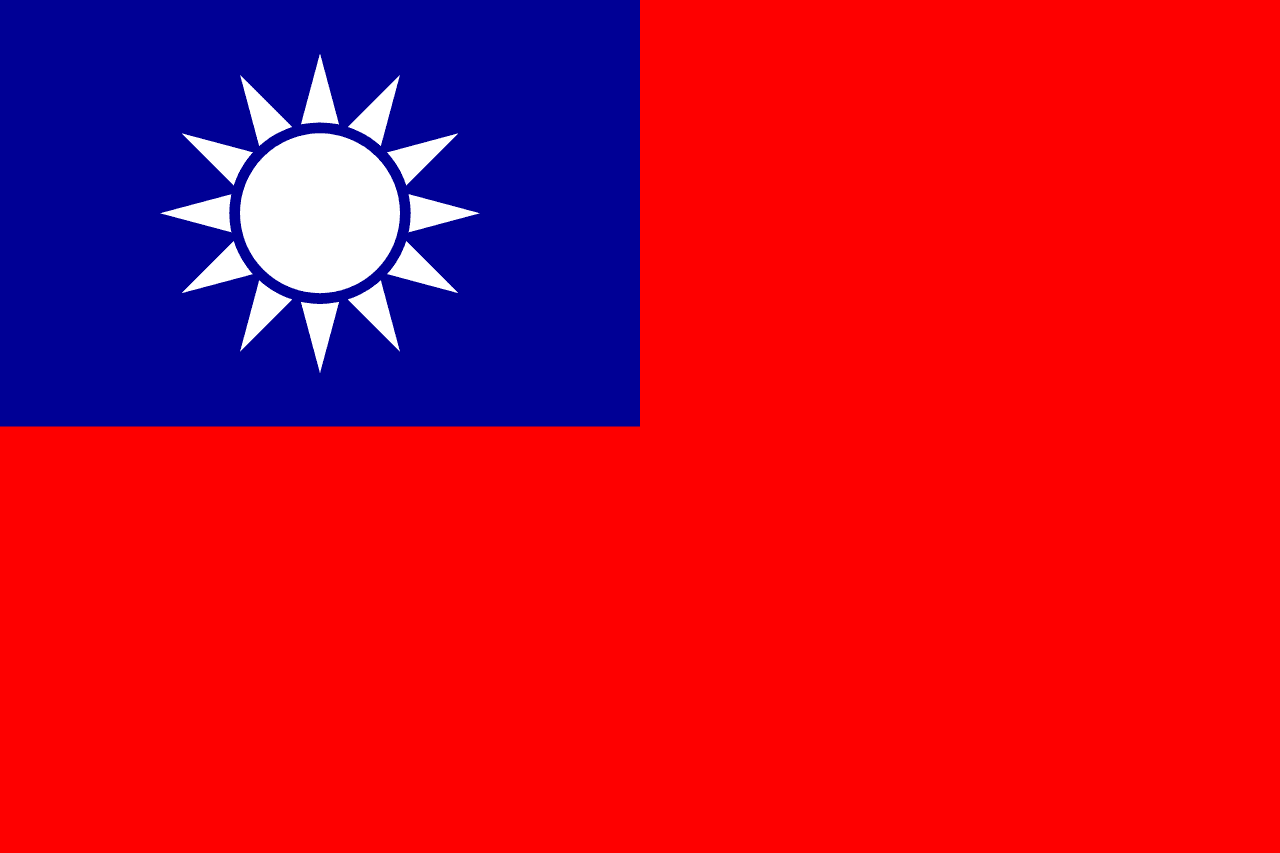
Few flags pack as much meaning into so compact a design as the banner most people recognize as the flag of Taiwan. A bold red field, a deep blue rectangle tucked into the upper corner, and a brilliant white sun radiating twelve points: it looks deceptively simple, yet every element carries a deliberate political and philosophical idea. Officially the flag of the Republic of China, this design first took its definitive form in the late 1920s and has flown over the island of Taiwan for decades, where it remains a fixture of daily life, sporting events, and civic ceremony.
A First Look at the Design
The flag is built around a simple but striking arrangement: a solid red field fills the entire flag, and a blue canton occupies the upper hoist corner, the rectangle nearest the flagpole. Centered within that blue canton sits a white sun with twelve triangular rays pointing outward like spokes on a wheel. This emblem is often called the "Blue Sky with a White Sun," and when set against the surrounding red field, the full composition is poetically described as the "Blue Sky, White Sun, and a Wholly Red Earth."
The layout follows the classic canton-and-field structure familiar from many world flags, but the placement of a single luminous sun rather than stars or stripes gives it an immediately distinctive silhouette. The geometry is clean and balanced, with the rays of the sun spaced evenly so the emblem reads clearly whether the flag is hanging limp or snapping in the wind.
What the Colors and Sun Represent
Each color was chosen to express a guiding principle. Red stands for sacrifice and the blood shed in the cause of the nation, a reminder of revolutionary struggle. Blue evokes the sky and the ideals of liberty and a bright, open future. White, in the form of the sun, represents equality and the spirit of democracy.
Together, these three colors map neatly onto the Three Principles of the People, the political philosophy that shaped the founding of the Republic: nationalism, democracy, and the livelihood of the people. The white sun is not merely decorative; it functions as the ideological heart of the flag, broadcasting a vision in which the people share equally in the life of the nation. The interplay of all three hues turns an otherwise plain field into a layered statement of values.
The Twelve Rays and Their Meaning
The most-discussed detail of the flag is the count of the sun's rays. There are precisely twelve, and they are widely understood to represent the twelve months of the year and, by extension, the twelve traditional two-hour periods into which a Chinese day was once divided. The symbolism is one of ceaseless progress: just as the months turn and the hours pass without stopping, the nation is meant to advance with the same unbroken rhythm.
This makes the emblem something more than a sunburst. It is a quiet emblem of time and momentum, an encouragement to keep moving forward through the full cycle of the calendar. The choice of twelve rays, rather than the more common figures of eight or sixteen seen in other solar emblems, helps make the flag instantly identifiable.
How the Flag Came to Be
The flag's roots lie in the revolutionary movements of the early twentieth century. The "Blue Sky with a White Sun" emblem began as a party symbol associated with the founding revolutionary cause, and over time it was incorporated into the larger national design with the addition of the surrounding red field. The complete flag, in the form recognized today, was formally adopted in 1928 as the national flag of the Republic of China.
Originally raised over mainland China, the flag accompanied the Republic's government when its seat relocated to the island of Taiwan in the mid-twentieth century. Since then it has been the banner flown across Taiwan, woven into the island's institutions and public spaces. For a fuller picture of the island's geography, culture, and travel highlights, see our taiwan country guide, which complements the story told by the flag itself.
Comparing It to Similar Flags
At a glance, a red flag with a blue canton invites comparison with other nations that share that palette, and red-white-and-blue is one of the most common color combinations in world vexillology. Yet very few national flags place a single radiant sun inside the canton, which is what sets this design apart from the crowd. Where many flags fill the canton with stars, this one offers a lone twelve-rayed sun, instantly distinguishing it from look-alikes.
The closest visual relatives are not other countries' national flags but the emblems within Taiwan's own symbolic family. The "Blue Sky with a White Sun" device also appears, in a slightly different framing, as a party and military emblem, and its repetition across these contexts reinforces the sun as a unifying motif. Compared with the layered stripes or multiple stars common elsewhere, the simplicity of one sun on blue, set against red, keeps the flag both memorable and easy to draw.
The Flag in Modern Life
Today the flag is part of the everyday visual landscape of Taiwan. It is hoisted at government buildings, schools, and public ceremonies, and it features prominently during national holidays and civic observances. Crowds wave it at parades, and it is a familiar sight at moments of public celebration.
Sports offer one of the most visible stages for national symbols, and supporters proudly carry the flag at competitions and rallies. Whether stitched onto a backpack, printed on a banner in a stadium, or flying above a public square, the design continues to serve as a shorthand for shared identity. Its strong contrast of red, blue, and white photographs well and reads clearly even from a distance, which helps explain its enduring presence in modern visual culture.
Interesting Facts at a Glance
- The sun carries exactly twelve rays, a nod to the twelve months of the year and the twelve traditional periods of the day.
- The full design is poetically known as the "Blue Sky, White Sun, and a Wholly Red Earth."
- The three colors align with the Three Principles of the People: nationalism, democracy, and the people's livelihood.
- The flag was formally adopted in 1928 as the national flag of the Republic of China.
- The "Blue Sky with a White Sun" emblem predates the full flag, originating as a revolutionary party symbol.
- The lone sun in the canton makes the flag stand out from the many star-filled designs that share its red, white, and blue palette.
Frequently Asked Questions
When was the flag of Taiwan adopted?
The flag was formally adopted in 1928 as the national flag of the Republic of China. Its central "Blue Sky with a White Sun" emblem is older still, having begun as a revolutionary party symbol before being combined with the red field to create the complete national design.
What do the colors and the sun mean?
Red represents sacrifice, blue stands for the sky and the ideals of liberty, and the white sun symbolizes equality and democracy. Together the three colors reflect the Three Principles of the People. The sun's twelve rays signify the twelve months of the year and the unstoppable forward march of the nation.
Who designed the flag?
The "Blue Sky with a White Sun" emblem emerged from the early revolutionary movement of the period and was later integrated into the full flag with its surrounding red field. Rather than being the work of a single celebrated artist credited in popular memory, the design grew out of that revolutionary context and was standardized as the national flag.
What continent is Taiwan on?
Taiwan is an island located in Asia, off the southeastern coast of the Asian mainland. The flag, officially that of the Republic of China, has flown over the island since the mid-twentieth century and remains its most recognizable national symbol.