
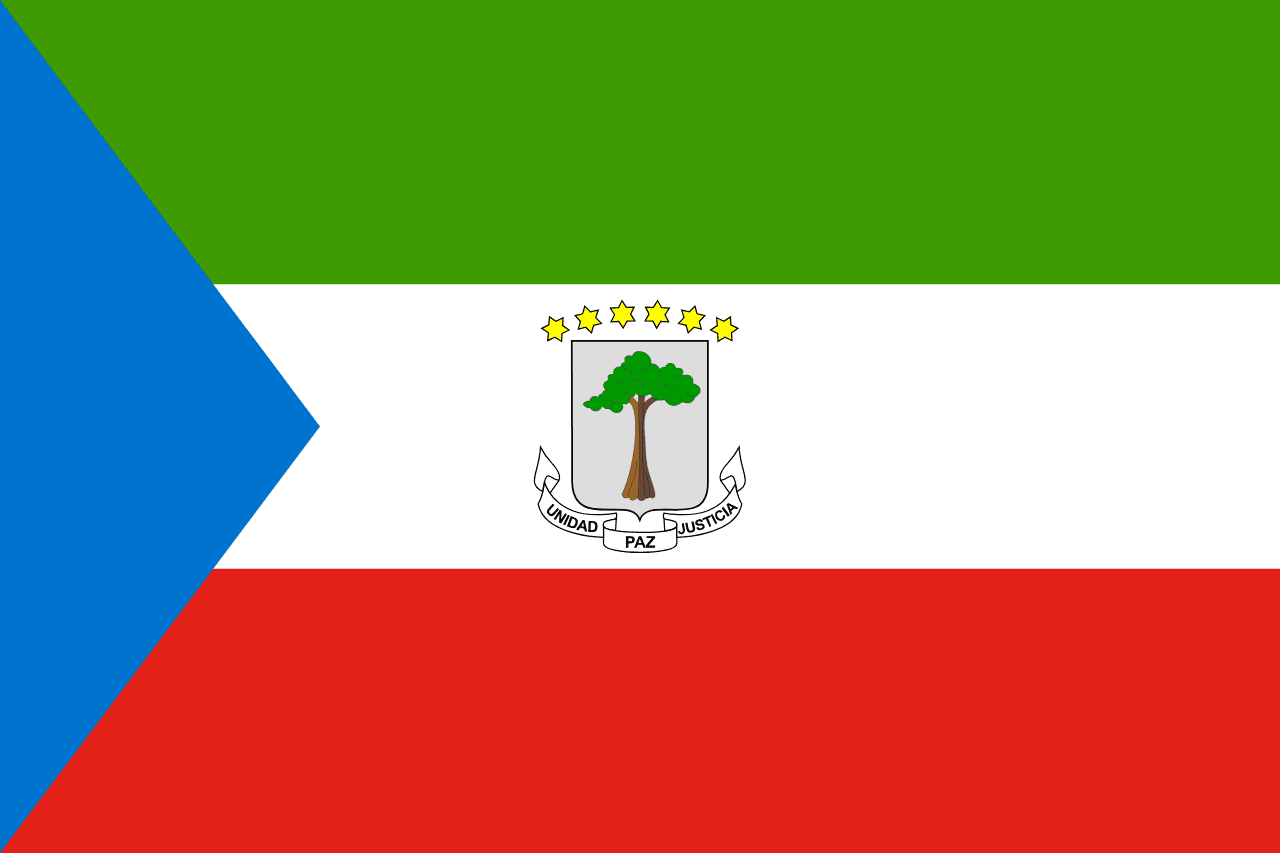
Few national flags pack as much geography, history, and botany into a single rectangle as the flag of Equatorial Guinea. A green, white, and red horizontal tricolor anchored by a blue triangle and a distinctive coat of arms, it tells the story of a small Central African nation split between a mainland region and a cluster of Atlantic islands. Hoisted for the first time when the country broke from Spanish rule, the flag has flown over a young republic that, despite its modest size, occupies a strikingly varied corner of the African continent. This article unpacks every stripe, symbol, and silhouette woven into the design.
A Quick Look at the Design
The flag follows a layout that vexillologists call a horizontal triband: three equal horizontal bands of color stacked one above the other. From top to bottom these run green, white, and red. Against the hoist side, the part of the flag nearest the pole, sits a blue triangle that points inward toward the fly. At the center of the white band, the national coat of arms gives the flag its unmistakable identity. This combination of a tricolor field plus a triangle and central emblem makes Equatorial Guinea's flag immediately distinguishable from the many plain three-stripe designs found around the world.
Placing the coat of arms in the middle stripe is a deliberate choice. Many tricolors leave their bands unadorned, relying purely on color symbolism. Equatorial Guinea instead foregrounds a detailed national crest, signaling that the emblem is not decorative but central to how the country wishes to present itself.
What the Colors Stand For
Each color in the flag carries a specific meaning rooted in the nation's land and its path to sovereignty. The four colors and their official associations are:
- Green represents the lush vegetation and natural wealth of a country covered in tropical forest.
- White stands for peace, a value emphasized at the dawn of independence.
- Red recalls the struggle for independence and the sacrifices made along the way.
- Blue, expressed through the triangle, evokes the sea that links the mainland to the country's islands.
The inclusion of blue is especially telling. Equatorial Guinea is geographically divided: a continental mainland region faces a set of Atlantic islands, and the ocean is the connective tissue between them. By giving the sea its own dedicated shape rather than folding it into a stripe, the flag elevates maritime identity to equal footing with the land.
The Coat of Arms at the Heart of the Flag
The emblem in the white band rewards a close look. Its centerpiece is a silk cotton tree, a towering hardwood common across tropical Africa. According to the country's own symbolism, this tree commemorates independence and the moment the nation took root as a sovereign state. Beneath or around the crest runs the national motto in Spanish, a linguistic fingerprint of the colonial era, since Equatorial Guinea is the only sovereign African state where Spanish holds official status.
Above the shield, a row of six golden stars traditionally represents the mainland together with the country's islands, a visual tally of the territories united under one government. The coat of arms therefore does double duty: it celebrates the natural environment through the silk cotton tree while also mapping the nation's unusual split geography in a single compact image.
From Spanish Rule to a Flag of Its Own
The flag was adopted in 1968, the year Equatorial Guinea gained independence from Spain. For decades the territory had been administered as a Spanish colonial possession, and the new banner was designed to mark a clean break from that status. The green, white, and red tricolor with its blue triangle and crest emerged as the emblem of the fresh republic, replacing colonial insignia with symbols chosen to speak for the people themselves.
Like several post-colonial flags, Equatorial Guinea's standard has weathered the political turbulence that often follows independence. The core design, however, has proven remarkably durable, and the tricolor-plus-triangle arrangement has remained the recognizable face of the nation on the world stage. Readers curious about how the flag fits into the broader national story can explore our equatorial guinea country guide for deeper context on the country's geography and culture.
How It Compares to Similar Flags
At a glance, a green-white-red tricolor invites comparison with a long roster of national flags that share parts of that palette. Italy, Hungary, Bulgaria, and Mexico all use green, white, and red in some arrangement, yet none looks quite like Equatorial Guinea's once you account for orientation and ornament. The Italian and Hungarian flags use vertical or horizontal stripes without any triangle or emblem on the open field in the same way.
The feature that truly sets Equatorial Guinea apart is the blue hoist triangle. Triangles at the hoist appear on flags such as those of the Philippines, Cuba, and several African nations, but the specific pairing of a blue triangle with a green-white-red triband and a botanical coat of arms is unique. Where look-alike tricolors rely on color alone, Equatorial Guinea layers in geometry and a detailed crest, giving observers two extra cues to tell it apart from its color cousins.
Within Africa, the flag also stands out for not adopting the popular pan-African color scheme of red, gold, and green or the red, black, and green combination favored by many neighbors. Its palette and its Spanish-language motto mark it as a distinctive outlier on the continent.
The Flag in National Life Today
The flag is woven into the rhythms of Equatorial Guinean public life. It flies over government buildings, appears at independence celebrations each year, and accompanies the national football and athletics teams when they represent the country abroad. For citizens, the green band and the silk cotton tree are shorthand for homeland, while the blue triangle quietly reminds everyone of the ocean that binds island and mainland together.
In diplomatic settings, the flag identifies Equatorial Guinea among the community of nations, and its emblem-bearing center makes it easy to spot in a row of otherwise similar tricolors. Whether stitched onto a jersey or raised at a state ceremony, the design continues to perform the job every national flag is built for: condensing land, history, and aspiration into one glance.
Interesting Facts About the Flag
- The silk cotton tree on the coat of arms is tied directly to the idea of independence and national rootedness.
- Blue is the only color expressed as a shape rather than a stripe, symbolizing the sea between the islands and the mainland.
- The flag was adopted in 1968, the same year the country left Spanish administration.
- Equatorial Guinea is the only African nation with Spanish as an official language, reflected in the Spanish motto on the crest.
- The six stars on the emblem traditionally represent the mainland and the country's islands as a unified whole.
Frequently Asked Questions
When was the flag of Equatorial Guinea adopted?
The flag was adopted in 1968, the year Equatorial Guinea achieved independence from Spain. It was introduced specifically to mark the transition from colonial rule to a sovereign republic.
What do the colors of the flag mean?
Green represents the country's abundant vegetation, white stands for peace, red recalls the struggle for independence, and the blue triangle symbolizes the sea connecting the mainland to the islands.
What is the tree on the Equatorial Guinea flag?
The tree at the center of the coat of arms is a silk cotton tree, a large tropical hardwood. In the national symbolism it represents independence and the rooting of the new nation.
What continent is Equatorial Guinea on, and how does its flag compare to similar ones?
Equatorial Guinea is located in Central Africa, with a mainland region and Atlantic islands. While its green-white-red palette resembles flags like Italy's or Hungary's, the blue hoist triangle and the silk cotton tree coat of arms make it distinct and easy to identify.