

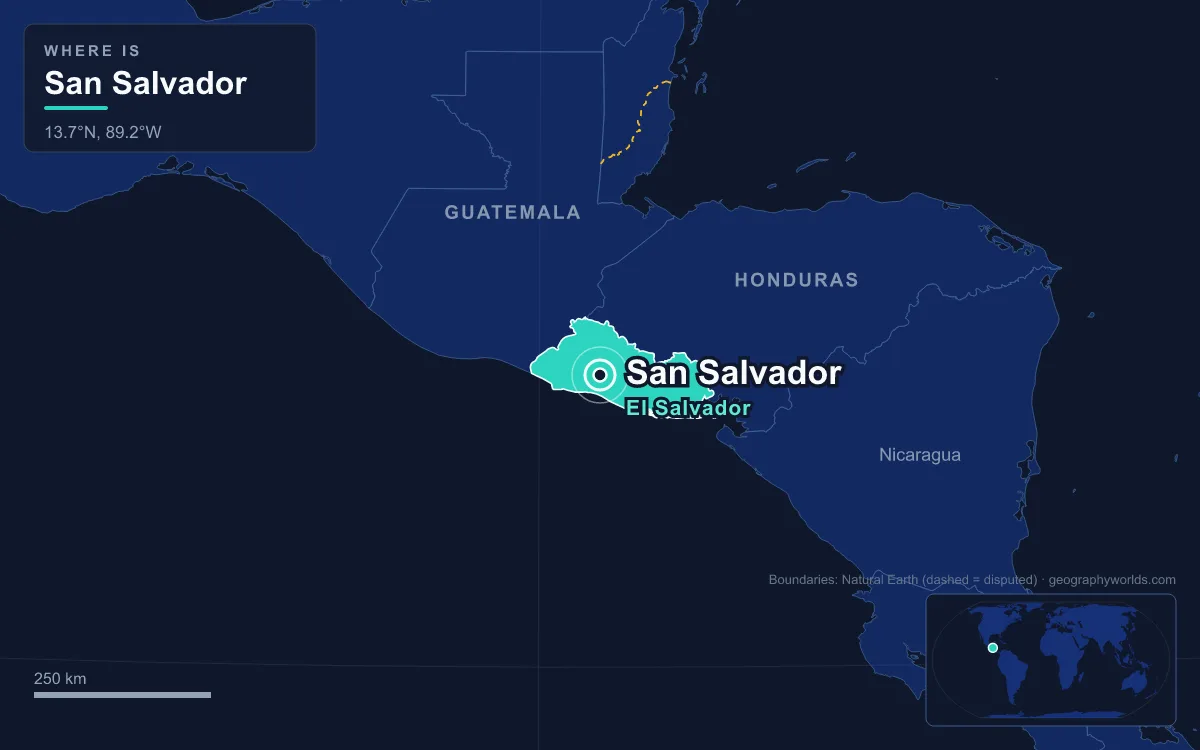
The capital of El Salvador is San Salvador, the country’s largest city and the seat of its president, Legislative Assembly and Supreme Court. It lies in a highland valley in the centre of the country, about 659 metres above sea level. The San Salvador volcano rises to the north-west, and the caldera of Lake Ilopango lies to the east. The municipality had 525,990 residents in 2024. The metropolitan area, made up of the capital and 13 neighbouring municipalities, had about 2.4 million, roughly two in every five Salvadorans. San Salvador is older than the country itself: the nation took its name from the city, not the other way round. The sections below look at it through four lenses, power, faith, trade and daily life, starting with how a mission town gave its name to a republic.
How a Mission Founded on 1 April 1525 Named a Republic
Before the Spanish arrived, the Nahua-speaking Pipil ruled a domain called Cuzcatlan, with its capital close to the present city. Its people abandoned it rather than submit. Pedro de Alvarado sent his brother Gonzalo de Alvarado and Diego de Holguín to occupy the site, and on 1 April 1525 they founded a town. Holguín became its first mayor. Alvarado had ordered that it be named San Salvador, the Holy Saviour. The name probably refers to the Feast of the Transfiguration on 6 August, the same devotion behind Columbus's naming of an island in the Bahamas in 1492. The town moved twice, in 1528 and 1545. It started at what is now the archaeological site of Ciudad Vieja, north of today's city, and ended in the Valle de las Hamacas, where the Acelhuate River supplied water and the soil was more fertile.
The city became the seat of the Intendancy of San Salvador in 1785. In November 1811 the priest José Matías Delgado and Manuel José Arce began a revolt against Spanish rule there. Delgado rang the bells of La Merced church, and a La Merced bell was placed on the city shield chosen in a 1943 design contest. After independence the province kept the city's name, and El Salvador simply means "the Saviour." The city then had a brief spell as capital of a much larger state. In June 1834 the Federal Republic of Central America moved its seat of government from Guatemala City to San Salvador. On 7 February 1835 it created a federal district reaching 32 kilometres around the city. The federation fell apart between 1838 and 1841. Regional institutions still meet here, though: the Central American Integration System, SICA, has its headquarters in San Salvador. The rival capital's side of that story is told in our guide to Guatemala City.
Power on Plaza Barrios: The Palacio Nacional and Its Coffee Tax
The east side of Plaza Gerardo Barrios, the square at the heart of the old centre, is taken up by the Palacio Nacional. The earlier palace, built between 1866 and 1870, burned down on 19 December 1889. Its replacement went up between 1905 and 1911 under the engineer José Emilio Alcaine. To pay for it, the legislature put a charge of one colón on every quintal of coffee exported. The building materials were imported from Germany, Italy and Belgium. The finished building has four main rooms and 101 secondary rooms. The Red Room is still used when ambassadors present their credentials. The Yellow Room is used as an office for the president. The Pink Room housed the Supreme Court and later the Ministry of Defence. The legislature sat in the Blue Room from 1906, and that room was declared a national historic landmark in 1974. That same year the government finally moved out of the palace.
Power in the square has not always changed hands peacefully. On 2 December 1931 a military coup removed President Arturo Araujo. His vice-president, General Maximiliano Hernández Martínez, then ruled until May 1944. The civil war that began with the coup of 15 October 1979 ran until the Chapultepec Peace Accords were signed on 16 January 1992. The UN puts the death toll at more than 75,000. When the accords were signed, crowds filled Plaza Barrios and Plaza Libertad to celebrate. City hall has launched national careers too. José Napoleón Duarte was mayor from 1964 to 1970 and later president. Nayib Bukele was mayor from 2015 to 2018 before he won the presidency.

Faith: Archbishop Romero’s Unfinished Cathedral, 1951–1999
On the north side of the same square stands the Metropolitan Cathedral of the Holy Saviour, and its history tracks the country's. The first cathedral, from 1842, fell in an earthquake in 1873. A wooden replacement completed in 1888 burned on 8 August 1951 as crowds watched. For the next four decades the site was a bare shell of concrete, brick and iron. In the late 1970s Archbishop Óscar Romero chose to leave it unfinished and spend the money on the poor. His fiery Sunday Masses there spoke out against social injustice and violence. On 9 May 1979, 24 demonstrators were shot dead on the cathedral steps. On 24 March 1980 Romero himself was shot dead while celebrating Mass. A 1993 United Nations report identified Major Roberto D'Aubuisson as the man who ordered the killing. At Romero's funeral on 30 March 1980, gunfire caused a stampede in the square that left 44 people dead.
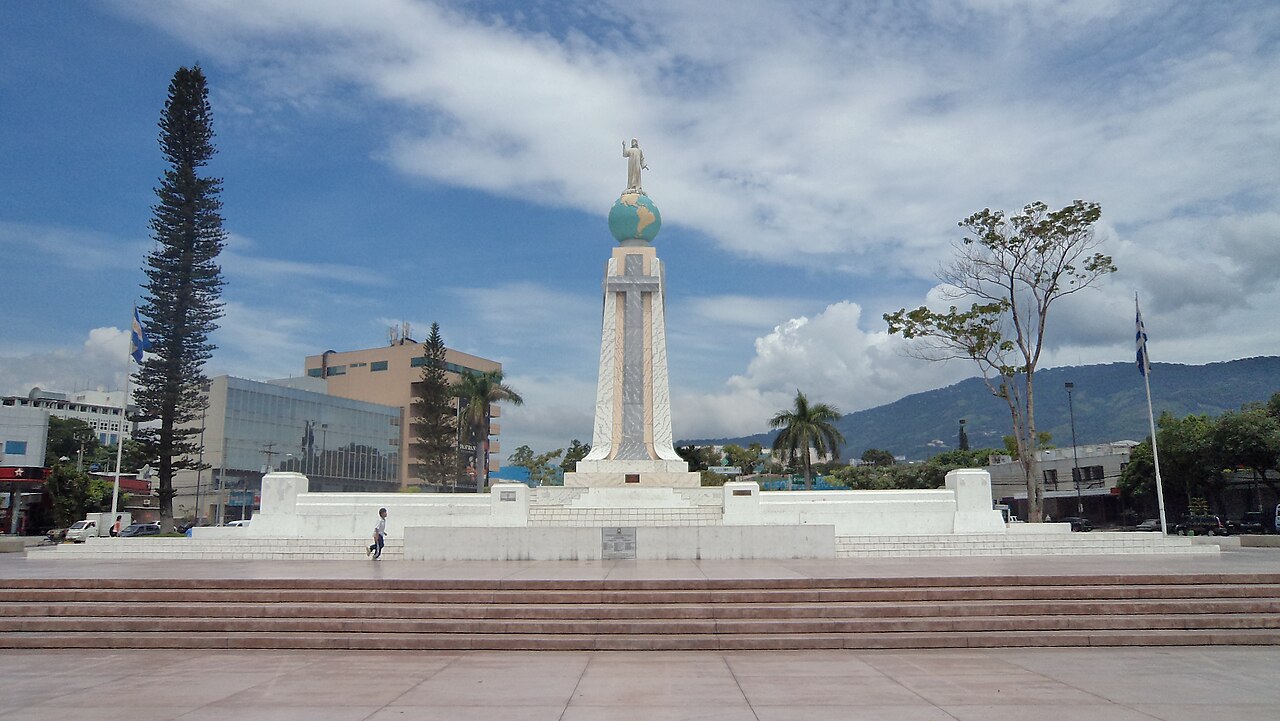
The cathedral was finally completed on 19 March 1999. Its façade was covered in bright ceramic tiles by the Salvadoran artist Fernando Llort. In December 2012 the archbishop had all 2,700 tiles chipped off without consulting the artist, and the decision caused an outcry. Romero's tomb inside the cathedral draws pilgrims. John Paul II prayed there in 1983 and 1996, and Barack Obama visited in March 2011. Pope Francis beatified Romero in 2015 and canonised him on 14 October 2018. Above the main altar is an image of the Divine Saviour that Charles V gave the city in 1546. Every August the Fiestas Agostinas honour that patron. The festival parade of floats traditionally sets out from the Monumento al Divino Salvador del Mundo, a statue of Christ standing on a globe, dedicated in 1942 and rebuilt after the 1986 earthquake.
The city's religious life has always been broader than one church. About 3,500 Jews live in San Salvador. During the Second World War the Salvadoran consul in Geneva, José Castellanos Contreras, issued Salvadoran nationality papers that helped save up to 40,000 Central European Jews. Palestinian Christian families arrived mostly between 1910 and 1925. Evangelical and Pentecostal churches have grown fast, and the Latter-day Saints opened a temple in 2011.
Trade: Coffee Quintals, the 2001 Dollar and the 2021 Bitcoin Law
Coffee built San Salvador. By 1880 it was almost the country's only export crop. For much of the next century it earned more than half of all export revenue, and the best land was concentrated in the hands of the so-called Fourteen Families. The palace tax is one sign of how closely the capital's growth depended on the harvest. Coffee revenue peaked in 1980 at more than $615 million. The civil war then cut investment, and by 2002 coffee made up only 3.5 percent of the country's output.
San Salvador today runs on services and money sent from abroad. On 1 January 2001 the Monetary Integration Law made the US dollar legal tender at 8.75 colones to the dollar. By 2004 the colón had stopped circulating. Remittances from Salvadorans abroad, mainly in the United States, reached nearly $6 billion in 2019, around 20 percent of GDP. On 9 June 2021 the Legislative Assembly passed a law making bitcoin legal tender, the first country in the world to do so. Research found that few people actually used it. After the government agreed to scale back its bitcoin policy in a 2024 deal with the International Monetary Fund, bitcoin lost its legal-tender status in February 2025.
The money flows unevenly. The metropolitan area covers about 3 percent of the national territory but receives about 70 percent of public and private investment. Banks cluster along the Alameda Manuel Enrique Araujo in District Two. Office towers, including the World Trade Center, have gone up in Colonia Escalón and San Benito in District Three, and retail groups such as Unicomer and Almacenes Simán keep their head offices in the city.
Daily Life in the Valle de las Hamacas, Under the San Salvador Volcano
The Spanish called the valley the Valley of the Hammocks because the ground here rarely stays still. The San Salvador volcano, also called Quezaltepeque or El Boquerón, looms over the western districts. Part of the city is built on its lower slopes. On the evening of 7 June 1917 two earthquakes, of magnitude 6.7 and 6.3, struck about fifteen minutes apart, causing heavy destruction and about 1,050 deaths. The volcano then erupted, but its lava flowed away down the far side. On 10 October 1986 a shallow magnitude 5.7 earthquake struck directly under the capital. It killed between 1,000 and 1,500 people and left about 200,000 homeless. The children's hospital and a market were among the buildings badly damaged or destroyed. Lake Ilopango, a 72-square-kilometre caldera on the eastern edge of the metro area, last erupted in 1880.
The weather follows two seasons. The dry season runs from November to April, and from November to February seasonal winds cool the city to a daily mean of about 22 °C. April and May are the hottest months, with highs of about 32 °C. From May to October thunderstorms roll in almost every afternoon and clear by morning. The historic centre has been reshaped more than once. In 1986 Mayor José Antonio Morales Ehrlich closed downtown streets to make a pedestrian mall. From 2009 Mayor Norman Quijano moved the street vendors into new market buildings as part of a plan to restore the centre, and the move set off riots. The city has also hosted the Central American and Caribbean Games three times, in 1935, 2002 and 2023, and the Miss Universe pageant in 1975 and 2023. For the volcanoes, coast and river basins beyond the capital, see our overview of El Salvador's geography. To place the city among its neighbours, our count of how many countries are in Central America covers all seven capitals of the isthmus.
Quick Facts About San Salvador
- Country: El Salvador
- Continent: North America (Central America)
- Country population: approximately 6.4 million
- Capital city status: San Salvador is the capital of El Salvador, the seat of national government, and the location of foreign embassies, parliament, and the head of state's official residence.
Frequently Asked Questions
What is the capital of El Salvador?
The capital of El Salvador is San Salvador. San Salvador is the seat of national government, hosts most foreign embassies and consulates, and is typically where the head of state and parliament are located.
What continent is San Salvador in?
San Salvador, the capital of El Salvador, is located in North America, in the Central America region. As El Salvador's capital, San Salvador serves as the country's primary connection to the broader North American political, economic, and cultural sphere.
Why is San Salvador the capital of El Salvador?
San Salvador was chosen as the capital of El Salvador for reasons that typically combine geography, history, and politics. Capital city selections often reflect a desire for centrality (being accessible from across the country), historical importance (being a longstanding seat of government or culture), or neutrality (being acceptable to multiple regions or ethnic groups within the country). The specific reasons for San Salvador's designation are detailed in the city's history above.
What is San Salvador known for?
As the capital of El Salvador, San Salvador is best known for housing the country's central government institutions — parliament, presidential or royal residences, supreme court, and key ministries. It is also typically a major cultural and economic center within El Salvador, hosting national museums, embassies, and signature monuments. The introduction and history sections above provide detailed coverage of the city's specific notable institutions and landmarks.
Related Pages
- El Salvador Country Guide — full geography, climate, economy, and culture overview
- Flag of El Salvador — meaning, history, and design of El Salvador's national flag