
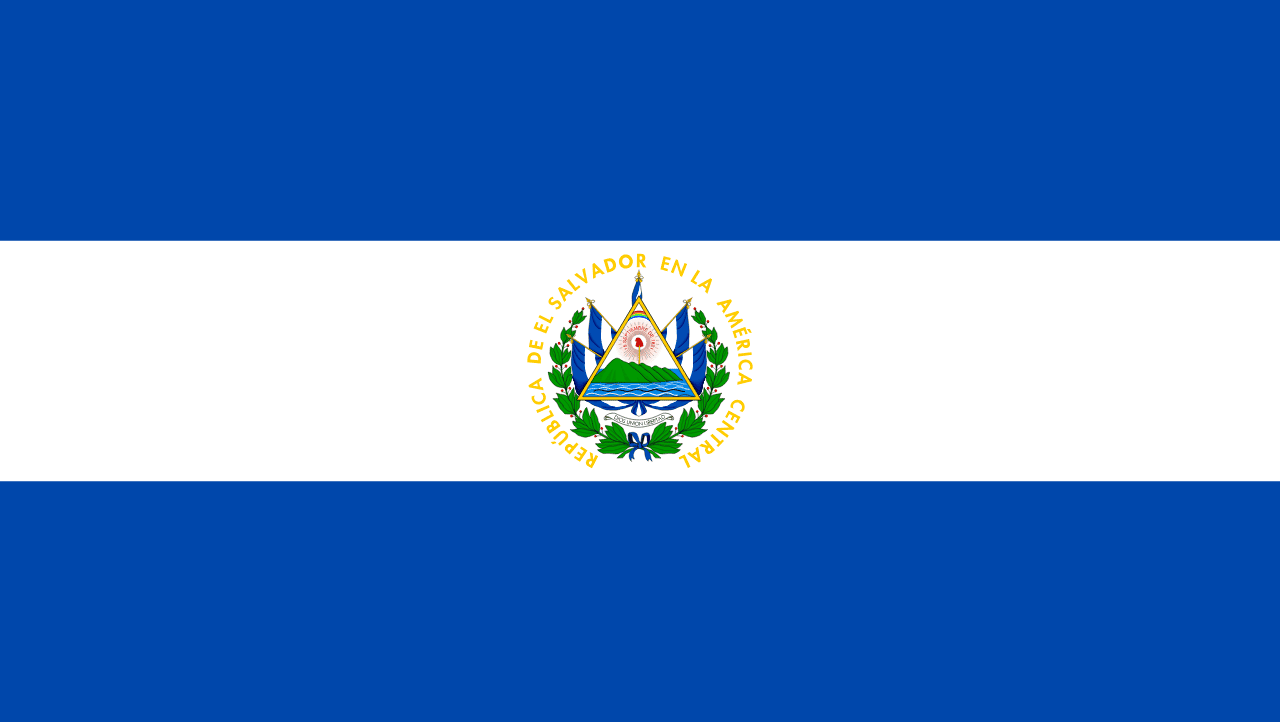
Hang the flag of El Salvador beside a few of its neighbors and you might do a double-take. Two bands of cobalt blue framing a strip of white, with a busy emblem in the middle, it belongs to a family of banners born from a single shared idea: that the small republics of Central America once stood together. El Salvador's version, formalized in 1972, carries that lineage proudly while telling a story all its own about volcanoes, oceans, and the stubborn ideal of liberty.
For a country roughly the size of a small U.S. state, the flag punches well above its weight in symbolism. Every element, from the precise shade of blue to the Latin words tucked inside a triangle, was chosen to anchor a young nation's sense of itself. Let's unpack what those choices mean and where they came from.
A Banner of Blue, White, and Gold
The flag is a horizontal triband: a blue stripe on top, white in the middle, and blue again at the bottom, with all three bands of equal height. At the heart of the white band sits the national coat of arms, rendered largely in gold and earthy tones, which gives the design its third signature color.
The two blues are doing double duty. They evoke the sea and the sky, the Pacific Ocean that washes El Salvador's southern coast and the open heavens above it. White, the calm center, stands for peace, harmony, and the well-being of the people. Gold appears chiefly through the emblem, lending the whole composition a flash of warmth against the cool blue. The combination is clean and immediately readable, even from a distance, which is part of why it has endured for decades.
Reading the Coat of Arms
What sets El Salvador's flag apart from plainer blue-and-white tricolors is the coat of arms in the center, and it rewards close inspection. The emblem is shaped as a triangle, an old symbol of equality and the three branches of government. Inside it rise five volcanoes, a nod both to the country's dramatic, fire-forged landscape and to the five states that once formed the Central American federation.
Above the volcanoes glows a red Phrygian cap, the classic emblem of liberty, often set on a staff and ringed by rays of light. A rainbow arcs over the scene, and the date 15 de Septiembre de 1821, the day Central America declared independence from Spain, anchors the composition. Encircling the triangle is the country's name and the motto that locals know by heart, while branches and banners frame the whole device. It is a dense little painting, far more narrative than the flag's simple stripes alone would suggest.
From Federation to a Flag of Its Own
El Salvador's flag did not appear out of nowhere. Its roots reach back to the United Provinces of Central America, the short-lived federation of the 1820s and 1830s that bound together the region after independence from Spain. That union flew a blue-white-blue tricolor, and when the federation dissolved, several of its former members kept the palette as a tribute to a shared past.
El Salvador experimented with other designs through the nineteenth century, including a period when it flew a striped, star-spangled banner reminiscent of other flags of the era. But the country eventually returned to the federation-inspired blue and white, the design that felt most authentically Central American. The modern flag, with its current proportions and the coat of arms in the form recognized today, was formally adopted in 1972, cementing a look that had effectively defined the nation for generations.
A Family Resemblance Across Central America
If El Salvador's flag looks familiar, that's no accident. Nicaragua, Honduras, and Guatemala all draw on the same blue-and-white federation heritage, and at a glance the four can be hard to tell apart. The shared palette is a deliberate echo of the old union rather than coincidence.
The distinguishing details live in the center. Honduras places five blue stars in the white band, with no full coat of arms. Nicaragua's emblem features a triangle with volcanoes and a rainbow much like El Salvador's, but its blues lean lighter and its arrangement differs. Guatemala turns the bands vertical and centers a quetzal bird with crossed rifles and swords. El Salvador's claim to distinction is its particular triangle, its five volcanoes rising from the sea, the September 1821 date, and the gold-toned circular inscription wrapping the device. Argentina, also blue and white but with a golden sun, sometimes gets mixed in too, though its origins are entirely separate. To learn more about the nation behind the banner, see our el salvador country guide.
What the Flag Means to Salvadorans
Beyond its formal symbolism, the flag functions as shorthand for national identity. The blue stripes and gilded triangle show up on government buildings, school walls, official documents, and the jerseys of athletes representing the country abroad. For the large Salvadoran diaspora, especially communities in the United States, the flag is a touchstone of home, flown at festivals and parades that celebrate Central American heritage.
The motto that rings the coat of arms, Dios, Unión, Libertad ("God, Union, Liberty"), captures the values the flag is meant to broadcast: faith, the unity once embodied by the federation, and the hard-won freedom from colonial rule. Those three words appear again and again in civic life, a verbal companion to the visual emblem.
The Flag in Everyday and Ceremonial Life
The flag reaches its highest visibility each September 15, Independence Day, when the streets fill with blue and white for parades, school processions, and band performances marking the 1821 break from Spanish rule, the same date stitched into the emblem. Throughout the year it presides over civic ceremonies, raised at dawn and lowered at dusk at official sites with appropriate respect.
In sport, the colors travel with the national football team and other competitors, turning stadiums into seas of blue whenever El Salvador takes the field. The flag also appears in subtler everyday forms, on license plates, in classrooms where children learn its meaning, and in the logos of national institutions, ensuring that even citizens who rarely think about vexillology absorb its imagery from an early age.
Quick Facts Worth Knowing
- El Salvador is the smallest country in Central America by land area, yet it carries one of the region's most detailed emblems.
- The five volcanoes in the coat of arms double as a tribute to the five original members of the Central American federation.
- The motto Dios, Unión, Libertad is woven directly into the national arms.
- The blue-white-blue scheme traces straight back to the United Provinces of Central America of the 1820s.
- El Salvador sits in Central America, on the southwestern, Pacific-facing edge of the North American continent.
- The current flag's official form dates to 1972, though its design ethos is far older.
Frequently Asked Questions
When was the flag of El Salvador adopted?
The modern flag was formally adopted in 1972. Its blue-and-white design, however, reflects a much older tradition that goes back to the Central American federation of the early nineteenth century, so the 1972 act standardized a look the country had long embraced rather than inventing something new.
What do the colors of the El Salvador flag mean?
The two blue bands represent the sea and the sky, the Pacific Ocean and the heavens above the country. The white band in the middle stands for peace and harmony. Gold, seen in the central coat of arms, adds warmth and highlights the emblem's volcanoes and inscription.
Who designed the El Salvador flag?
The flag was not the work of a single famous designer but evolved from the shared blue-and-white banner of the United Provinces of Central America. After experimenting with other designs in the 1800s, El Salvador returned to this federation-inspired palette, and the version codified in 1972 is the one used today.
What continent is El Salvador on, and how does its flag compare to others?
El Salvador lies in Central America, part of the North American continent, with a coastline on the Pacific. Its flag closely resembles those of Honduras, Nicaragua, and Guatemala because all share the federation's blue-and-white scheme. El Salvador stands out through its central triangle, five volcanoes, the date 15 September 1821, and its gold-rimmed coat of arms.