
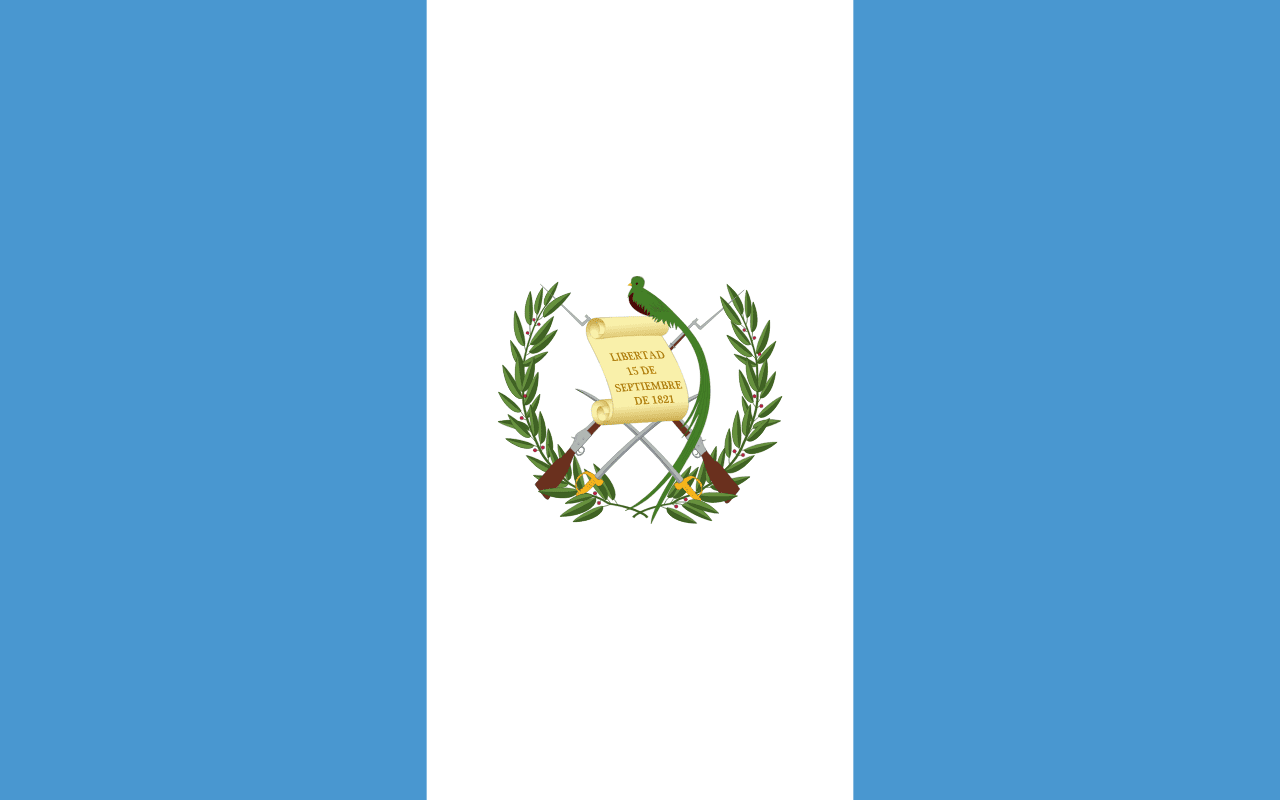
Among the flags of Central America, Guatemala's stands out for the cool serenity of its sky-blue and white stripes, broken in the center by an emblem dense with national meaning. Where many neighboring nations stack their colors in horizontal bands, Guatemala chose vertical stripes, giving its banner a distinctive upright posture that has flown over the country since the early 1870s. It is a flag that rewards a second look: at a glance it reads as a calm pairing of two colors, but at its heart sits a coat of arms crowded with rifles, swords, laurel, an unfurled scroll, and a brilliant green bird that has become shorthand for the nation itself.
A Quiet Palette With a Loud Center
The Guatemalan flag uses just two colors, blue and white, arranged in three equal vertical bands. The two outer stripes are a clear, light blue often described as sky blue, while the central stripe is white. This restrained two-color scheme is deliberate. The blue is meant to evoke the two bodies of water that frame the country: the Pacific Ocean to the southwest and the Caribbean Sea to the northeast. In this reading, Guatemala sits as a strip of land cradled between two stretches of blue water, an image the flag turns into geography you can hang from a pole.
The white center carries a gentler idea. It stands for peace and purity, the open space at the heart of the design suggesting cleanliness of purpose and the calm aspiration of a young republic. The choice to place the emblem on white rather than on color is not incidental either; the pale background lets the detailed coat of arms read clearly, so that the most symbolically loaded part of the flag is also the easiest to see.
Reading the Coat of Arms
The element that makes Guatemala's flag unmistakable is the coat of arms set in the white central band. Its centerpiece is the quetzal, a long-tailed bird whose vivid green plumage made it sacred to pre-Columbian peoples of the region. On the flag the quetzal symbolizes liberty — a fitting choice, since the bird was traditionally believed to be unable to live in captivity. The quetzal is also Guatemala's national bird, and its name even attaches to the national currency, so the creature appears in daily life far beyond the flagpole.
Around and beneath the bird the emblem assembles several other motifs. A scroll bears a date marking independence from Spain, framing the flag's symbolism in the country's founding moment. Crossed rifles and swords speak to the willingness to defend that freedom, while laurel branches signal victory and honor. Together these elements turn the calm two-tone field into a compact statement of values: independence won, peace sought, liberty embodied by a bird that will not be caged.
How the Design Came Together
Guatemala's flag, in the form recognized today, dates to 1871, when it was adopted during a period of liberal political reform. But its roots run deeper, into the shared history of the region. After independence from Spain, much of Central America joined together as the United Provinces (later the Federal Republic) of Central America, and that union flew a blue-white-blue banner. When the federation dissolved and its members went their separate ways, several of the new nations carried forward versions of those colors.
Guatemala did exactly that, modifying the old Central American flag for its own use. The most visible change was orientation: rather than the federation's horizontal bands, Guatemala set its blue and white in vertical stripes, and it placed a national coat of arms at the center to mark the flag as its own. The result is a banner that honors a shared regional heritage while clearly asserting a distinct national identity. The 1871 design has remained remarkably stable, with only refinements to the emblem over the following decades.
Family Resemblances and Key Differences
Because so many Central American states descend from the same federal flag, the region's banners form an unmistakable family. The flags of El Salvador, Honduras, and Nicaragua all use blue and white in horizontal bands, a direct inheritance from the United Provinces. A traveler glancing quickly might lump Guatemala in with them, but two features set it apart at once.
First is the vertical arrangement. While its neighbors kept the horizontal blue-white-blue layout, Guatemala rotated the stripes to stand upright, which alone is enough to distinguish it in a lineup of regional flags. Second is the quetzal-centered coat of arms, which differs sharply from the emblems used elsewhere — Honduras features a cluster of stars, Nicaragua a triangle with a rainbow and volcanoes, El Salvador a similar volcanic triangle. No other national flag puts the resplendent quetzal at its heart, so even where the colors overlap, Guatemala's central device is uniquely its own. For a fuller picture of the country behind the flag, see our guatemala country guide.
A Symbol of Belonging
Within Guatemala, the flag functions as a daily reminder of nationhood across a country of striking diversity, where Spanish sits alongside more than twenty Mayan languages. The banner appears in schoolyards, on government buildings, and at civic ceremonies, and its imagery is woven tightly into national pride. The quetzal in particular has escaped the confines of the emblem to become a free-standing emblem of the country, turning up on coins, in branding, and in the everyday language of identity.
The flag's symbolism also reinforces a national self-image built around independence and resilience. By literally placing liberty — the quetzal — at its center and surrounding it with the laurel of honor and the date of independence, the flag tells a compressed origin story every time it is raised. It is less a decorative banner than a visual creed.
The Flag in Modern Guatemala
In contemporary life the flag is everywhere you would expect a national symbol to be. It is hoisted for Independence Day celebrations in September, displayed during civic and patriotic observances, and carried by Guatemalan athletes and supporters at international sporting events, where the sky-blue and white become an instantly recognizable cheering color. Guatemala sits in North America, in the Central American isthmus, and across that region its vertical blue-and-white stands out among the horizontally striped flags of its neighbors.
A few notable points to remember about the flag:
- It uses only two colors, blue and white, in three equal vertical bands.
- The blue represents the Pacific Ocean and the Caribbean Sea on either side of the country.
- The white stripe symbolizes peace and purity.
- The central coat of arms features the quetzal, a symbol of liberty and the national bird.
- The current design dates to 1871 and is adapted from the old Central American federation flag.
- Its vertical stripes distinguish it from the horizontal flags of El Salvador, Honduras, and Nicaragua.
Frequently Asked Questions
When was the flag of Guatemala adopted?
The flag in its modern form was adopted in 1871, during a period of liberal reform. While the emblem at its center has been refined over the years, the basic blue-white-blue vertical design has remained in place since then.
What do the colors of the Guatemalan flag mean?
The blue stripes represent the two seas that border the country, the Pacific Ocean and the Caribbean Sea, while the white central stripe stands for peace and purity. The quetzal bird in the coat of arms represents liberty.
What continent is Guatemala on?
Guatemala is in North America, specifically within the Central American isthmus. It shares borders with Mexico, Belize, Honduras, and El Salvador, and its territory touches both the Pacific and Caribbean coasts.
How does Guatemala's flag compare to other Central American flags?
It shares the blue-and-white palette of El Salvador, Honduras, and Nicaragua because all descend from the flag of the United Provinces of Central America. Guatemala distinguishes itself with vertical stripes instead of horizontal bands and a unique central coat of arms featuring the quetzal, found on no other national flag.