
Few national banners pack as much visual information into a single rectangle as the flag of Belize. Where many countries opt for clean bands of two or three colors, Belize chose abundance: a deep blue field framed by red, anchored by a detailed coat of arms bursting with figures, tools, and a flourishing tree. The result is one of the most intricate state flags on Earth, and a design that tells the story of a young Central American nation the moment you look closely. Adopted in 1981 as the country stepped out of British colonial rule, this flag is less a tidy emblem than a crowded, confident portrait of who Belizeans are.
A Flag Born at Independence
Belize raised this flag for the first time in 1981, the year it became fully independent from Britain. For decades the territory had been known as British Honduras, governed as a colony on the Caribbean coast of Central America. As independence approached, the country needed a symbol that belonged to Belizeans rather than to a distant crown, and the flag that emerged was designed to capture the national mood at that pivotal moment. Unlike flags imposed from above, this one grew out of the political life of the country itself, and its colors carry the fingerprints of the parties that shaped the road to self-government.
The timing matters. Many former British territories adopted spare, modern designs at independence, sweeping away colonial imagery in favor of bold simplicity. Belize went the other way, keeping a richly illustrated coat of arms at its heart. That choice gives the flag a slightly older, more heraldic feel, even though as a national symbol it is younger than many people assume.
The Colors and What They Stand For
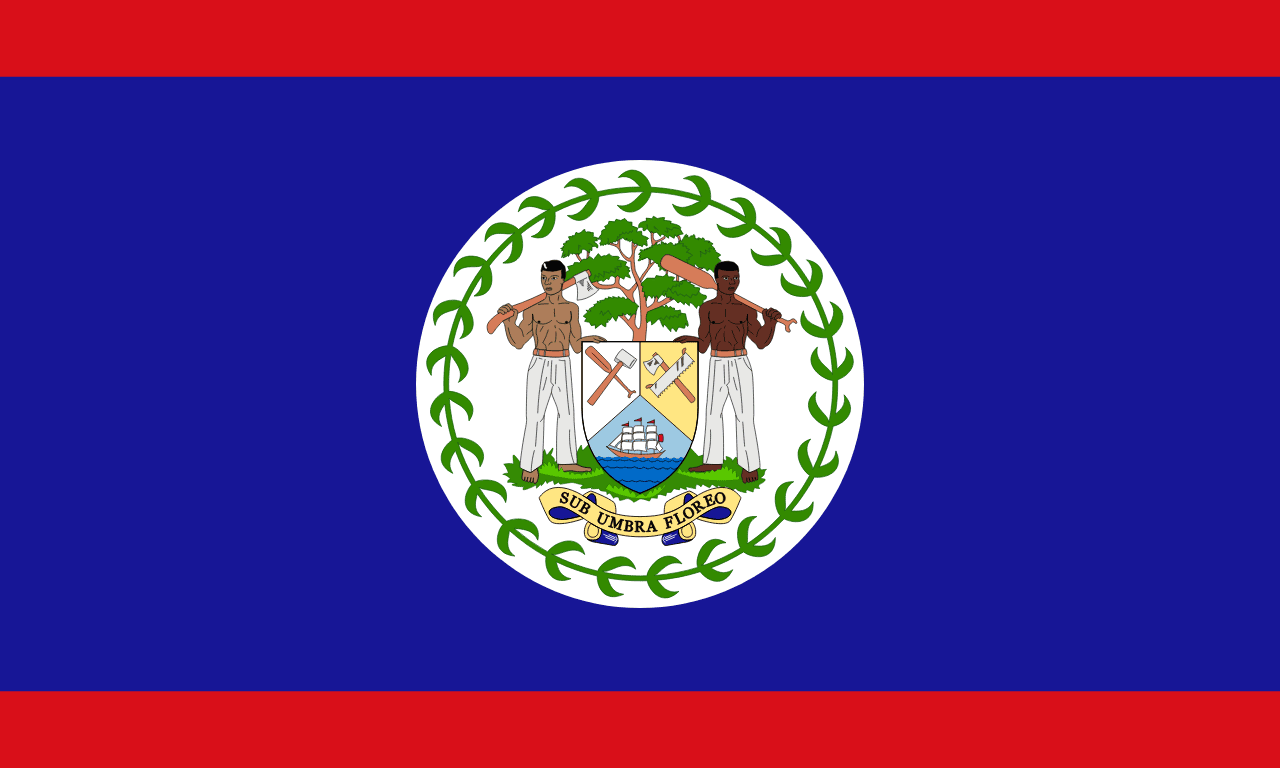
The flag uses three colors, and in Belize the politics behind them is unusually transparent. The dominant blue field is associated with the People's United Party, the movement that led the long campaign for independence. The two horizontal red stripes running along the top and bottom edges represent the United Democratic Party, the country's other major political force. Folding both parties' colors into a single national flag was a deliberate gesture of unity, a way of saying that independence belonged to all Belizeans rather than to one faction.
The third color, white, appears in the large central disc that holds the coat of arms, providing a clean background against which the emblem's many details can be read. Together blue, red, and white give the flag a balanced, civic character: the calm expanse of blue steadied by red borders and brightened by a white medallion at its core.
Reading the Design and the Coat of Arms
The layout is straightforward to describe but dense to examine. A royal-blue field fills most of the flag, with a horizontal red stripe along the top edge and another along the bottom. Centered on the blue is a white circle, and inside that circle sits the national coat of arms, the most elaborate element of the entire design.
The coat of arms is where Belize's history and economy come alive. At its center stands a mahogany tree, a nod to the logging trade that drove the colonial economy and shaped settlement along the rivers and coast. The arms also show tools of that trade, and two human figures flank the shield, a detail that makes the Belizean flag one of the very few national flags in the world to depict people. A wreath of leaves encircles the emblem, and a motto ribbon completes the composition. Every component points back to land, labor, and the natural wealth that defined the region long before independence.
How It Compares to Other Flags
Set beside its neighbors, the Belizean flag stands apart. The other nations of Central America largely share a common palette of blue and white inherited from the old Federal Republic of Central America, so Guatemala, Honduras, Nicaragua, El Salvador, and Costa Rica all read as variations on a theme. Belize, with its blue-and-red scheme and central medallion, looks like none of them, a visual reminder that its colonial heritage was British rather than Spanish.
What truly distinguishes the flag, though, is its sheer chromatic richness. Because the coat of arms is rendered in full color, the flag contains far more hues than the usual two or three, and it is frequently cited as having more colors than almost any other national flag. Where most countries reduce their identity to a handful of bold shapes, Belize embraces detail, putting trees, tools, figures, and foliage on display. If you are exploring the wider history and geography behind the symbol, the belize country guide fills in the national context the flag only hints at.
Cultural Significance and National Identity
For Belizeans, the flag is more than a chart of party colors. The decision to blend the emblems of rival political movements speaks to a small, diverse nation determined to define itself on its own terms after generations of colonial administration. The mahogany tree at the center is especially resonant, linking modern Belize to the forests and waterways that sustained earlier generations and to the laborers, including the descendants of enslaved Africans, whose work built the colony's wealth.
That layered meaning gives the flag an emotional weight beyond decoration. It is a document of how Belize came to be: a place shaped by the timber trade, by Caribbean and Central American currents, and by a hard-won political consensus that all of its people share in the country's future.
The Flag in Modern Life
Today the flag is woven into Belizean public life. It flies over government buildings, schools, and ceremonies, and it takes center stage during the September Celebrations, the patriotic season that runs into Independence Day on the twenty-first of that month. During these weeks the blue-red-and-white appears on everything from buildings to clothing as the country marks both its independence and the earlier Battle of St. George's Caye.
The flag also represents Belize abroad, carried by athletes at regional and international competitions and raised at diplomatic posts and cultural events. Because its design is so distinctive, it is instantly recognizable to anyone who has seen it once, a quiet advantage for a small nation seeking to stand out on the world stage.
Interesting Facts About the Flag of Belize
- It is widely regarded as one of the most colorful national flags in the world, thanks to its full-color coat of arms.
- It is one of only a handful of national flags to feature human figures in its design.
- The blue and red colors come directly from the country's two major political parties, the People's United Party and the United Democratic Party.
- A mahogany tree sits at the heart of the coat of arms, honoring the timber trade that shaped Belize's economy.
- The flag was first hoisted in 1981, the year Belize gained independence from Britain.
- Belize's blue-and-red scheme sets it apart from the blue-and-white flags common among its Central American neighbors.
Frequently Asked Questions
When was the flag of Belize adopted?
The flag was adopted in 1981, the same year Belize achieved full independence from Britain after a long period as the colony of British Honduras. It replaced colonial-era symbols with a design rooted in the country's own political life.
What do the colors of the Belize flag mean?
Blue is associated with the People's United Party, which led the independence movement, while red represents the United Democratic Party. White forms the disc behind the coat of arms. Combining both parties' colors was a deliberate symbol of national unity.
What is shown in the coat of arms?
The coat of arms features a mahogany tree at its center, tools tied to the historic logging trade, two human figures flanking the shield, and a surrounding wreath with a motto ribbon. It celebrates the land, labor, and natural wealth of Belize.
What continent is Belize on, and how does its flag compare to nearby flags?
Belize sits on the Caribbean coast of Central America, part of the North American continent. Unlike the blue-and-white flags shared by many of its Spanish-influenced neighbors, Belize's blue-and-red design with a detailed central emblem reflects its distinct British colonial heritage.