
Few national emblems carry their geography quite as openly as the flag of Honduras. At first glance it looks like a calm horizontal band of two blue stripes wrapped around a white center, but step closer and you find five blue stars arranged across that white field, each one standing in for a nation that once shared a single dream of unity. This is a flag that remembers something larger than the country it represents today, and that quiet ambition is what makes it worth a longer look. Adopted in its modern form in 1949, the Honduran flag distills sea, sky, peace, and a regional brotherhood into one of Central America's most recognizable banners.
A First Look at the Stripes and Stars
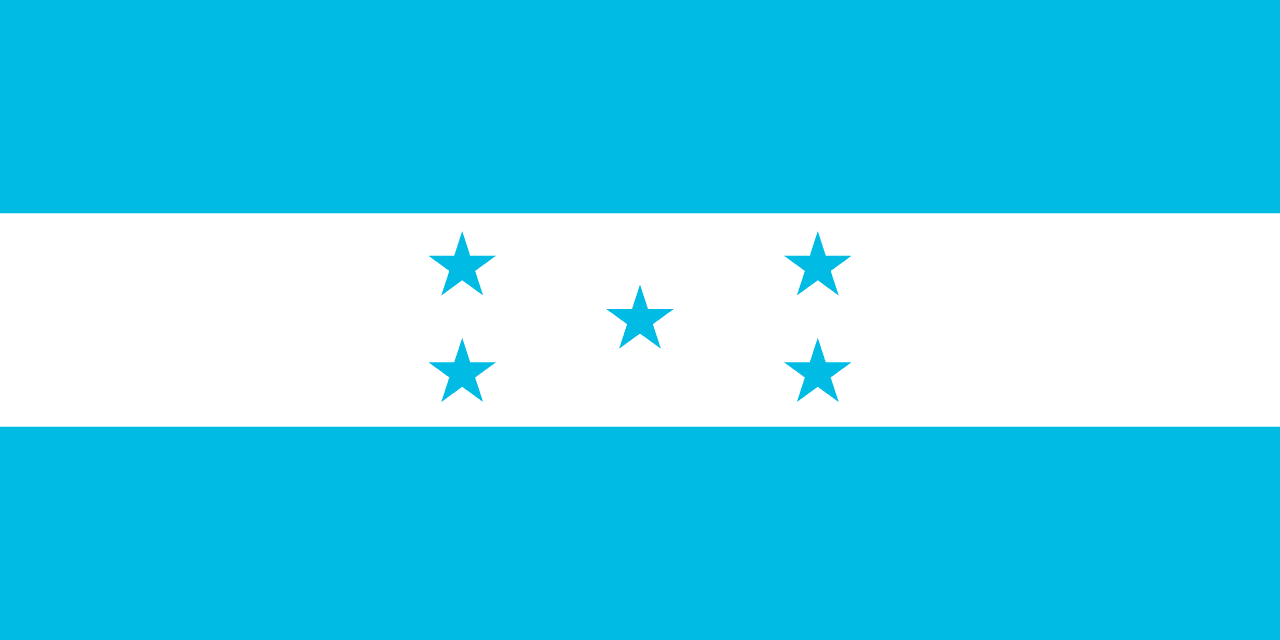
The Honduran flag is a horizontal triband: a blue stripe on top, a white stripe in the middle, and a blue stripe on the bottom, each occupying an equal third of the flag's height. Centered on the white band are five blue, five-pointed stars. They are usually shown in an X-like or quincunx arrangement, with one star in the middle and four around it, though they are sometimes drawn in a simple horizontal row. The palette is deliberately restrained, just two colors, and that simplicity gives the design a clean, almost luminous quality that reads well from a distance and translates easily onto everything from official seals to schoolbooks.
What the Blue and White Mean
The symbolism of the Honduras flag is rooted in both landscape and aspiration. The two blue stripes are commonly understood to represent the sea and the sky, a fitting tribute for a country that touches both the Caribbean Sea and the Pacific Ocean. Some interpretations frame the upper and lower blue bands as the two oceans that frame Central America, reinforcing the maritime theme. The white stripe in the center stands for peace, and in broader readings, for the purity, prosperity, and harmony the nation hopes to uphold.
The five stars are the most distinctive element. They represent the five nations of the former Federal Republic of Central America: Honduras, Guatemala, El Salvador, Nicaragua, and Costa Rica. Their presence is not merely decorative. They encode a political memory and an enduring hope, the wish that these republics might one day be reunited under a common banner. In this sense the flag is forward-looking even as it honors the past.
How the Design Came Together
To understand the flag, you have to understand the federation it descends from. After gaining independence from Spain in the early nineteenth century, several Central American provinces joined together as the Federal Republic of Central America. That federation flew a blue-white-blue tricolor, and when it dissolved into separate sovereign states, its former members carried that color scheme forward into their own national flags. Honduras was one of them, which is why its banner is built on the same foundation as those of its neighbors.
The defining Honduran touch came later. To set their flag apart and to declare their loyalty to the federal ideal, Hondurans added the five blue stars to the white central stripe. The arrangement and tone of the flag were standardized over the years, and the version recognized as the modern national flag dates to 1949. That date marks not the birth of the design but the moment its details, including the shade of the stars and their placement, were settled into the form flown today.
Honduras Among Its Look-Alike Neighbors
If you have ever confused the flags of Central America, you are in good company. Because Honduras, El Salvador, and Nicaragua all inherited the blue-white-blue federal tricolor, their flags can look nearly identical at a quick glance. The differences live in the center. Honduras places five blue stars on its white band, a feature none of its siblings share in the same way. El Salvador and Nicaragua both carry a central coat of arms instead, while Guatemala broke from the horizontal format entirely, turning its stripes vertical and shifting to a lighter sky-blue.
So the quickest way to identify the Honduran flag is to count the stars. Five blue points scattered across a white field, with no elaborate emblem or motto crowding the center, is the signature look. The relative plainness of the design, compared with the detailed crests of some neighbors, is itself a clue. For travelers wanting deeper context on the nation behind the banner, the honduras country guide offers a broader picture of the land these stars celebrate.
A Banner Woven Into National Identity
For Hondurans, the flag is more than a state symbol; it is a fixture of daily and ceremonial life. Schoolchildren learn its meaning early, and the colors appear in patriotic songs, civic murals, and public celebrations. The blue and white have become shorthand for the country itself, instantly evoking Honduras whether printed on a passport, stitched onto a uniform, or painted across a stadium crowd.
The flag's link to Central American unity also gives it a layer of meaning that purely national emblems lack. Every time the five stars are displayed, they restate a quiet promise about cooperation among neighbors. That regional dimension is part of what makes Hondurans feel connected to a story bigger than their own borders, a shared heritage rather than an isolated national myth.
The Flag in Modern Life
Today the flag turns up wherever national feeling runs high. Independence Day in mid-September brings parades, marching bands, and seas of blue and white through towns across the country. The colors travel with Honduran sports teams, most visibly the national football side, whose supporters drape themselves in the flag at home and abroad. Government buildings, embassies, and schools fly it as a matter of routine, and Honduran communities living overseas raise it to stay connected to home.
Because the design is so clean, it adapts effortlessly to modern uses, from digital emoji to merchandise to social media avatars during big national moments. The five-star motif, in particular, has become a compact emblem that Hondurans can deploy on its own as a kind of visual signature.
Quick Facts Worth Knowing
- The flag uses only two colors, blue and white, in a horizontal triband.
- The five stars stand for the five members of the former Federal Republic of Central America.
- The blue stripes evoke the sea and sky; the white stripe represents peace.
- The modern standardized version dates to 1949.
- The design descends directly from the blue-white-blue federal flag of Central America.
- Counting the stars is the easiest way to tell the Honduran flag from those of El Salvador and Nicaragua.
- The stars symbolize a hoped-for reunited Central America, making the flag both historical and aspirational.
Frequently Asked Questions
When was the flag of Honduras adopted?
The modern national flag of Honduras was adopted in 1949. While the blue-white-blue color scheme reaches back to the era of the Federal Republic of Central America in the nineteenth century, the specific standardized design flown today, including the shade and arrangement of the five stars, was established in 1949.
What do the colors and stars of the Honduran flag mean?
The two blue stripes represent the sea and the sky, often read as the oceans that border Central America, while the white central stripe stands for peace. The five blue stars symbolize the five nations of the former Central American federation, Honduras, Guatemala, El Salvador, Nicaragua, and Costa Rica, and express the hope of one day reuniting them.
Why does the flag of Honduras look so similar to other flags?
Honduras shares its blue-white-blue palette with El Salvador and Nicaragua because all three descend from the flag of the Federal Republic of Central America. The distinguishing feature of the Honduran flag is the cluster of five blue stars on the white stripe, where its neighbors place a coat of arms instead. Guatemala, by contrast, uses vertical stripes and a lighter blue.
What continent is Honduras on?
Honduras is located in Central America, which is part of the continent of North America. It sits between Guatemala, El Salvador, and Nicaragua, with coastlines on both the Caribbean Sea and the Pacific Ocean, a dual maritime setting echoed in the flag's twin blue stripes.
