
Few national flags pack as much symbolic weight into so simple a shape as the banner of Costa Rica. At first glance it is a tidy arrangement of horizontal bands in blue, white, and red, the kind of palette you find echoed across the democracies of the world. Look a little closer, though, and the proportions tell their own story: the central red stripe is deliberately broader than its neighbors, and resting within it sits a coat of arms crowded with mountains, ships, and a rising sun. This is a flag built to be read, a small painting of a country that has spent much of its modern history insisting on peace while its volcanoes quietly remind everyone who is really in charge.
A Flag You Can Read at a Glance
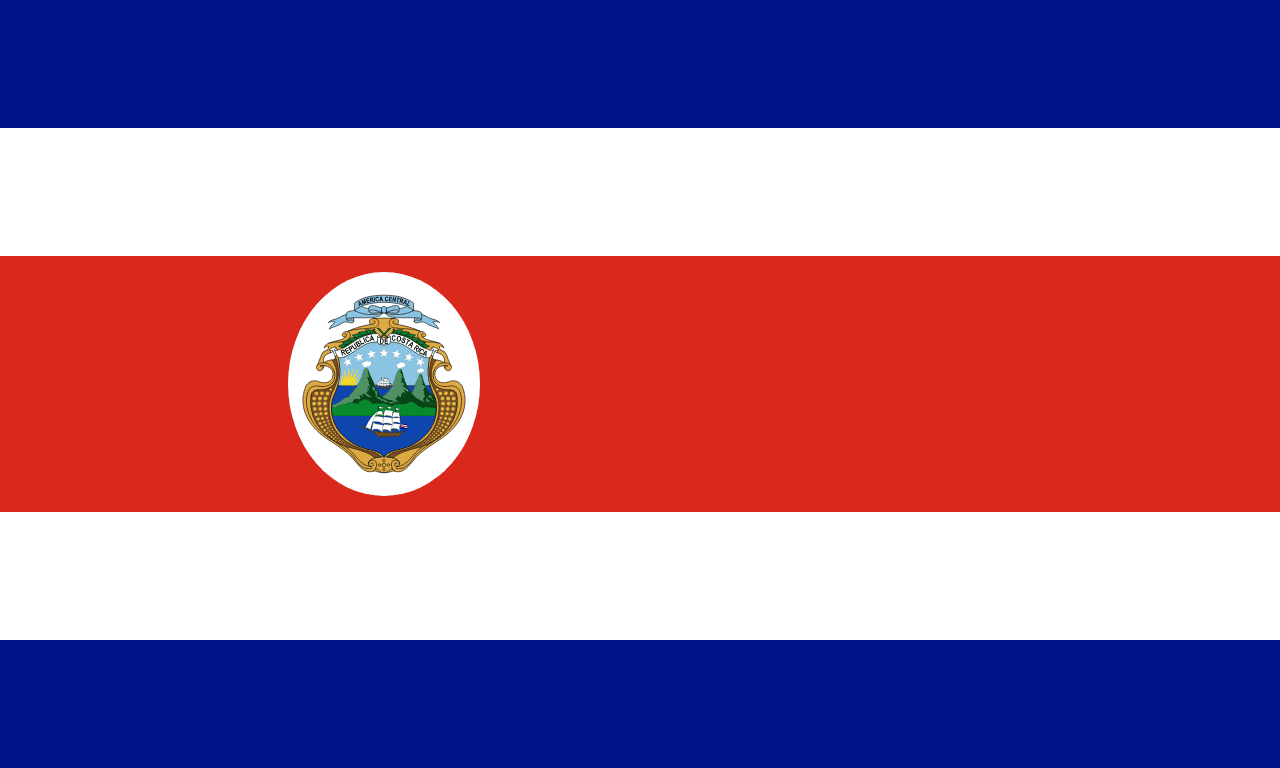
The Costa Rican flag is composed of five horizontal stripes. From top to bottom they run blue, white, red, white, and blue, with the red band in the middle counting as the widest of the five. The two white stripes and two blue stripes are of equal, narrower width, which gives the design a satisfying symmetry broken only by that emphatic red center. Toward the hoist side of the red stripe, set within a white oval, is the national coat of arms, the detail that separates the state and civic versions of the flag from the simpler version used by ordinary citizens. The overall effect is balanced but not bland, formal but instantly recognizable.
What the Colors Are Saying
Each color carries a meaning that Costa Ricans learn young. The blue stands for the sky that arches over the country, and by extension for opportunity, perseverance, and the heavens that protect the nation. The white represents peace, wisdom, and the clear conscience of a people, an especially resonant idea in a country that famously abolished its standing army in 1948. The red, broadest and most commanding, honors the warmth and generosity of the Costa Rican people and, in the older patriotic reading, the blood of those who fought and died for the country's freedom. Together the three colors give the flag both a heavenly canopy of blue and white and an earthly, human heart of red at its core.
The Coat of Arms in the Middle
The emblem tucked into the red stripe is where the flag stops being abstract and starts narrating geography. Its centerpiece is a chain of volcanoes set in a green valley between two oceans, the Pacific and the Caribbean, each represented by a stretch of water carrying a merchant ship. Those three volcanoes are the flag's most-cited detail and a nod to the dramatic spine of mountains that defines the country's interior. Above the landscape a rising sun signals prosperity, while a band of stars across the top of the shield has, over the years, grown to reflect the country's provinces. The whole device is framed by coffee branches or sprigs, a quiet tribute to the crop that built much of the national economy and that, for generations, was the country's economic lifeblood. There is a deliberate logic to the layout: the oceans on either side acknowledge that Costa Rica is one of the few nations touched by two great bodies of water, while the central volcanoes insist that the heart of the country is its rugged, fertile highlands. Because this detailed emblem only appears on official and civic flags, the everyday tricolor most tourists photograph on a beach is the plainer, armless version, which makes the appearance of the coat of arms a small signal that you are looking at the state in its formal dress.
How the Design Came Together
The flag's roots reach back to the turbulence of the early nineteenth century and, more specifically, to the imagery of the French Revolution. When Costa Rica was finding its footing as an independent state, the revolutionary tricolor of blue, white, and red offered an attractive template for a young republic eager to align itself with liberal, democratic ideals. The red stripe was added to a previously blue-and-white scheme in 1848, transforming a Central American banner into something that consciously echoed France's own colors. The version of the flag with the coat of arms in its modern form was established in 1906, fixing the design that, with only minor refinements to the emblem, Costa Ricans still raise today. That long continuity is itself part of the flag's appeal: it has changed remarkably little for well over a century, and the only meaningful revisions have been small adjustments to the coat of arms rather than wholesale redesigns. In an age when many nations have reinvented their banners several times over, Costa Rica's steadiness reflects a political culture that prizes stability and gradual reform over rupture.
Look-Alikes and Close Cousins
Blue, white, and red is one of the most popular flag combinations on earth, so Costa Rica's banner inevitably invites comparison. Visually, its five-stripe layout most resembles the flag of Thailand, which uses the same blue-white-red-white-blue arrangement, though Thailand's central stripe is blue rather than red and it carries no emblem. The shared French inheritance also links Costa Rica spiritually to France, the Netherlands, and a host of other tricolors, even though none of those use horizontal stripes in quite this proportion. What sets the Costa Rican flag apart is the combination of that broad red middle band with the detailed, geography-rich coat of arms. No other national flag tells you, in a single glance, that this is a narrow isthmus of volcanoes wedged between two seas. The emblem turns a generic palette into something unmistakably local.
The Flag in National Life
For a country that traded its army for schools and national parks, the flag does a lot of patriotic heavy lifting. It flies over civic ceremonies, appears at Independence Day celebrations every September, and travels with the national football team, the Sele, to World Cups and regional tournaments where fans drape it across stadiums. School children parade with it, and its colors turn up on everything from coffee packaging to surf-shop signs along both coasts. Because the simple tricolor is free for any citizen to fly while the armed version is reserved for the state, the flag also quietly encodes the country's distinction between the people and their institutions. If you are planning a trip and want the fuller picture of the nation behind the banner, the costa rica country guide is a good next stop.
Quick Facts Worth Knowing
- The flag has five horizontal stripes in the order blue, white, red, white, blue, with the red stripe the widest.
- Its current design with the coat of arms dates to 1906.
- The red stripe was added in 1848, inspired by the colors of the French Revolution.
- The coat of arms famously depicts three volcanoes between two oceans, complete with merchant ships.
- The plain version without the emblem is used by ordinary citizens; the version with the coat of arms is official.
- Costa Rica sits in Central America, part of the North American continent.
Frequently Asked Questions
When was the Costa Rican flag adopted?
The modern flag, including its coat of arms in essentially the form used today, was adopted in 1906. The red stripe that gives the flag its distinctive tricolor character had been added earlier, in 1848, when the country revised an older blue-and-white scheme.
What do the colors of the flag mean?
Blue represents the sky, along with ideals such as opportunity and perseverance. White stands for peace, wisdom, and a clear conscience. Red, the broad central band, symbolizes the warmth of the people and the blood of those who fought for the nation's freedom.
Who designed the Costa Rican flag?
The red-white-blue scheme drew its inspiration from the French Revolution, and the 1848 redesign is traditionally associated with the influence of Pacífica Fernández, the first lady of the time. Rather than crediting a single artist, Costa Ricans generally treat the flag as a national creation shaped over the nineteenth century.
What continent is Costa Rica on, and which flags look similar?
Costa Rica lies in Central America, on the North American continent, bridging the Pacific and Caribbean. Its closest visual cousin is the flag of Thailand, which shares the five-stripe layout, though Thailand's central band is blue and carries no emblem, while Costa Rica's red center and volcano-filled coat of arms make it unique.
