

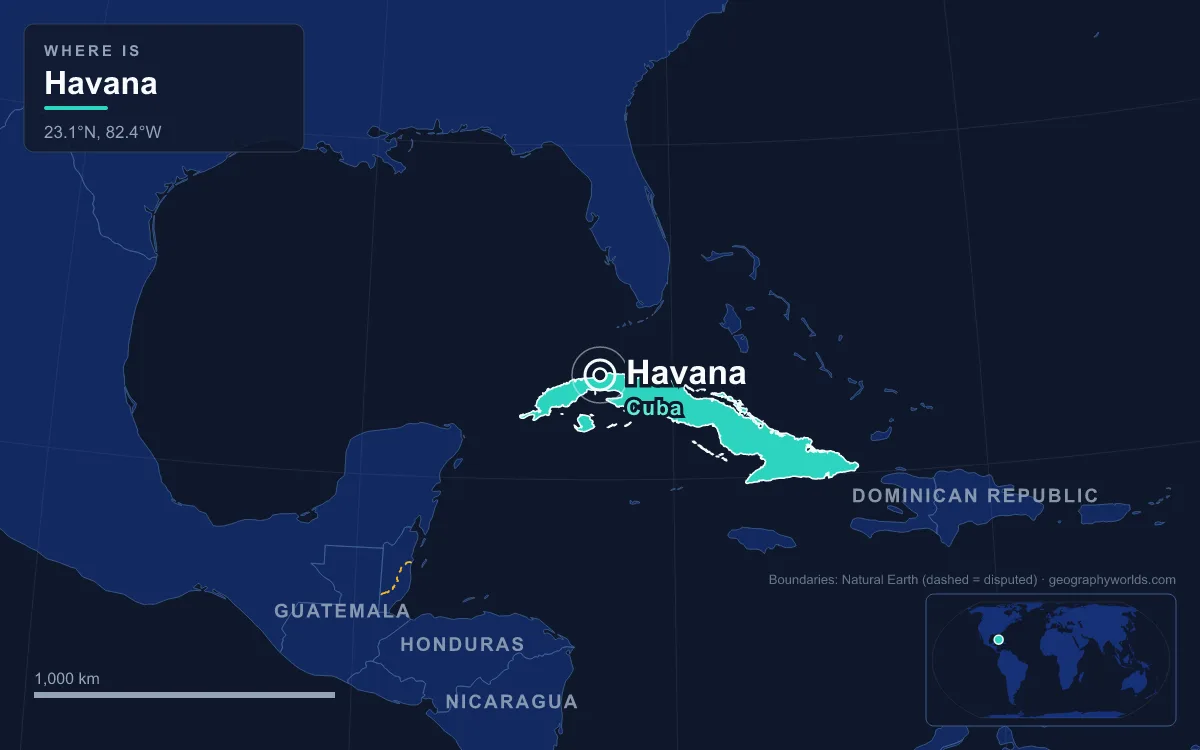
Havana (La Habana) is the capital and largest city of Cuba, spread west and south of a deep, narrow-mouthed bay on the island’s northwest coast, facing the Straits of Florida. The 2021 count put 2,142,939 people in its 728 km² city-province, though the official figure had fallen to about 1.75 million by the end of 2024. What defines Havana is that harbour: it is why the Spanish moved the town there in 1519, why they made it the island’s capital in 1552, and why so much of the city’s story reads as a sequence of eras built around guarding, trading through and finally looking out from that bay.
Puerto de Carenas, 1514–1555: A Town Moves to Its Harbour
Havana did not start where it stands. Diego Velázquez de Cuéllar founded San Cristóbal de la Habana in 1514 on the opposite, southern coast, near the mouth of the Mayabeque River where the town of Batabanó is today, some 69 km south of the present city. The land was low and swampy and the settlement failed. Colonists shifted north, first to La Chorrera at the mouth of the Almendares River (ground that later became the Vedado and Miramar districts), and then in 1519 to the shore of a sheltered anchorage the Spanish called Puerto de Carenas, the “careening port”, where ships could be hauled over and scraped. The Old Havana municipality dates that final founding to 16 November 1519.
The name may come from Habaguanex, a Taíno chief of the area about whom almost nothing else is recorded. The deciding factor was the bay itself. Entered through a slim channel and widening inside into three basins, it gave Havana a harbour that Santiago de Cuba, the colonial capital in the east, could not match. By the middle of the century Havana had overtaken Santiago, and it is usually dated as the island’s capital from 1552, although some accounts keep Santiago as the seat of the colony until 1589.
Fortress of the Fleets, 1555–1762
A port that rich was also a target. In 1555 the French corsair Jacques de Sores took Havana with little resistance and burned much of it. The Crown answered with stone. Work on the Castillo de la Real Fuerza began in 1558, the first stones went down in 1562, and the fort was finished in 1577; it is considered the oldest stone fort in the Americas, although it sat too far inside the bay to be much use and became the governor’s residence instead. The real guard went up on the far side of the channel: the Castillo de los Tres Reyes del Morro, designed by the Italian engineer Battista Antonelli and begun in 1589, with a chain strung across the harbour mouth to a smaller fort at La Punta.
Behind those walls Havana became the assembly point for the treasure fleets. Ships from across Spain’s American empire gathered in the bay before crossing the Atlantic, and supplying them with food, water and repairs built the city’s farms and workshops. Philip II granted Havana the title of city on 20 December 1592. Growth was uneven: a yellow fever epidemic carried from Cartagena in 1649 killed about a third of the population. Construction of a ring of city walls began in 1674 and was completed by 1740, the same year by which Havana had become Spain’s largest and most active shipyard and the only drydock in the New World. By the mid-18th century the city had more than 70,000 inhabitants, the third-largest in the Americas behind Lima and Mexico City and ahead of Boston and New York.

British Havana and the Bourbon Rebuild, 1762–1800
The fortifications failed their biggest test. On 6 June 1762, during the Seven Years’ War, a Royal Navy force escorting some 160 troopships appeared off the coast and landed a force of over 11,000 men east of the city. The Morro stood on rock that could not be trenched, but it was overlooked by a hill the Spanish governor had neglected to fortify. British batteries were placed there, the fortress fell after its commander Luis Vicente de Velasco was mortally wounded, and the city surrendered before the hurricane season could drive the fleet away.
British occupation lasted until February 1763 and opened Havana to trade with Britain’s North American and Caribbean colonies. Under the Treaty of Paris, Spain got the city back and ceded Florida in exchange. Madrid then made Havana the most heavily fortified city in the Americas. The Fortress of San Carlos de la Cabaña was built on the very ridge the British had used, and was completed in 1774. In the old town, the baroque cathedral facing the Plaza de la Catedral was built between 1748 and 1777 and consecrated in 1782; from 1796 until 1898 it held what were believed to be the remains of Christopher Columbus, brought from Santo Domingo.
Paris of the Antilles, 1800–1898
Sugar and North American trade made 19th-century Havana wealthy enough to earn the nickname “Paris of the Antilles”. In 1837 a 51 km railway opened between Havana and Bejucal to carry sugar from the Güines valley to the port, making Cuba the seventh country in the world with a railway and the first in Latin America. The Tacón Theatre, forerunner of today’s Gran Teatro de La Habana, opened in the same era. In 1863 the colonial walls were knocked down so the city could expand beyond them, and the modern street pattern west of the old core began to take shape.
That prosperity rested on slavery, which remained legal in Cuba until 1886. The century ended with war: the explosion of the USS Maine in Havana harbour in 1898 became the immediate trigger of the Spanish–American War, which was the last phase of a Cuban independence struggle already three years old. On 12 August 1898 Spain gave up sovereignty over Cuba, ending its rule in the Americas.
Republican Capital, 1902–1958
Havana became capital of the independent Republic of Cuba in 1902, when Tomás Estrada Palma was inaugurated as the first president. The new state reshaped the waterfront. Construction of the Malecón, the seawall and boulevard that now runs for 8 km from the harbour mouth through Centro Habana and Vedado to the Almendares, began in 1901 under the temporary United States military government, and by 1923 it had reached K and L streets in Vedado. Vedado itself, laid out from 1860 and built up heavily between 1930 and 1960, became the modern city of hotels, offices and apartment blocks along Calle 23, known as La Rampa.
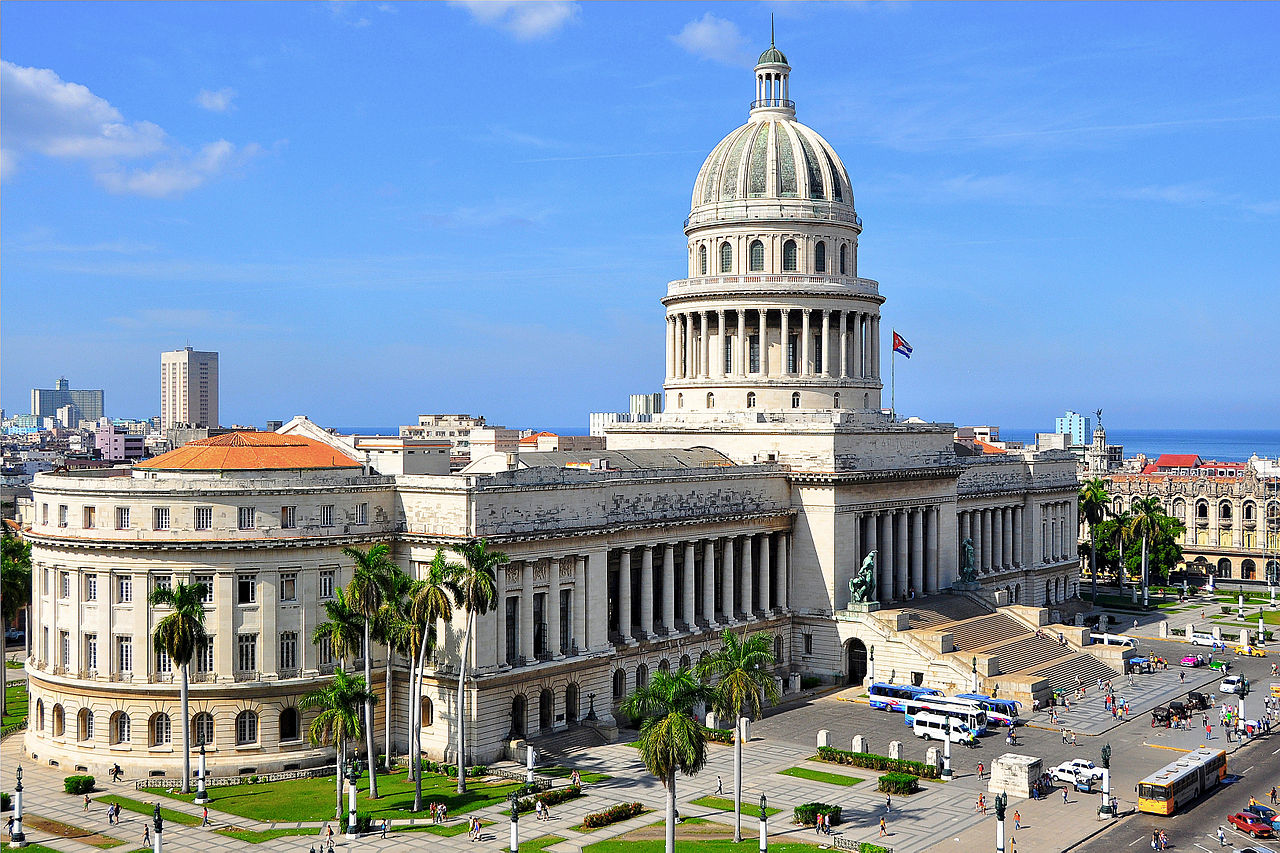
The republic’s great monument went up on the site of an old railway terminal. President Gerardo Machado commissioned El Capitolio, built from 1926 to 1929 by more than 5,000 workers at a cost of about 17 million dollars. It is 207 m long, and its stone-clad dome reaches almost 92 m, which made it the highest point in Havana until the 121 m FOCSA Building rose in Vedado in 1956. FOCSA then stayed the tallest building in Cuba for more than six decades, until Torre K in 2025. In July 1940 the city hosted the Havana Conference, where the United States and 20 Latin American countries agreed on the defence of European colonies in the Americas.
By the late 1950s Cuba had one of the highest GDPs per head in Latin America, but the wealth was concentrated in the capital: around 80% of the country’s hospital beds were in Havana, while the countryside outside it had a single rural hospital.
Revolution and the Special Period, 1959–2009
Fulgencio Batista fled on 1 January 1959. The columns of Che Guevara and Camilo Cienfuegos entered Havana within days, meeting no resistance on the road from Santa Clara, and Fidel Castro arrived on 8 January after a victory march across the island. The revolutionary government expropriated private property and industry; the United States imposed its embargo in 1960, and by 1968 almost every private business, down to small shops, had been nationalised. Housing and services were extended, but maintenance of the old building stock fell away, and many buildings in the old town fell into ruin in the decades that followed.
The 1976 constitution gave Havana the status of both a city and a province, run by a city-provincial council with little autonomy from the national government. When the Soviet Union collapsed in 1991, the subsidies that had supported Cuba vanished and the capital entered the years of shortages known as the Special Period. Restoration focused on Old Havana: the district, whose limits still follow the line of the demolished walls, was inscribed as a UNESCO World Heritage Site in 1982 together with its fortifications, and a campaign to restore its buildings began a year later (the story of that listing is told in our guide to Old Havana’s World Heritage site).
Havana Since 2010: Tourists, a Tornado and a Shrinking Count
Tourism now drives much of the city’s change. Havana received 1,176,627 international visitors in 2010, 20% more than in 2005, and foreign investors converted the nationalised Manzana de Gómez building into a five-star hotel. The dome of El Capitolio was unveiled after restoration in 2019. The same year brought a rare disaster: in January 2019 a tornado rated EF4 tore through the eastern side of the city, the first tornado of that strength recorded in Cuba since 1940. Hurricanes usually strike Cuba’s south coast, but Ian passed near Havana at hurricane strength in 2022.
The climate is tropical savanna, with average temperatures from about 22 °C in January and February to 28 °C in August and roughly 1,200 mm of rain a year, heaviest in June and October. The city is divided into 15 municipalities, from the dense colonial core to the suburbs of the south, and the bay still splits into the Marimelena, Guanabacoa and Atarés basins that first drew the Spanish here.
The recent fall in the official count mirrors the national picture: Cuba’s population peaked at about 11.2 million in 2012 and dipped below 10 million in 2025 for the first time since 1980, a loss of about 13% driven by low fertility and emigration. Our page on the population of Cuba sets out those figures. For how the capital fits into the rest of the island, from Pinar del Río to Santiago, continue with the Cuba country guide.
Quick Facts About Havana
- Country: Cuba
- Continent: North America (Caribbean)
- Country population: approximately 10.9 million
- Capital city status: Havana is the capital of Cuba, the seat of national government, and the location of foreign embassies, parliament, and the head of state's official residence.
Frequently Asked Questions
What is the capital of Cuba?
The capital of Cuba is Havana. Havana is the seat of national government, hosts most foreign embassies and consulates, and is typically where the head of state and parliament are located.
What continent is Havana in?
Havana, the capital of Cuba, is located in North America, in the Caribbean region. As Cuba's capital, Havana serves as the country's primary connection to the broader North American political, economic, and cultural sphere.
Why is Havana the capital of Cuba?
Havana was chosen as the capital of Cuba for reasons that typically combine geography, history, and politics. Capital city selections often reflect a desire for centrality (being accessible from across the country), historical importance (being a longstanding seat of government or culture), or neutrality (being acceptable to multiple regions or ethnic groups within the country). The specific reasons for Havana's designation are detailed in the city's history above.
What is Havana known for?
As the capital of Cuba, Havana is best known for housing the country's central government institutions — parliament, presidential or royal residences, supreme court, and key ministries. It is also typically a major cultural and economic center within Cuba, hosting national museums, embassies, and signature monuments. The introduction and history sections above provide detailed coverage of the city's specific notable institutions and landmarks.
Related Pages
- Cuba Country Guide — full geography, climate, economy, and culture overview
- Flag of Cuba — meaning, history, and design of Cuba's national flag