

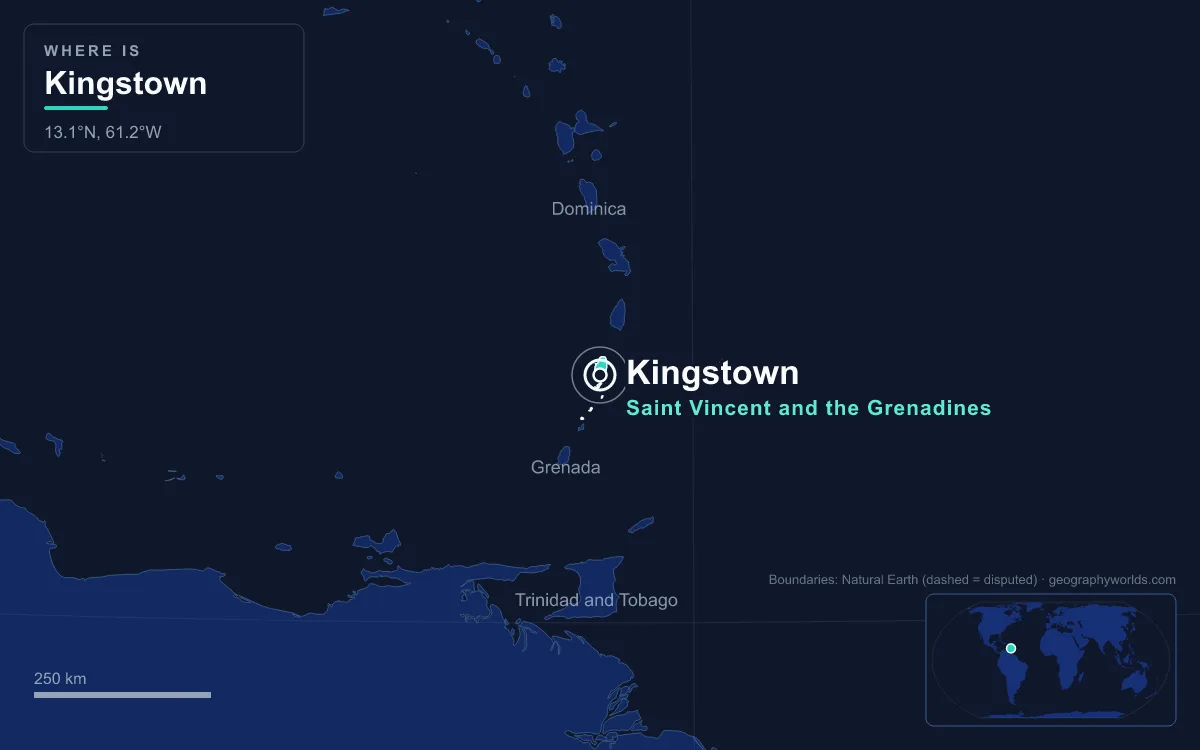
The capital of Saint Vincent and the Grenadines is Kingstown, a harbour town of 12,909 people (2012) in the parish of Saint George, at the southwest corner of the main island of Saint Vincent. It is the country’s largest settlement, its main port and commercial centre, and the seat of government for a nation of about 110,000 people spread across Saint Vincent and the northern two-thirds of the Grenadines chain. Kingstown is squeezed onto a narrow strip of flat land around its bay, with steep hills rising on every landward side, and it holds a botanic garden founded in 1765 that is described as the oldest in the Western Hemisphere.
Power on the Hills: Fort Charlotte, Dorsetshire Hill and the Garifuna Wars
Kingstown was founded by French settlers shortly after 1722, but the island’s history as a colony is mostly British. Britain took Saint Vincent from France in the Seven Years’ War, a transfer confirmed by the Treaty of Paris in 1763, and began fortifying the heights above the new capital. The real contest for power, though, was not with France. It was with the Garifuna, an Afro-Indigenous people descended from Africans and the Kalinago, who opposed the British presence and the spread of plantations.
In the First Carib War of 1772 to 1773, the Garifuna under their paramount chief Joseph Chatoyer forced the British to sign a treaty, a rare concession in the 18th-century Caribbean. When fighting broke out again in 1795, Chatoyer, supported by French radicals inspired by the Revolution, worked his way along the coast towards Kingstown. On 12 March 1795 his forces took the fort on Dorsetshire Hill, just outside the town. Two nights later, on 14 March, British troops marched on the hill and Chatoyer was killed. The French forces supporting the rising surrendered in June 1796. The British then deported 4,195 Garifuna to the small Grenadine island of Baliceaux, where about half died of famine and disease, and in 1797 shipped the 2,248 survivors to Roatán off the coast of Honduras. Their descendants spread along the Caribbean coast of Central America, and Chatoyer’s monument now stands on Dorsetshire Hill. He was named the country’s first National Hero on 14 March 2002, and the date is kept as National Heroes Day.
The wars explain the odd design of Kingstown’s main fortress. Fort Charlotte, on Berkshire Hill just west of town at 601 feet (183 m) above the sea, was begun after 1763 and completed in 1806, with room for 600 troops and 34 guns. Because the French had invaded in 1779 by landing at Calliaqua rather than attacking the harbour, the British built it as a redoubt with many of its cannon pointing inland, towards threats from the island itself. Named after Queen Charlotte, wife of George III, the fort later served as a poor house, a leper colony, a mental hospital and a prison; its women’s prison closed only in 2015. Its lighthouse still guides ships into Kingstown Bay with three white flashes every 20 seconds, and on a clear day Grenada, about 90 miles south, is visible from the ramparts.
Power in Kingstown has since passed through the ballot box. Universal adult suffrage came in 1951, associated statehood on 27 October 1969, and full independence exactly ten years later, on 27 October 1979. The unicameral House of Assembly has 23 members, 15 of them elected. At the election of 27 November 2025, the New Democratic Party led by Godwin Friday won 14 of the 15 seats, forming its first government in nearly 25 years. Earlier that year the outgoing government had announced plans to rename places across the country, Kingstown included, as part of a decolonisation project.
Faith in Stone: St George’s and the Cathedral of the Assumption
Two cathedrals show the island’s colonial layers. St George’s Cathedral is the seat of the Anglican Diocese of the Windward Islands, created on 8 November 1877 for Saint Vincent, Grenada and Tobago. Saint Lucia joined it in 1899, and until 1927 the diocese shared its bishop with Barbados. The first full-time Bishop of the Windward Islands, Alfred Berkeley, took office that year, and the diocese’s cathedral church is St George’s in Kingstown, even though the bishop’s flock is spread across several countries.
The Catholic cathedral nearby is harder to miss. The Cathedral of Our Lady of the Assumption, also called St Mary’s, grew in stages from a first structure begun in 1823, and the present building was finished in the 1930s. It mixes Moorish, Romanesque, Byzantine, Venetian and Flemish elements in dark stone, with towers, turrets and pinnacles that contrast strongly with the rest of the town.

Until 1989 Kingstown shared a Catholic diocese with Bridgetown in Barbados. The church became co-cathedral of the Diocese of Bridgetown-Kingstown in 1971, and on 23 October 1989 Pope John Paul II split that diocese in two, making Kingstown a diocese of its own covering the whole country, with about 10,000 Catholics in six parishes. It answers to the Archdiocese of Castries, whose cathedral anchors the centre of Castries, capital of Saint Lucia, while its old partner is covered in our guide to Bridgetown, capital of Barbados.
Trade Through Kingstown Harbour: Arrowroot, Bananas and the Airport at Argyle
Kingstown exists to move goods on and off the island. It is the centre of Saint Vincent’s agricultural industry and the port through which the crops leave. For generations the most distinctive of them was arrowroot, a starch-producing root of which Saint Vincent is the world’s leading producer. In the 20th century bananas took over, coming to account for upwards of 60 percent of the workforce and about half of merchandise exports, helped by preferential access to European markets. When the European Union moved to phase out that preference, the country began to diversify, and in 1993 tourism overtook bananas as the main source of foreign exchange.
The harbour changed with the economy. New cruise ship and ferry berths came into service in 1996, sharply increasing passenger arrivals, and by 1998 total visitor arrivals had reached 202,109, most of them from other Caribbean islands and the United Kingdom. The Grenadines, whose largest inhabited islands are Bequia, Mustique, Canouan and Union Island, have become a favourite of the up-market yachting trade.
The biggest shift came in the air. For decades the country’s main airport was E. T. Joshua Airport at Arnos Vale, near Kingstown, which had reached saturation point with no physical space to expand. Construction of a replacement at Argyle, on the island’s southeast coast about 8.3 kilometres from the capital, began on 13 August 2008 with a team of Vincentian and Cuban workers. Argyle International Airport opened on 14 February 2017, five years later than first planned, with capacity for 1.5 million passengers a year, more than four times that of the old field. E. T. Joshua closed the same day, and the government announced plans to turn its terminal into a retail and entertainment centre.
Daily Life Around the 1765 Botanic Gardens
For all its port and politics, Kingstown is a small place, and it has been getting smaller. The town had about 3,000 people in 1825 and just over 5,000 by 1861, despite cholera and smallpox epidemics in the 1850s. By 1970 it had reached 17,117, but it then began to lose people to the suburbs spreading along the coast and up the hills. Between 1980 and 1991 the town’s population fell by 7.81 percent while its suburbs grew by 25.56 percent.
The town has also been shaped by disasters. A large fire in 1866 destroyed much of it and prompted plans for a piped water supply, completed in 1871. In April 2021 the La Soufrière volcano in the north of the island erupted explosively, forcing the evacuation of about 16,000 people, and ash and sulphur dioxide affected people across the island while electricity and water supplies were badly disrupted. Unrest has a long history too: in 1841 the arrest of three militiamen for firing celebratory shots set off a riot of 200 to 300 people that destroyed the police station.
The calmest place in town is the one it is best known for. The Botanic Gardens grew from an order of 15 December 1765 to set aside six acres for growing plants that might feed, heal or enrich the colonies, an idea pushed by General Robert Melville and the island surgeon Dr George Young. Surviving catalogues show the collection growing from 52 plant species in 1773 to 1,311 catalogued plants by 1806. The gardens’ best-known delivery arrived on 23 January 1793, when Captain William Bligh sailed into Kingstown aboard HMS Providence with breadfruit plants from Tahiti, completing the mission that the mutiny on the Bounty had wrecked four years earlier. A third-generation clone of one of Bligh’s breadfruit trees still grows in the gardens.

Today the gardens cover about 8 hectares and are among the most visited sites in the country. The Nicholas Wildlife Aviary Complex inside them runs a captive breeding programme for the Saint Vincent amazon, the vulnerable parrot that is the national bird. For the volcano, the Grenadines and the rest of the country beyond the capital, see our Saint Vincent and the Grenadines country guide.
Quick Facts About Kingstown
- Country: Saint Vincent And The Grenadines
- Continent: North America (Caribbean)
- Country population: approximately 99 thousand
- Capital city status: Kingstown is the capital of Saint Vincent And The Grenadines, the seat of national government, and the location of foreign embassies, parliament, and the head of state's official residence.
Frequently Asked Questions
What is the capital of Saint Vincent And The Grenadines?
The capital of Saint Vincent And The Grenadines is Kingstown. Kingstown is the seat of national government, hosts most foreign embassies and consulates, and is typically where the head of state and parliament are located.
What continent is Kingstown in?
Kingstown, the capital of Saint Vincent And The Grenadines, is located in North America, in the Caribbean region. As Saint Vincent And The Grenadines's capital, Kingstown serves as the country's primary connection to the broader North American political, economic, and cultural sphere.
Why is Kingstown the capital of Saint Vincent And The Grenadines?
Kingstown was chosen as the capital of Saint Vincent And The Grenadines for reasons that typically combine geography, history, and politics. Capital city selections often reflect a desire for centrality (being accessible from across the country), historical importance (being a longstanding seat of government or culture), or neutrality (being acceptable to multiple regions or ethnic groups within the country). The specific reasons for Kingstown's designation are detailed in the city's history above.
What is Kingstown known for?
As the capital of Saint Vincent And The Grenadines, Kingstown is best known for housing the country's central government institutions — parliament, presidential or royal residences, supreme court, and key ministries. It is also typically a major cultural and economic center within Saint Vincent And The Grenadines, hosting national museums, embassies, and signature monuments. The introduction and history sections above provide detailed coverage of the city's specific notable institutions and landmarks.
Related Pages
- Saint Vincent and the Grenadines Country Guide — full geography, climate, economy, and culture overview
- Flag of Saint Vincent and the Grenadines — meaning, history, and design of Saint Vincent and the Grenadines's national flag