

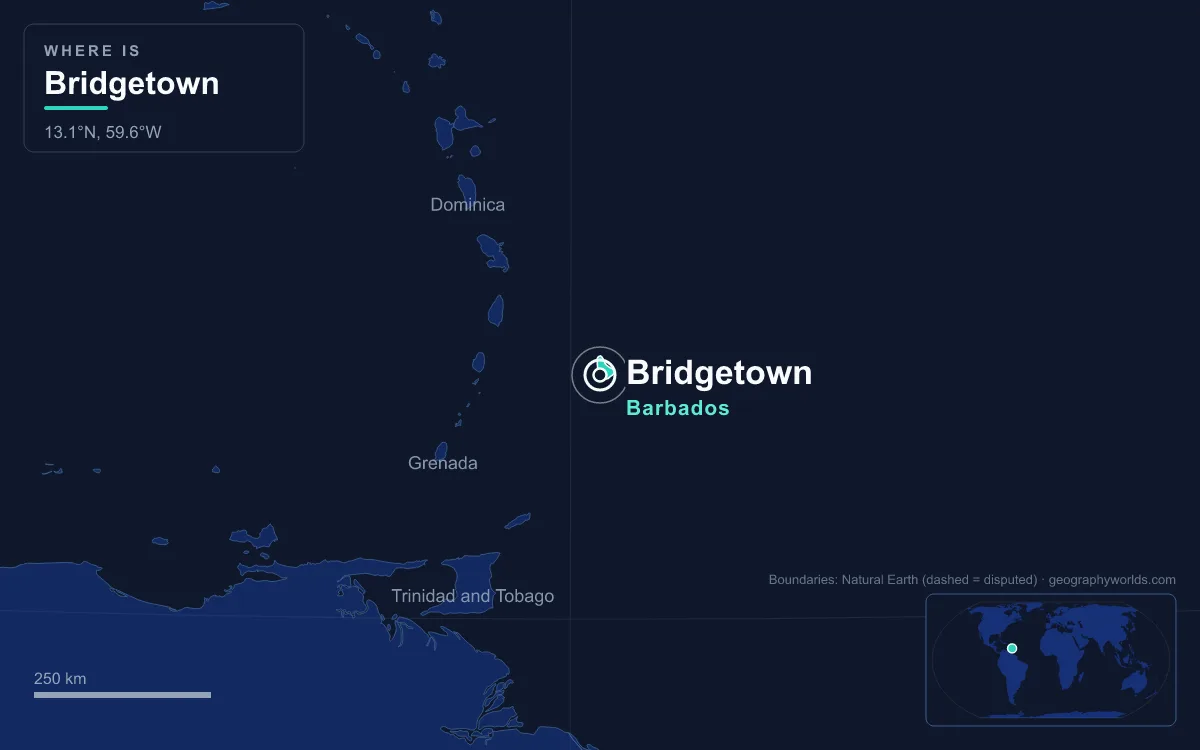
Bridgetown is the capital and largest city of Barbados, a port on Carlisle Bay on the island's sheltered southwest coast in the parish of Saint Michael. Its metropolitan area held roughly 110,000 people in 2014, well over a third of a country whose 2010 census counted 277,821 residents. English settlers laid out the present town in 1628 around a narrow tidal inlet called the Careenage, and the colonial town and military garrison that grew from it were listed by UNESCO as "Historic Bridgetown and its Garrison", a World Heritage Site, on 25 June 2011. A decade later, in 2021, the city became the capital of a republic.
Indian Bridge on the Careenage Swamp, 1628–1654
When the English arrived, Barbados was uninhabited. One of the few signs of earlier people was a rough bridge thrown across the swamp at the head of the Careenage, which the settlers credited to the Taino, a people who are thought to have been driven off the island to Saint Lucia by the Kalinago. The newcomers called the spot Indian Bridge, and the town's later name kept the bridge in it.
Settlement at the site began on 5 July 1628, when Charles Wolverstone landed with 64 settlers on land formally claimed by James Hay, Earl of Carlisle. Wolverstone was acting for a group of London merchants led by Sir Marmaduke Rawdon, who had been granted a lease of 10,000 acres by Carlisle to settle a debt, and he gave each settler 100 acres on the north side of the Careenage. Carlisle's agents claimed the southern shore at Needham's Point that October. An earlier settlement under Sir William Courten had been founded up the coast at St. James Town, but it was Carlisle's bay that became the colony's harbour. The House of Assembly first sat in 1639, which makes Barbados's parliament the third-oldest continuous parliament in the Commonwealth, though for more than two centuries it had no permanent home and on several occasions met in taverns and alehouses.
The town grew on the English market-town pattern, with narrow, winding streets and alleys rather than a grid, and much of its centre stands on swamp that had to be drained and filled. After 1654 a new bridge was built over the Careenage, and the settlement became the Town of Saint Michael, later Bridgetown, a name usually tied to Sir Tobias Bridge.
Sugar, Synagogue and Slavery on Carlisle Bay, 1640–1780
Sugar cane arrived from Dutch Brazil around 1640 and remade the island within a generation. Sephardic Jews who had lived in Dutch Brazil helped establish the crop, and about 300 Jews from Recife settled in Barbados in the 1660s. Their Nidhe Israel Synagogue, first built in 1654 on what is now Synagogue Lane, is one of the oldest synagogues in the Western Hemisphere.

The plantations needed labour on a vast scale, and Bridgetown was the port through which it was forced in. In 1644 Barbados had about 30,000 people, of whom only about 800 were of African descent. By 1660 the island had roughly 27,000 Black and 26,000 White inhabitants, and by 1666 at least 12,000 White smallholders had sold up, died or emigrated to Jamaica and the Carolinas. Between 1627 and 1807 an estimated 387,000 enslaved Africans were shipped to Barbados, and the slave code the colony passed influenced the laws of other colonies.
Bridgetown's position at the eastern edge of the Caribbean made it, for a time, the most important town in England's New World possessions. On 2 November 1751 a 19-year-old George Washington landed here with his half-brother Lawrence, who hoped the climate would ease his tuberculosis. George caught smallpox during the visit and sailed home on 22 December; it was the only time he ever left what became the United States. The plantation house they rented, a mile or so from town near the Garrison, reopened as the George Washington House museum in January 2007.
Hurricanes, Fires and a Cathedral City, 1780–1885
The Great Hurricane of 1780 struck Barbados on 10 October, probably at Category 5 strength, as the opening blow of the deadliest Atlantic storm on record, which killed an estimated 22,000 people across the Lesser Antilles. Half a century later the Great Barbados hurricane of 1831 laid the island waste again; it destroyed the 1654 synagogue, which the congregation rebuilt in the form it keeps today.
In between, the town gained its civic landmarks. On 22 March 1813 a bronze statue of Lord Nelson was unveiled in what was then Trafalgar Square, about 27 years before Nelson's Column went up in London; distances across Barbados were measured from its base. Bussa's rebellion of 14–16 April 1816, the largest slave revolt in the island's history, was put down by the militia, but it was the first of three late rebellions in the British West Indies that eroded support for slavery. The Emancipation Statue, popularly called Bussa's Statue, now stands on a roundabout east of the city.
Bridgetown's formal status rose in the same decades. When the Anglican Diocese of Barbados and the Leeward Islands was created in 1824, St Michael's parish church became a cathedral, making Bridgetown a city; royal letters patent in 1842 made the title official. From 1800 until 1885 the town was also the main seat of government for the British Windward Islands, until Barbados left that union and the seat moved to St. George's in Grenada. Fires in 1844 and 1860 cleared land in the centre, and the second blaze gave the government the site it wanted for a permanent legislature.
Gothic Parliament and the Deep Water Harbour, 1870–1961
The Public Buildings went up between 1870 and 1874 on the north bank of the Careenage, to a neo-Gothic design by John F. Bourne, the Superintendent of Public Works. Benjamin L. Harris built the west block for £13,750, finishing in late 1871; Richard F. Roberts won the east block with a tender of £11,750. Both chambers met there from 16 June 1874, and an Act of Parliament renamed the complex the Parliament Buildings in 1989.

The twentieth century brought the politics that would eventually take the flag down at the Garrison. Labour unrest in the 1930s led Britain to send the Moyne Commission in 1938, the year Grantley Adams helped found the Barbados Labour Party, and universal suffrage followed in 1950. On the waterfront the change was physical. Work on the Deep Water Harbour began in 1956 under Britain's Costain Group and finished in 1961 at a cost of EC$28 million, building a man-made isthmus out to the small former quarantine station of Pelican Island and creating about 90 acres of new land off Fontabelle.
A Mayor, a Federation and a Flag, 1958–1967
For a brief spell Bridgetown governed itself. A 1925 petition for a royal charter had failed, but the Local Government Act of 1958 gave the city a mayor, six aldermen and twelve councillors, four for each of three wards, and the College of Arms granted it a coat of arms on 20 September 1960. In the same years Barbados belonged to the West Indies Federation of 1958–1962, and Bridgetown was one of three cities considered for the federal capital.
Independence came on 30 November 1966, when the Union Flag was lowered and the Barbadian flag raised at the Garrison Historic Area, about 3.2 km south of the city centre, with Errol Barrow as the first prime minister. The civic experiment did not last: in April 1967 the local councils were dissolved, the Corporation of Bridgetown ceased to exist, and the city has been run directly by members of the national parliament ever since.
Heroes Square and the Republic, 1999–2021
Independent Barbados gradually renamed its colonial core. Trafalgar Square became National Heroes Square in April 1999, and in 2020 the Nelson statue was removed to the Barbados Museum. UNESCO's 2011 inscription took in the old town and the Garrison together: the Parliament Buildings, the synagogue and its 17th-century mikveh, uncovered by an archaeologist in 2008, and the George Washington House are all protected properties within the site.
The largest change came on 30 November 2021, the 55th anniversary of independence, when Barbados became a republic within the Commonwealth. Sandra Mason, until then the governor-general, was sworn in as the first president in the capital, with Prince Charles attending, and the singer Rihanna, born in the parish of Saint Michael, was named a National Hero at the same ceremony.
Broad Street, the Port and Kensington Oval Today
Modern Bridgetown is a financial and shipping centre as well as a seat of government. Broad Street runs through the middle past the Parliament Buildings and is the main shopping street; Swan Street parallels it to the north, and Bay Street leads south toward Christ Church. All seven of the island's main highways start near the city, and the Grantley Adams International Airport lies 16 km to the southeast. The Deep Water Harbour, dredged in 2002 so the largest cruise ships can berth, now handles roughly 700,000 cruise passengers and 900,000 tonnes of containerised cargo a year. From 2020 Parliament began sitting in rented venues elsewhere on the island, including the Worthing Corporate Centre, with no firm date set for its return to the Careenage.
West of the centre, Kensington Oval has hosted Test cricket since January 1930 and was rebuilt to hold the 2007 Cricket World Cup final. The University of the West Indies has its Cave Hill campus on a bluff north of the city. For the wider island around the capital, see our Barbados country guide; to set it beside its larger southern neighbour, try Trinidad and Tobago vs Barbados, and for the regional bloc Barbados helped found, read our guide to CARICOM.
Quick Facts About Bridgetown
- Country: Barbados
- Continent: North America (Caribbean)
- Country population: approximately 283 thousand
- Capital city status: Bridgetown is the capital of Barbados, the seat of national government, and the location of foreign embassies, parliament, and the head of state's official residence.
Frequently Asked Questions
What is the capital of Barbados?
The capital of Barbados is Bridgetown. Bridgetown is the seat of national government, hosts most foreign embassies and consulates, and is typically where the head of state and parliament are located.
What continent is Bridgetown in?
Bridgetown, the capital of Barbados, is located in North America, in the Caribbean region. As Barbados's capital, Bridgetown serves as the country's primary connection to the broader North American political, economic, and cultural sphere.
Why is Bridgetown the capital of Barbados?
Bridgetown was chosen as the capital of Barbados for reasons that typically combine geography, history, and politics. Capital city selections often reflect a desire for centrality (being accessible from across the country), historical importance (being a longstanding seat of government or culture), or neutrality (being acceptable to multiple regions or ethnic groups within the country). The specific reasons for Bridgetown's designation are detailed in the city's history above.
What is Bridgetown known for?
As the capital of Barbados, Bridgetown is best known for housing the country's central government institutions — parliament, presidential or royal residences, supreme court, and key ministries. It is also typically a major cultural and economic center within Barbados, hosting national museums, embassies, and signature monuments. The introduction and history sections above provide detailed coverage of the city's specific notable institutions and landmarks.
Related Pages
- Barbados Country Guide — full geography, climate, economy, and culture overview
- Flag of Barbados — meaning, history, and design of Barbados's national flag