
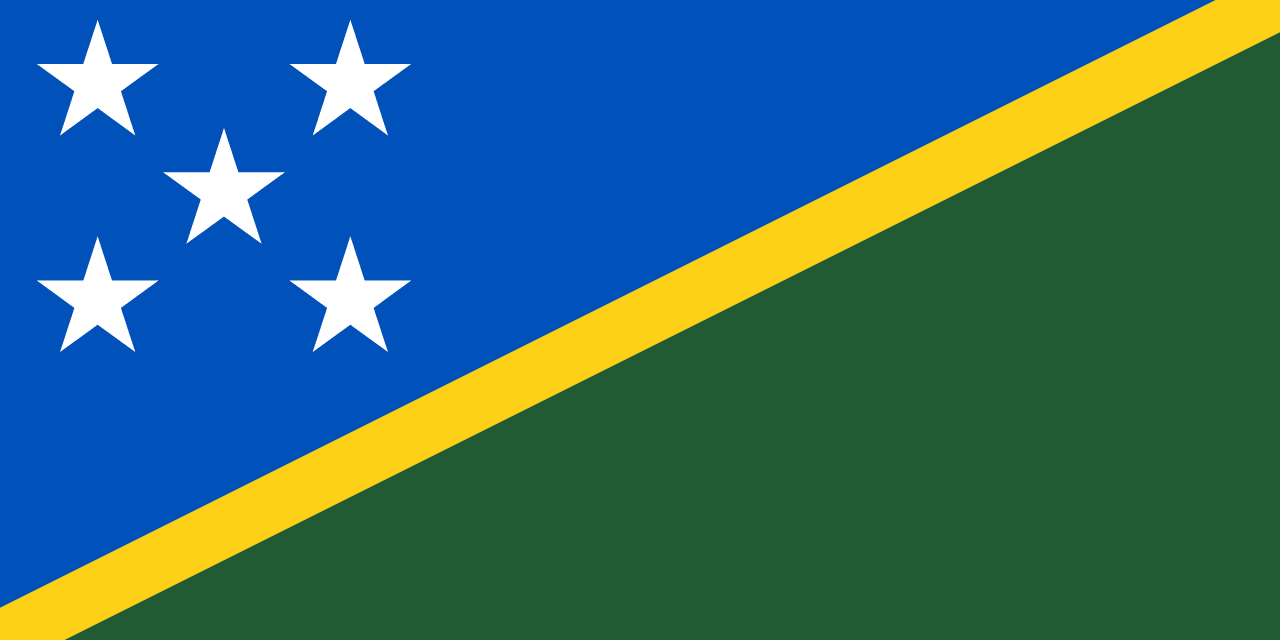
Few flags in the South Pacific manage to pack as much geography into a single rectangle as the flag of the Solomon Islands. With one bold diagonal slash of gold dividing a field of blue from a field of green, and a cluster of five white stars riding in the upper corner, it tells you almost everything about this nation at a glance: an archipelago scattered across warm tropical seas, lush with rainforest, baked by an equatorial sun, and organized historically around five main island groups. Adopted in 1977 as the country stood on the threshold of independence, it remains one of the more graphically distinctive ensigns in Oceania.
A Flag Built From Sea, Land, and Sun
The Solomon Islands flag is a diagonal bicolor, which immediately sets it apart from the horizontal and vertical stripes that dominate most national flags. A thin yellow band runs from the lower hoist corner to the upper fly corner, slicing the rectangle in two. Above that line sits a blue triangle; below it, a green triangle. Tucked into the blue section, near the hoist, are five white five-pointed stars arranged in an X pattern.
That arrangement is deliberate rather than decorative. The yellow stripe is the sun, and in a tidy bit of visual storytelling it physically separates the blue from the green, just as the horizon separates the ocean from the land in real life. It is the kind of design where the symbolism is not hidden in heraldic obscurity but written plainly into the geometry.
What the Colors Mean
Each color on the flag carries a specific meaning rooted in the nation's environment and identity. There are four colors in total, and none of them are arbitrary:
- Blue stands for the sea, the vast stretches of the South Pacific that surround and connect the islands and have shaped every aspect of Solomon Islander life, from food to trade to travel.
- Green represents the land itself, the densely forested, mountainous islands whose fertile soil and rich vegetation sustain communities across the country.
- Yellow is the sun, beaming down over an equatorial nation and, in the layout of the flag, marking the boundary between water and earth.
- White appears in the five stars, lending them clarity and prominence against the deep blue of the upper field.
It is a palette of sea, land, and sky, the three elements that define daily existence on a tropical archipelago.
The Five Stars and the Shape of a Nation
The five white stars are the emotional center of the design. They were intended to represent the five main island groups that made up the country at the time of independence. There is a charming subtlety here: the Solomon Islands actually comprise hundreds of islands, but the flag chose to crystallize that sprawling geography into five clear symbols, an act of national shorthand.
Over time the country's internal administrative divisions have grown beyond five provinces, but the stars were never reduced or multiplied to match. They remain a fixed historical statement about how the young nation saw itself in 1977, a reminder that flags often freeze a moment of self-definition rather than tracking every later reorganization. Arranged in their distinctive X formation, the stars also give the flag a sense of constellation, fitting for a people whose ancestors navigated open ocean by reading the night sky.
From British Protectorate to Independent Flag
For much of the late nineteenth and twentieth centuries, the islands were administered as a British protectorate. The flag we know today was adopted in 1977, two years before the country achieved full independence from Britain in 1979, as part of the broader transition to self-governance. Designing a new flag is one of the first symbolic acts of an emerging nation, a way of declaring that the colonial chapter is closing and a sovereign identity is beginning.
Rather than borrowing heavily from British vexillary tradition, the Solomon Islands chose a clean, modern, locally meaningful design. There is no Union Jack in the canton, no inherited heraldry. Instead the flag speaks in the universal language of landscape, an approach shared by several Pacific nations that gained independence in the same era and wanted symbols rooted in their own geography. For readers who want the broader context of the country's history, culture, and travel, the solomon islands country guide offers a fuller picture.
How It Compares to Other Pacific and World Flags
Diagonal divisions are relatively rare among national flags, which makes the Solomon Islands instantly recognizable. The closest visual cousins tend to share either the diagonal cut or the blue-green-sun-and-stars vocabulary common across Oceania.
Within the Pacific, many neighboring flags reach for similar imagery: blue for the ocean, stars for islands, and warm tones for the sun. The Solomon Islands distinguishes itself through its bold diagonal geometry and its specific five-star X, where others favor horizontal bands or a single emblem. Compared to flags that use the Southern Cross constellation, the Solomon Islands' five-star cluster is its own arrangement, tied to island groups rather than a celestial pattern.
Globally, the diagonal yellow stripe invites loose comparison to other flags that split their field on the diagonal, but the combination of a blue-and-green field with white stars is genuinely unusual. There is little risk of confusing this flag with any other once you know what to look for. The pairing of green and blue as the two dominant fields is itself uncommon, since many flags avoid placing two such similar-value colors side by side.
The Flag in National Life Today
The flag is woven into the rhythm of public life in the Solomon Islands. It flies over government buildings, schools, and ceremonies, and it takes pride of place during Independence Day celebrations each July, when the country marks its 1979 break from colonial rule. Sporting fans wave it when national teams compete in regional Pacific games and football tournaments, where the blue, green, and gold become a shorthand for home.
Because its meaning is so accessible, the flag works well as a teaching tool too. A child can look at it and learn the country's geography in a single sentence: blue sea, green land, golden sun, five island groups. That clarity is part of why the design has endured without revision for decades, a steady symbol through political change and natural challenges alike.
Interesting Facts About the Flag
- It is one of the few national flags in the world that uses a true diagonal division rather than stripes or a canton-based layout.
- The yellow stripe does double duty, representing the sun while physically separating the sea (blue) from the land (green).
- The five stars represent the five main island groups recognized at independence, even though the country today has more provinces.
- The flag was adopted in 1977, ahead of full independence in 1979, making it a symbol of the country's transition to nationhood.
- Its palette of four colors, blue, green, yellow, and white, captures the elemental landscape of a tropical Pacific archipelago.
Frequently Asked Questions
When was the flag of the Solomon Islands adopted?
The flag was adopted in 1977, two years before the Solomon Islands gained full independence from Britain in 1979. It was introduced as part of the country's transition toward self-governance and has remained unchanged since.
What do the colors and stars on the flag mean?
Blue represents the sea, green represents the land, and yellow represents the sun. The yellow stripe also separates the blue and green fields. The five white stars stand for the five main island groups that made up the country at independence.
Who designed the Solomon Islands flag?
The flag emerged from the country's move toward independence in the late 1970s and was adopted in 1977. Like many national flags created during decolonization, it was chosen through an official process rather than credited to a single widely recognized individual, so it is best understood as a national symbol of that era rather than the work of one famous designer.
What continent is the Solomon Islands on?
The Solomon Islands is located in Oceania, in the South Pacific Ocean to the east of Papua New Guinea. It is an archipelago made up of hundreds of islands, which is why themes of sea, land, and island groups feature so prominently in its flag.