

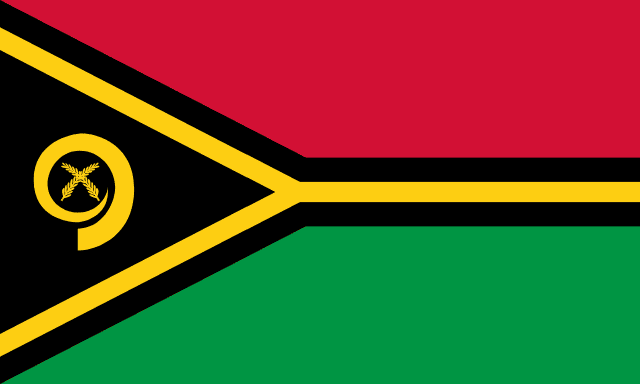
Few national flags pack as much cultural storytelling into a single sheet of cloth as the flag of Vanuatu. Raised for the first time when this scattered archipelago in the South Pacific shook off joint British and French rule in 1980, the flag is instantly recognizable for its bold horizontal Y, its deep tropical reds and greens, and the curling boar's tusk that sits at its center like a badge of honor. It is not a borrowed pattern or a colonial leftover; it was built from scratch to speak the language of the Melanesian people who call these islands home, and it remains one of the most distinctive emblems flown anywhere in Oceania.
A Quick Portrait of the Flag
The design is dominated by a yellow horizontal Y-shape, fattest at the hoist and tapering as its two arms reach toward the upper and lower corners. This Y divides the field into red on top, green on the bottom, and a black triangle along the hoist side. Inside that black triangle sits the flag's signature emblem: a yellow boar's tusk curled into a near-circle, framed by two crossed fern leaves. Thin black fimbriations outline the yellow Y, giving the whole composition crisp definition. It is a layout you will not mistake for any other country, and that uniqueness was entirely the point when the design was chosen at independence.
What the Colors Are Meant to Say
Each color on the flag carries deliberate meaning rooted in the land and its people. Black stands for the Melanesian population, the indigenous people who make up the overwhelming majority of the islands' inhabitants, and it is given pride of place in the broad triangle at the hoist. Red evokes the blood shared by all people, a reminder of common humanity and the sacrifices tied to nationhood. Green represents the lushness of the islands themselves, the fertile volcanic soil and dense forest that sustain village life. Yellow, used for the Y-band and the central emblem, suggests the light of the sun and, by extension, the Christian faith that spread across the archipelago. Together the palette is read as a compact summary of who Vanuatu is: its people, its land, and the lifeblood and light that bind them.
The Design and What Its Shapes Mean
The flag is more than a pretty arrangement of color; nearly every element is a deliberate symbol. The Y-shape is often interpreted as a map of the nation itself, its branching arms echoing the rough north-to-south sprawl of the islands as they trail across the ocean. Inside the black triangle, the boar's tusk is the emblem that surprises newcomers most. In traditional Vanuatu culture, a boar raised until its tusk grows into a full circle is a treasure of enormous value, and the tusk is therefore a symbol of prosperity, wealth, and standing in the community. Curled beside and behind it are two leaves of the namele fern, a plant associated with peace, and the leaves are commonly said to number thirty-nine to nod to the islands' regional councils. The result is a coat-of-arms-style centerpiece that compresses ceremony, custom, and governance into one small motif.
From Colonial Condominium to Independent Banner
For decades before 1980, the islands were governed under one of the most unusual colonial arrangements in the world: the New Hebrides Condominium, a joint administration shared awkwardly between Britain and France. Two flags, two legal systems, and two languages overlapped across the same territory. When independence finally arrived in 1980 and the New Hebrides became the Republic of Vanuatu, the new nation needed a banner that owed nothing to either former power. The flag was adopted in that founding year, its colors reportedly drawn from those of the Vanua'aku Pati, the party that had led the push for self-rule. Choosing an entirely original design, anchored by indigenous symbols rather than European heraldry, was itself a statement: this was a country defining itself on its own terms. To understand how that independence shaped the broader nation, the vanuatu country guide is a useful companion read.
How It Compares to Other Flags
Vanuatu's flag shares a color family with several other banners, yet stands apart through its emblem and geometry. The red-green-black-yellow combination calls to mind various Pan-African flags and even some Caribbean designs, but Vanuatu's meaning for those colors is entirely its own and unrelated to that movement. The hoist-side triangle invites comparison with flags like those of the Czech Republic, the Philippines, or Jordan, all of which use a triangle to anchor their design, but none place an animal-tusk emblem inside it. Perhaps the closest visual cousins are other Pacific and Melanesian flags that lean on local symbols rather than abstract stripes. Among the world's national flags, almost nothing else features a boar's tusk, and that single detail makes Vanuatu's banner one of the easiest to identify once you know what you are looking at. Where many flags signal allegiance to a region or ideology, this one signals a place and a way of life.
The Flag in Identity and Everyday Life
For a young nation born only in 1980, the flag has become a genuine focal point of pride. It flies over government buildings in the capital, Port Vila, and is hoisted with particular ceremony each year on Independence Day in late July, when villages and towns mark the anniversary of self-rule with parades, string-band music, and traditional dance. The emblem at its heart connects the modern republic to kastom, the local term for traditional custom and culture, so that even an official state symbol carries the weight of ancestral practice. Vanuatu's athletes carry the flag at regional sporting events such as the Pacific Games, and travelers spot it on everything from passports to fishing boats. Because the design is so unmistakably tied to Melanesian heritage rather than to any outside power, it functions as a daily reminder that the country's identity is homegrown.
Quick Facts Worth Knowing
- Vanuatu is part of the continent of Oceania, lying in the South Pacific Ocean as a chain of roughly eighty islands.
- The flag was adopted in 1980, the same year the nation gained independence from joint British and French rule.
- The five colors are red, green, black, yellow, and white, with white appearing in the thin fimbriations that outline the Y.
- The curled boar's tusk is a traditional symbol of prosperity and high social standing.
- The namele fern leaves beside the tusk are associated with peace.
- The Y-shape is widely read as representing the layout of the islands themselves.
Frequently Asked Questions
When was the flag of Vanuatu adopted?
The flag was adopted in 1980, the year Vanuatu became an independent republic. It was created specifically for the new nation as it emerged from the joint British and French administration known as the New Hebrides Condominium, replacing the colonial flags that had previously flown over the islands.
What do the colors of the Vanuatu flag mean?
Black represents the indigenous Melanesian people, red stands for shared human blood and common humanity, green reflects the fertility and lush vegetation of the islands, and yellow symbolizes sunlight and the spread of Christianity. The yellow boar's tusk at the center signifies prosperity, while the fern leaves stand for peace.
What continent is Vanuatu on?
Vanuatu is located in Oceania, in the South Pacific Ocean. It is a Melanesian nation made up of around eighty islands stretching roughly from north to south, lying east of Australia and northeast of New Caledonia.
How does Vanuatu's flag compare to similar flags?
Its red, green, black, and yellow palette resembles Pan-African and some Caribbean flags, and its hoist-side triangle echoes flags such as those of the Czech Republic or the Philippines. What sets Vanuatu's flag apart is its central emblem, a curled boar's tusk crossed by fern leaves, a symbol drawn from local custom that appears on virtually no other national flag in the world.