
There is no objective answer to which country is the most beautiful, but two checkable measures point to the same handful of places: China, Australia and the United States hold the most natural and mixed UNESCO World Heritage Sites of the countries compared here (19, 16 and 14), and the public New7Wonders of Nature poll, which closed in November 2011, picked seven landscapes: the Amazon and Iguazu Falls in South America, and sites in Vietnam, South Korea, Indonesia, the Philippines and South Africa. This article builds its list from those two named sources, says which source puts each country on it, and gives the landscapes and figures behind each choice. It does not rank one country’s scenery above another’s by taste, because that would be opinion dressed as fact.
How This List Is Built: UNESCO Natural Sites and the 2011 New7Wonders Vote
The first measure is the UNESCO World Heritage List. Sites are inscribed under ten criteria; the first six are cultural, and criteria vii to x are natural. The natural criteria are the ones closest to the question in this article’s title, since UNESCO’s definition of natural heritage includes sites important for “natural beauty” as well as for science and conservation. A site listed for natural values is called natural, and one listed for both is called mixed. As of July 2026 the list held 1,273 sites, of which 240 were natural and 42 mixed. Counting a country’s natural and mixed sites gives a rough, dated, checkable measure of how much internationally recognised natural landscape it contains. Large countries obviously have an advantage, and transboundary sites are counted for each country that shares them.
| Rank | Country | Natural + mixed sites |
|---|---|---|
| 1 | China | 19 (15 natural, 4 mixed) |
| 2 | Australia | 16 (12 natural, 4 mixed) |
| 3 | United States | 14 (13 natural, 1 mixed) |
| 4 | Canada | 12 (11 natural, 1 mixed) |
| 5 | Russia | 11 natural |
| 6 | Brazil | 10 (9 natural, 1 mixed) |
| 7 | France | 9 (7 natural, 2 mixed) |
| 8 | India | 8 (7 natural, 1 mixed) |
| 9 | Mexico | 8 (6 natural, 2 mixed) |
| 10 | Italy | 6 natural |
The second measure is a popularity vote. The New7Wonders of Nature campaign, run by the Swiss-based New 7 Wonders Foundation from 2007 to 2011, narrowed 440-plus nominations to 28 finalists and reported about 100 million votes before voting closed on 11 November 2011. The winners were the Amazon rainforest, Hạ Long Bay, Iguazu Falls, Jeju Island, Komodo National Park, the Puerto Princesa Subterranean River and Table Mountain. The poll is a weaker source than UNESCO: repeat voting was allowed, so national tourism campaigns could push their own sites, and Indonesia’s vice-minister for tourism complained about the organisers’ demands. It is included because it is named, dated and shows what a large public chose, not because it settles anything. Italy, with 62 World Heritage Sites in total, the most of any country, appears in the table only tenth because 56 of its sites are cultural; the site’s list of countries with the most World Heritage Sites covers the full count.
China: Wulingyuan’s 3,000 Pillars and the South China Karst
On the list because: it has the most natural and mixed UNESCO sites of the countries compared, 15 natural and 4 mixed out of 61 sites in total.
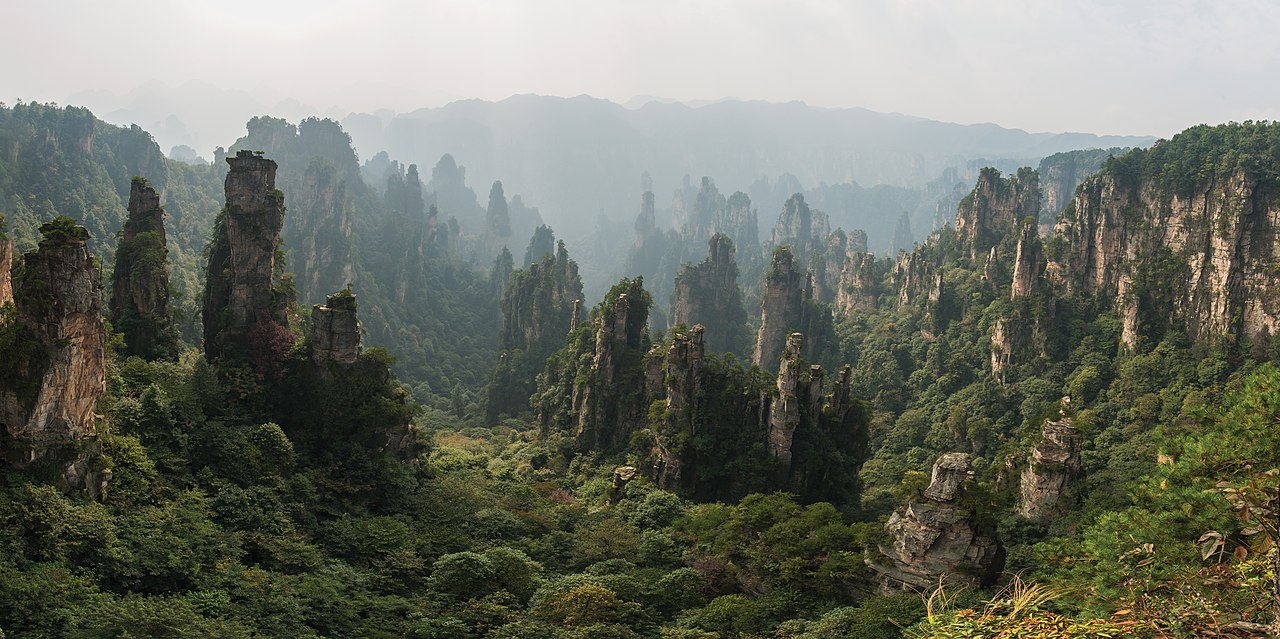
Wulingyuan, in Zhangjiajie in Hunan province, was inscribed in 1992 for more than 3,000 quartzite sandstone pillars, many over 200 m high, spread across a 690 km² park with 40 caves and one of the highest natural bridges in the world. Jiuzhaigou in northern Sichuan, inscribed the same year, is a long valley on the edge of the Tibetan Plateau, between 2,000 and 4,500 m above sea level, known for its multi-level waterfalls, colourful lakes and snow-capped peaks. The South China Karst, a serial site added in 2007 and extended in 2014, groups seven karst areas in Yunnan, Guizhou, Guangxi and Chongqing, including the Shilin stone forest and the tower karst of Guilin; UNESCO describes it as “unrivalled” for the diversity of its karst landscapes. Among the mixed sites are Mount Tai and Huangshan, the granite peaks of Anhui.
Australia: the Great Barrier Reef and Uluru-Kata Tjuta
On the list because: it has 16 natural and mixed UNESCO sites out of 21 in total, second among the countries compared.
The Great Barrier Reef was one of Australia’s first three listings, in 1981, along with Kakadu National Park and the Willandra Lakes. It is the world’s largest coral reef system: more than 2,900 individual reefs and 900 islands spread over about 2,300 km and some 344,400 km² of the Coral Sea off Queensland. The Great Barrier Reef Marine Park Authority considers climate change, which warms the ocean and drives coral bleaching, the greatest threat to it.

Inland, Uluṟu-Kata Tjuṯa National Park is a mixed site, listed both for its landforms and for its meaning to the Aṉangu, the Aboriginal people of the area. Uluru, a sandstone monolith 335 km southwest of Alice Springs, is sacred to the Pitjantjatjara. The Tasmanian Wilderness, another mixed site, meets seven of UNESCO’s ten criteria, which no other site exceeds; only Mount Tai in China matches it.
The United States: Yellowstone and the Grand Canyon
On the list because: the United States has 14 natural and mixed sites out of 27, third in the table.
Yellowstone, which in 1872 became the first national park in the United States and is widely regarded as the first in the world, was among the country’s first two listings in 1978, alongside the cultural site of Mesa Verde. It sits mainly in Wyoming, with small parts in Montana and Idaho, and is known for geothermal features such as Old Faithful. The Grand Canyon in Arizona, carved by the Colorado River, is 446 km long, up to 29 km wide and more than 1,857 m deep, exposing nearly two billion years of rock. The most recent American listing is the Okefenokee National Wildlife Refuge, added in 2026, and the one mixed site is Papahānaumokuākea in the northwestern Hawaiian Islands. The Everglades in Florida has been on the List of World Heritage in Danger since 2010 because of the deterioration of its aquatic ecosystems.
Canada: Nahanni and the Canadian Rocky Mountain Parks
On the list because: Canada has 12 natural and mixed sites out of 22, fourth in the table.
Nahanni National Park Reserve in the Northwest Territories was one of the world’s first four natural sites, inscribed in 1978. The Canadian Rocky Mountain Parks, listed in 1984 for Banff, Jasper, Kootenay and Yoho national parks, were extended in 1990 to the Hamber, Mount Assiniboine and Mount Robson provincial parks in British Columbia. They hold glaciers, hot springs, limestone caves and the headwaters of the North Saskatchewan, Athabasca, Columbia and Fraser rivers, and IUCN’s recommendation drew attention to their “exceptional natural beauty”. The site also absorbed the Burgess Shale fossil beds, listed separately from 1980 to 1984. Canada’s newest natural site is Anticosti Island in Quebec, added in 2023, and it shares two transboundary sites with the United States.
Brazil and Argentina: Iguazu Falls and the Amazon
On the list because: two of the seven New7Wonders of Nature winners, Iguazu Falls and the Amazon rainforest, lie partly in Brazil, which also has 10 natural and mixed UNESCO sites.
Iguazu Falls, on the Iguazu River between the Argentine province of Misiones and the Brazilian state of Paraná, together form the largest waterfall system in the world. Most of the falls are on the Argentine side, and both countries protect them: Iguazú National Park in Argentina was inscribed in 1984 and Iguaçu National Park in Brazil in 1986. The name comes from Guarani or Tupi words meaning “big water”.

The Amazon entry in the 2011 poll covered the whole rainforest and river across several countries. Brazil’s share includes the Central Amazon Conservation Complex, whose Jaú National Park is one of the largest forest reserves in South America, while its other natural sites run from the Pantanal wetlands to the Atlantic Forest reserves.
Southeast Asia’s Three Poll Winners: Hạ Long Bay, Komodo and Puerto Princesa
On the list because: Vietnam, Indonesia and the Philippines each have a New7Wonders of Nature winner, and each winner is also a UNESCO natural site.
Hạ Long Bay in northeastern Vietnam covers about 1,553 km² and contains 1,969 islets, most of them limestone towers shaped by some 20 million years of karst erosion in a wet tropical climate. It was listed in 1994. Vietnam’s Phong Nha–Kẻ Bàng National Park, listed in 2003, contains Hang Sơn Đoòng, the largest known cave passage in the world by volume, whose entrance a local man, Hồ Khanh, found in 1990 while searching for agarwood. The site’s guide to Hạ Long Bay covers the bay in more depth.

Komodo National Park in Indonesia, inscribed in 1991, protects the islands where the Komodo dragon lives. The Puerto Princesa Subterranean River on Palawan in the Philippines, inscribed in 1999, is an underground river running through a limestone cave system in the Saint Paul Mountain Range; in 2010 explorers found that it has a second, upper level with small waterfalls inside the cave. Jeju Island in South Korea, the seventh poll winner, is a volcanic island whose lava tubes are also on the UNESCO list.
South Africa: Table Mountain and the Cape Floral Region
On the list because: Table Mountain was a New7Wonders of Nature winner, and South Africa has five natural and mixed UNESCO sites out of twelve.
Table Mountain’s level plateau, about 3 km across and edged by cliffs, rises about 1,000 m above Cape Town between Devil’s Peak and Lion’s Head. The mountain has 2,285 plant species, about 80% of them fynbos, and Table Mountain National Park draws 4.2 million visits a year. It forms part of the Cape Floral Region Protected Areas, a UNESCO site covering the smallest of the world’s six floral kingdoms, with over 9,000 vascular plant species, 69% of them found nowhere else. The country’s other natural and mixed listings are the iSimangaliso Wetland Park, the Vredefort Dome, the Barberton Makhonjwa Mountains and the Maloti-Drakensberg Park, a mixed site shared with Lesotho.
Read together, the two sources agree more than they differ: rainforest, reef, karst and big waterfalls dominate both. If you want to see how the same countries fare by visitor numbers rather than listings, the site’s ranking of the most visited countries in the world tells a different story, led by France and Spain.