

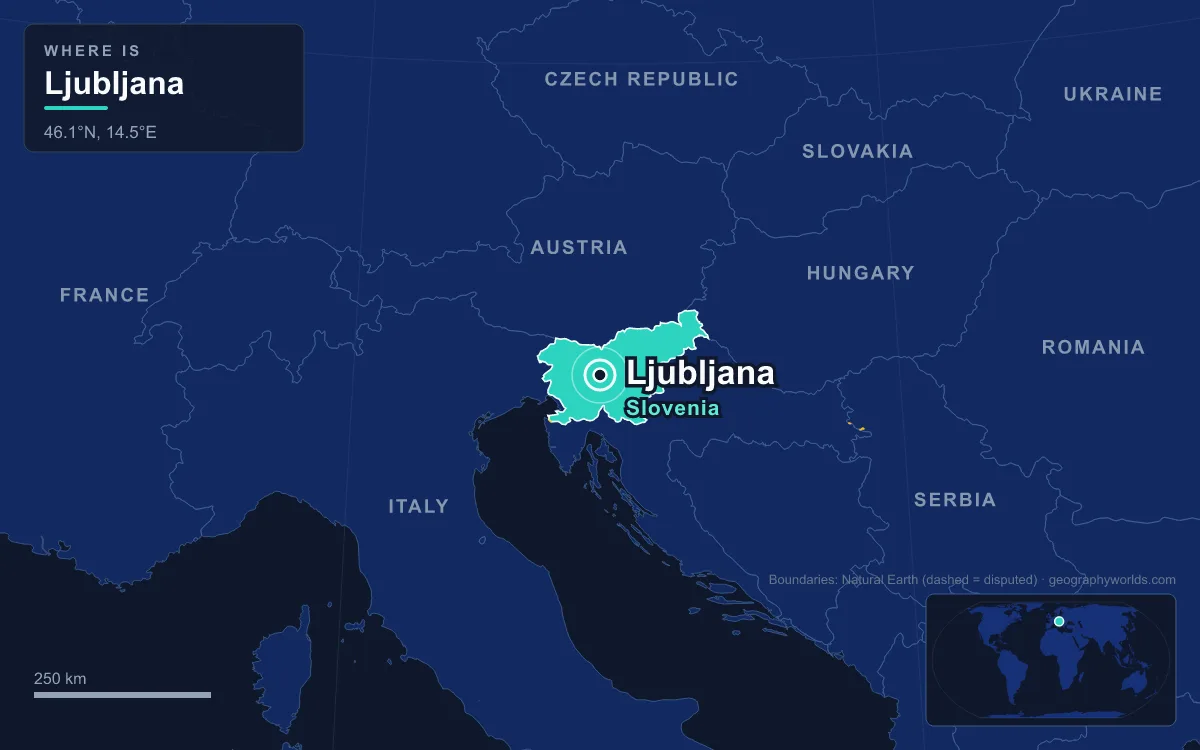
Ljubljana is the capital and largest city of Slovenia. It lies in the Ljubljana Basin in the middle of the country, between the Alps and the Karst, where the Ljubljanica river curves around a wooded castle hill before meeting the Sava at the city's eastern edge. The 2022 census counted 293,218 people in the city proper, roughly one in seven of Slovenia's 2.1 million inhabitants. What sets Ljubljana apart is how readable its past is on the ground: a Roman town plan, a medieval castle, a Baroque cathedral, a Vienna Secession bridge built after an earthquake, and a riverfront redesigned between the wars by the architect Jože Plečnik, whose works in the city joined the UNESCO World Heritage List in 2021. Six places carry that story.
Ljubljana Castle and the Hill Above Roman Emona
Castle Hill (Grajski grič) rises to 366 metres, almost 70 metres above the riverside streets of the centre. Archaeological surveys show that the area of the present castle has been settled continuously since about 1200 BC. The lowlands were settled even earlier: around 2000 BC people built pile dwellings in the Ljubljana Marsh to the south, and the marsh has yielded the oldest wooden wheel yet found. Those pile-dwelling sites, now in the Municipality of Ig, have been part of a UNESCO World Heritage Site since June 2011.
At the foot of the hill, where the navigable Nauportus river came closest to it, the Romans set up a military stronghold in the 1st century BC and then, from AD 14, the walled town of Emona. Its 5,000 to 6,000 residents were mostly merchants and craftsmen, colonists from northern Italy who lived in plastered brick houses linked to drains. The Visigoths camped by Emona in the winter of 408 to 409, the Huns attacked it in 452, and after the first half of the 6th century the town was abandoned. The ancestors of the Slovenes moved into the area during that same century.
The first castle was probably a wood-and-stone fort of the 11th century. Its oldest written trace is the Nomina defunctorum, a parchment most likely written in 1161, which records a gift of 20 farmsteads beside "castrum Leibach" made between 1112 and 1125. In 1256 Duke Ulrich III of Spanheim moved the capital of Carniola here from Kamnik, and after Rudolph of Habsburg took the province in 1278, the town, known in German as Laibach, stayed under the Habsburgs almost continuously until 1918. In the 15th century the castle was nearly all torn down and rebuilt with walls, entrance towers and a drawbridge, to guard against Ottoman raids and peasant revolts. The dragon on the city's coat of arms probably comes from St George's Chapel, added in that rebuild: George is the saint who kills a dragon. The viewing tower dates from 1848, and since 2006 a funicular has run up from the old town.
The Triple Bridge and Prešeren Square
The oldest crossing of the Ljubljanica is where the Triple Bridge stands today. A wooden bridge is recorded on the site in 1280, linking the walled medieval town on the south-east bank with the settlement opposite. It was rebuilt after a fire in 1657 and replaced in 1842 by a two-arched stone bridge by the Italian architect Giovanni Picco, dedicated to Archduke Franz Karl; the Latin inscription dated MDCCCXLII is still carved above its central pier.
By the 1920s that single bridge had become a bottleneck. In 1929 Plečnik proposed two footbridges set at a slight angle on either side of it, so that the three spans fan out towards the square. They were built between 1931 and spring 1932, with 642 concrete balusters and stone lamps, and since 2007 the whole crossing has been part of the pedestrian zone that closed the centre to cars in September of that year.

The bridges open onto Prešeren Square, the city's central square. Max Fabiani designed it after the 1895 earthquake as the hub of four streets, and in the 1980s Edvard Ravnikar proposed its circular layout and granite paving. At its centre is Ivan Zajec's 1905 monument to France Prešeren, the national poet, on a pedestal by Fabiani. Behind it rises the pink Franciscan Church of the Annunciation, built between 1646 and 1660 on the site of an older Gothic church, with a Baroque high altar by the Italian sculptor Francesco Robba.
St Nicholas's Cathedral and the Town Rebuilt After 1511
Medieval Ljubljana was three districts: the Town (Mesto), built around a predecessor of the present cathedral, Old Square (Stari trg), which received market rights around 1200, and New Square (Novi trg) across the river. The town gained its privileges sometime between 1220 and 1243, and when the diocese was created in 1461, the Church of St Nicholas became its cathedral. Disasters kept remaking it. After the Idrija earthquake of 1511 the city was rebuilt in the Renaissance style with a new wall, and after a large fire in New Square in 1524, wooden buildings were banned.
The cathedral seen today is the result of a later, Baroque rebuild. Between 1701 and 1706 the Jesuit architect Andrea Pozzo designed a church in the shape of a Latin cross with two side chapels, and Giulio Quaglio painted its frescoes in 1703 to 1706 and 1721 to 1723. The green dome that makes it easy to spot from the castle was added only in 1841. The Italian models continue on Town Square outside, where the Gothic town hall of 1484 was given a Baroque, Venetian-inspired front by Gregor Maček Sr. in 1717 to 1719. In front of it stands a copy of Robba's fountain, whose three marble figures represent the three main rivers of Carniola; the original was moved into the National Gallery in 2006.
That Baroque skin covers a turbulent 16th century. From 1529 Ljubljana had an active Slovene Protestant community, and the reformer Primož Trubar, who lived on today's Ribji trg, took the speech of the town as the basis for written Slovene. In his time the town had around 4,000 to 5,000 inhabitants, about 70 percent of them Slovene speakers and most of the rest German speakers. The Protestants were expelled in 1598, Bishop Thomas Chrön ordered eight cartloads of Protestant books burned, and the Jesuits, who arrived in 1597, re-Catholicised the town and staged its first theatre productions.
The Dragon Bridge and Ivan Hribar's Rebuilding After 1895
From 1809 to 1813 Ljubljana was the capital of Napoleon's Illyrian Provinces, and in 1821 it hosted the Congress of Laibach, for which Congress Square was laid out. The railway from Vienna arrived in 1849 and reached Trieste in 1857. Then in 1895 an earthquake of magnitude 6.1 struck the city of 31,000. Twenty-one people died and about a tenth of its 1,400 buildings were destroyed. The mayor Ivan Hribar used the reconstruction to modernise Ljubljana, and the years from 1896 to 1910 are remembered as its "revival": electric street lighting arrived in 1898, and whole districts were rebuilt in the Vienna Secession style.
The Dragon Bridge is the emblem of that period. It replaced the Butchers' Bridge, an oak bridge of 1819 damaged in the earthquake. Built by the Viennese firm Pittel+Brausewetter on a patent by the engineer Josef Melan, to a design by Giorgio Zaninovich, a graduate of Otto Wagner's school, it was one of Europe's earliest reinforced-concrete bridges. Work began on 1 July 1900 and the bridge opened to traffic on 4 October 1901. Its arch spans 33.34 metres, at the time the third-largest in Europe.

It was originally dedicated to Emperor Franz Joseph I to mark 40 years of his reign. In 1918 Austria-Hungary dissolved and Ljubljana joined the Kingdom of Serbs, Croats and Slovenes, and in July 1919 the bridge was renamed after the dragon statues on its four corners, which Zaninovich designed and which were made in Vienna. It is now protected as a technical monument.
Plečnik's National and University Library
The first Slovenian university was founded in Ljubljana in 1919, and in 1929 the city became the capital of the Drava Banovina, a province of Yugoslavia. The university's library had been founded around 1774, by decree of Maria Theresa, from the remains of the Jesuit library, and it needed a building. Plečnik drew the plans in 1930 and 1931. The authorities in Belgrade resisted, and it took sustained student protests before the building went up between 1936 and 1941. It is regarded as the most monumental of his works in Slovenia, and in 2011 it held about 1.3 million books and 8,700 manuscripts.
The library is one piece of a programme that remade the centre. Between 1921 and 1939 Plečnik renovated Tivoli City Park, laid out in 1813 under French rule, adding the broad Jakopič Promenade. He built the Cobblers' Bridge in 1930 and the Trnovo Bridge in 1929 to 1932, a bridge wide enough to serve as a square and planted with two rows of birches. His colonnaded Central Market, which follows the curve of the river between the Triple and Dragon bridges, was built in 1940 to 1942. By then the city was occupied: Italy occupied Ljubljana in 1941, and from February 1942 the whole city was ringed with barbed wire to separate the resistance inside from partisans outside. Since 1985 a commemorative trail has followed the line of that fence.
Republic Square and the Declaration of 26 June 1991
After the Second World War Ljubljana became the capital of the Socialist Republic of Slovenia within Yugoslavia, and it grew fast. The city had about 22,600 inhabitants in 1869 and almost 60,000 by 1931; since the 1970s it has expanded mainly by absorbing nearby settlements.
The largest square, originally Revolution Square, was designed by Edvard Ravnikar in the second half of the 20th century. The National Assembly Building stands on its north side, Cankar Hall, Slovenia's largest cultural and congress centre, on the south, and Ravnikar's Maximarket department store on the east. Protest had been building nearby: in 1988 Congress Square filled with demonstrations against Yugoslav authority. On 26 June 1991 Slovenia's independence was declared on this square, now Republic Square, and Ljubljana became the capital of a new state that joined the European Union in 2004.
The modern city lives close to its landscape. Yearly rainfall of about 1,400 millimetres makes it one of the wettest capitals in Europe, fog appears on about 64 days a year, and the city still floods, most recently in August 2023. The city won the European Green Capital title for 2016. For the wider country, from the Julian Alps to the limestone caves of the Karst Plateau, see our Slovenia country guide, and if you are planning around that rain and fog, our notes on the best time to visit Slovenia cover the seasons.
Quick Facts About Ljubljana
- Country: Slovenia
- Continent: Europe (Southern Europe)
- Country population: approximately 2.1 million
- Capital city status: Ljubljana is the capital of Slovenia, the seat of national government, and the location of foreign embassies, parliament, and the head of state's official residence.
Frequently Asked Questions
What is the capital of Slovenia?
The capital of Slovenia is Ljubljana. Ljubljana is the seat of national government, hosts most foreign embassies and consulates, and is typically where the head of state and parliament are located.
What continent is Ljubljana in?
Ljubljana, the capital of Slovenia, is located in Europe, in the Southern Europe region. As Slovenia's capital, Ljubljana serves as the country's primary connection to the broader Europen political, economic, and cultural sphere.
Why is Ljubljana the capital of Slovenia?
Ljubljana was chosen as the capital of Slovenia for reasons that typically combine geography, history, and politics. Capital city selections often reflect a desire for centrality (being accessible from across the country), historical importance (being a longstanding seat of government or culture), or neutrality (being acceptable to multiple regions or ethnic groups within the country). The specific reasons for Ljubljana's designation are detailed in the city's history above.
What is Ljubljana known for?
As the capital of Slovenia, Ljubljana is best known for housing the country's central government institutions — parliament, presidential or royal residences, supreme court, and key ministries. It is also typically a major cultural and economic center within Slovenia, hosting national museums, embassies, and signature monuments. The introduction and history sections above provide detailed coverage of the city's specific notable institutions and landmarks.
Related Pages
- Slovenia Country Guide — full geography, climate, economy, and culture overview
- Flag of Slovenia — meaning, history, and design of Slovenia's national flag