

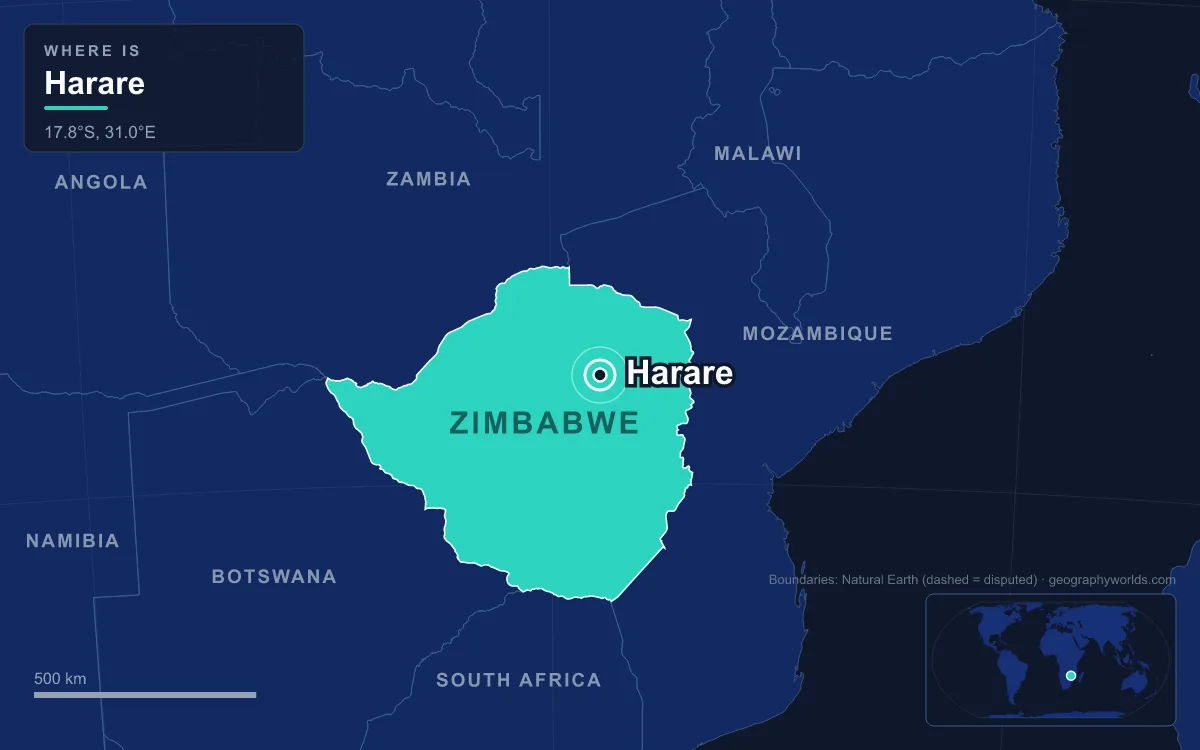
The capital of Zimbabwe is Harare, a highland city in the north-east of the country known as Salisbury until 1982. It stands on the Highveld plateau at 1,483 metres above sea level. The 2022 census counted about 1.85 million people in the city proper, and roughly 2.5 million in the wider Harare Metropolitan Province, which includes Chitungwiza, Epworth and Ruwa. Harare is the seat of the presidency, the ministries and the courts, and by far the country's largest commercial centre. The one big change of recent years is that Parliament now meets in a new building at Mount Hampden, roughly 20 kilometres north-west of the city centre. That has not changed Harare's legal status as the capital.
Harare Kopje and the Pioneer Column: Power Since 1890
Harare began as a fort. On 12 September 1890 the Pioneer Column, a force of settler volunteers organised by Cecil Rhodes's British South Africa Company, halted beside a rocky hill and built a fort. They named the post Fort Salisbury after the 3rd Marquess of Salisbury, then Prime Minister of the United Kingdom. The column had been heading for Mount Hampden, a little to the north-west, but settled here instead. The hill, Harare Kopje, rises to 1,540 metres and is still the highest point in the city.
The ground below the kopje was wet and poorly drained. The first town grew on sloping land along a stream, and the first stretch to be fully drained, known as Causeway, became the government quarter. Causeway still holds Senate House and the former Office of the Prime Minister, which became presidential offices after the post of prime minister was abolished in January 1988. Salisbury became a municipality in 1897 and a city in 1935. It was the seat of the company administrator, then capital of self-governing Southern Rhodesia from 1923, and from 1953 to 1963 capital of the Federation of Rhodesia and Nyasaland. Ian Smith's government kept it as capital after declaring independence from Britain on 11 November 1965.
Independent Zimbabwe was recognised on 18 April 1980. Two years later to the day, on 18 April 1982, Salisbury was renamed Harare. The new name came from the village of the Shona chief Neharawa near the kopje. His nickname is usually translated as "he who does not sleep". Before 1982, the name Harari had belonged to the Black township now called Mbare. So the rename moved a name from the African side of the colonial city to the whole of it.
Power in Harare has also been shown through monuments. National Heroes' Acre, a 23-hectare burial ground on a ridge about seven kilometres out of the city towards Norton, was started in 1981 and completed in 1982. North Korean architects from Mansudae Overseas Projects worked on it alongside Zimbabweans, and the black granite came from Mutoko, about 140 kilometres away. By November 2022, 161 people had been buried there. Hero status has been conferred under ZANU-PF, which has governed since 1980, and most of those who received it were known sympathisers of the party.
Parliament Leaves for Mount Hampden in 2023
For most of Zimbabwe's history, Parliament met in Parliament House in central Harare. In 2012 President Robert Mugabe's government announced a new parliament at Mount Hampden, in Mashonaland West Province. Mugabe signed agreements with China in 2014. Shanghai Construction Group put up the building between late 2018 and April 2022, with about 140 million US dollars of Chinese funding, and China formally handed it over as a gift on 26 October 2023. Parliament moved in that same month. The chamber has 650 seats, well above the 280 members of the National Assembly, which leaves room for the legislature to grow.
The move is meant to be the first stage of a new city sometimes called New Harare. Plans include a presidential palace, the Supreme Court, the High Court and the Reserve Bank, with a planned population of one million on 18,863 hectares. As of 2026 most of that plan is still unbuilt. The ministries, the Reserve Bank and the higher courts remain in Harare. For now, Mount Hampden is where laws are debated, while Harare is where they are carried out.
Harare's streets have also seen the biggest political moments of recent decades. The city hosted the Non-Aligned Movement summit in September 1986 and the 1991 Commonwealth Heads of Government Meeting, which produced the Harare Declaration on the Commonwealth's membership criteria. In November 2017, the largest demonstration in Zimbabwe's history filled its streets in the days before 93-year-old Robert Mugabe was forced to resign.
Sacred Heart, St Mary and All Saints and a Christian Majority
Missionaries followed the flag. Jesuits reached Salisbury within three years of the fort's founding and opened a chapel for forty people in the grounds of the Dominican Convent in 1893. Their bigger Church of the Sacred Heart opened in 1900. It soon became too small, and the foundation stone of the present Cathedral of the Sacred Heart was laid on Fourth Street on 28 June 1924. The cathedral opened on 2 August 1925. It is the seat of the Catholic Archdiocese of Harare, and Masses there are said in English and Shona, and to a lesser extent French and Portuguese. Jesuits ran it until the end of 2008, when it passed to diocesan clergy.

The Anglicans organised even earlier. Their Diocese of Mashonaland was formed in 1891, and its bishop sits at the Cathedral of St Mary and All Saints. In the 2000s that cathedral became a battleground. Bishop Nolbert Kunonga, an outspoken supporter of Mugabe, broke away from the Church of the Province of Central Africa and was excommunicated in 2008. He took control of church property in the diocese. It took until 19 November 2012 for the Supreme Court to rule that he had to hand it all back. In 1998 Harare hosted the 8th Assembly of the World Council of Churches.
Harare's religious life is much broader than its two cathedrals. National figures show how Christian the country is overall, with most of that majority Protestant.
The large Protestant churches include the Anglicans, Seventh-day Adventists and Methodists, but recent years have brought a surge of newer "Apostolic" churches, known in Shona as Mapostori. The best known grew out of Johane Marange's preaching from 1932 and became the largest independent church in Central Africa. Many Christians also keep elements of traditional religion alongside church membership.
Mbare Musika, Eastgate and the Tobacco Trade
Harare is Zimbabwe's main financial, commercial and communications centre, and an international trading hub for tobacco, maize, cotton and citrus. Gold, diamonds and platinum are also traded through the city. Much of the country's farm produce passes through Mbare, the city's first township, set up in 1907. Its market, Mbare Musika, is the largest farm-produce market in Zimbabwe. Farmers bring in fresh crops each morning, some from as far away as Mutare, Masvingo and Kariba, and the same site doubles as the main bus terminus for rural routes. It has become run-down in recent years but remains central to the city's food supply.
Downtown, the best-known commercial building is the Eastgate Centre on Robert Mugabe Avenue and Second Street. It opened in 1996 at a cost of 36 million US dollars, designed by the Zimbabwean architect Mick Pearce with engineers from Arup. It has no conventional air conditioning. Instead, 48 brick funnels draw cool night air through the building and let warm air escape from the top, a design Pearce based on the way termite mounds control their temperature. Its stone patterns borrow from the walls of Great Zimbabwe, the medieval city about 300 kilometres to the south-east.

The economy has had hard years. After the disputed elections of 2002 and 2005 the elected council was replaced by a government-appointed commission, and rubbish collection and road repair broke down. In May 2005, Operation Murambatsvina ("Drive Out Trash") demolished shacks, market stalls and backyard cottages across Harare and Epworth. In 2011 the Economist Intelligence Unit ranked Harare the least liveable of the 140 cities it surveyed. Since the global recession the city has steadied. New building has spread across northern suburbs such as Borrowdale, and the top of the property market is dominated by wealthy and dual-citizen Zimbabweans, along with Chinese and South African buyers.
Kombis, Jacarandas and Daily Life at 1,483 Metres
Everyday Harare runs on kombis, the shared minibus taxis that carry most of the population. Metered taxis usually have to be booked, the state bus operator ZUPCO runs the public buses, and there is no passenger rail. Long-distance trains to Bulawayo and Mutare stopped in 2020, and the "Freedom Train" commuter services were suspended again in November 2022. The city was segregated by race and class until 1976 and was built for cars. It sprawls in low-density suburbs, with wealthier "dales" such as Avondale and Borrowdale in the north and high-density townships such as Highfield, founded in 1930, in the south-west.
The altitude sets the pace of the year. Harare has a subtropical highland climate, with an average annual temperature of about 18 °C. July, the coolest month, runs from about 7 to 22 °C, and October, the hottest, from about 15 to 29 °C. Rain falls mostly between November and March, around 825 to 855 millimetres a year. October and November are when the colonial-era street trees flower: purple jacarandas from South America and red flamboyants from Madagascar, often planted on alternating streets.
Weekends belong to sport. The Harare Sports Club ground hosts Test cricket. Dynamos, the most successful club in Zimbabwean football, plays in the city, as do CAPS United and Black Rhinos. The University of Zimbabwe, founded in 1952 and still the country's largest, has more than 20,000 students. For how the capital fits into the country beyond the plateau, from the Zambezi valley to the eastern highlands, continue with our Zimbabwe country guide.
Quick Facts About Harare
- Country: Zimbabwe
- Continent: Africa (Southern Africa)
- Country population: approximately 17.3 million
- Capital city status: Harare is the capital of Zimbabwe, the seat of national government, and the location of foreign embassies, parliament, and the head of state's official residence.
Frequently Asked Questions
What is the capital of Zimbabwe?
The capital of Zimbabwe is Harare. Harare is the seat of national government, hosts most foreign embassies and consulates, and is typically where the head of state and parliament are located.
What continent is Harare in?
Harare, the capital of Zimbabwe, is located in Africa, in the Southern Africa region. As Zimbabwe's capital, Harare serves as the country's primary connection to the broader African political, economic, and cultural sphere.
Why is Harare the capital of Zimbabwe?
Harare was chosen as the capital of Zimbabwe for reasons that typically combine geography, history, and politics. Capital city selections often reflect a desire for centrality (being accessible from across the country), historical importance (being a longstanding seat of government or culture), or neutrality (being acceptable to multiple regions or ethnic groups within the country). The specific reasons for Harare's designation are detailed in the city's history above.
What is Harare known for?
As the capital of Zimbabwe, Harare is best known for housing the country's central government institutions — parliament, presidential or royal residences, supreme court, and key ministries. It is also typically a major cultural and economic center within Zimbabwe, hosting national museums, embassies, and signature monuments. The introduction and history sections above provide detailed coverage of the city's specific notable institutions and landmarks.
Related Pages
- Zimbabwe Country Guide — full geography, climate, economy, and culture overview
- Flag of Zimbabwe — meaning, history, and design of Zimbabwe's national flag