

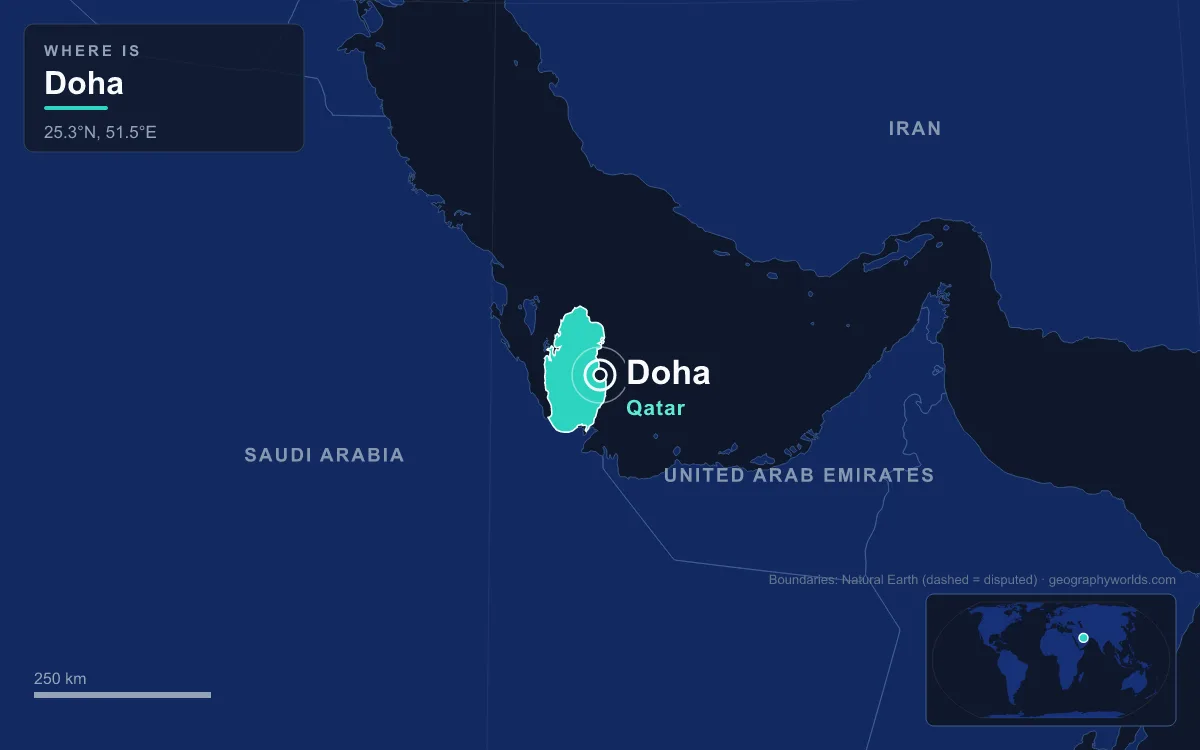
Qatar’s capital is Doha, a port city on the east coast of the Qatar peninsula facing the Persian Gulf. Doha municipality recorded 1,186,023 residents in the 2020 census, and more than 80 per cent of the country’s population lives in the city or the suburbs that make up the Doha Metropolitan Area. Founded in the 1820s beside the older town of Al Bidda, it served as the seat of the Al Thani rulers from the mid-19th century, became the official capital of the British protectorate in 1916 and was confirmed as capital of the independent State of Qatar in 1971. Its defining feature is the crescent of Doha Bay, lined by a seven-kilometre waterfront promenade, the Corniche.
Al Bidda and Doha: Two Towns on One Bay in the 1820s
Doha did not start as the obvious choice for anything. In the 18th century the most important town on the peninsula was Zubarah, on the north-west coast about 105 km from today’s capital, founded by the Bani Utbah tribal confederation after they migrated from Kuwait. It was a trading and pearling centre facing Bahrain, and it is now a UNESCO World Heritage Site. On the east coast, the settlement that mattered was Al Bidda, first documented in 1681 and shown on Carsten Niebuhr’s map of 1765 under the name Guttur.
Al Bidda had a problem that also became its advantage: shallow water. In 1801 a British political resident from Muscat tried to bombard it but found the sea too shallow to bring his warship within range. The East India Company razed the town in 1821 as punishment for alleged piracy, sending 300 to 400 inhabitants fleeing to offshore islands. Sometime in the 1820s a new settlement, Doha, grew up right next to the ruins. When the British resident John MacLeod visited in January 1823, he met its founder, Buhur bin Jubrun of the Al-Buainain tribe, and noted that Al Bidda was the only substantial trading port on the peninsula. The two places sat so close together that for decades writers treated them as one.
The name itself describes the site. According to Qatar’s municipal ministry, Doha comes from the Arabic dohat, meaning “roundness”, a reference to the rounded bays of the coastline. The British administrator J. G. Lorimer, writing in 1908, described a natural harbour about three miles across, protected by reefs, with an entrance less than a mile wide that ships drawing more than 15 feet could not use.
The Al Thani Move from Fuwayrit in 1847
The mid-19th century decided which family would rule from the bay. Control of the town changed hands repeatedly: the Al-Buainain were evicted after a dispute with the Al Khalifa of Bahrain in 1828, the Sudan (Al-Suwaidi) tribe held sway in the 1830s and was fined by British naval squadrons in 1841, and the chief Isa bin Tarif took the town in 1843 before dying at the Battle of Fuwayrit in 1847. Shortly after that battle, the Al Thani family moved to Doha from Fuwayrit, a coastal village about 90 km to the north, under Mohammed bin Thani.
Doha’s central position on the east coast suited the new rulers, but it also made the town a target. In 1867 forces from Bahrain and Abu Dhabi, about 2,700 men, sacked both Doha and Al Wakrah; a British record says the towns were “temporarily blotted out of existence”. The settlement imposed by the British political agent Lewis Pelly in 1868 proved a turning point. It implicitly treated Qatar as a distinct entity rather than a dependency of Bahrain, and it named Mohammed bin Thani as the principal representative of the peninsula’s tribes. From that point, the town where the Al Thani lived was, in practice, the political centre of Qatar.
Ottoman Troops, Al Wajbah and the 1916 Treaty
Doha’s status grew through a series of outside powers that each chose to deal with it. In December 1871, about 100 Ottoman troops occupied the Musallam fort in Doha with the consent of Jassim Al Thani, who wanted protection from Saudi incursions. An Ottoman report of January 1872 called Al Bidda an “administrative centre” with about 1,000 houses and 4,000 inhabitants.
That relationship broke down over tribute and interference. In March 1893 Jassim Al Thani’s forces defeated the Ottomans at the Battle of Al Wajbah, fought at a fort about 16 km west of old Doha. The Ottoman garrison fell back to the Al Bidda fort and surrendered after the Qataris cut off the town’s water supply. The Ottoman garrison nonetheless remained in Doha until it evacuated the fort in August 1915. The following year Qatar signed a treaty making it a British protectorate, with Doha as its official capital. There was no serious rival by then: Zubarah had long since declined, and Al Wakrah was a smaller port to the south.

The fort itself became the symbol of that continuity. Built in the 18th century as the Al Bidda Fort, it served the Ottomans as the military post Qal’at Al-Askar, then became the office of Qatar’s rulers under the name Doha Palace. In 1971 it was renamed the Amiri Diwan, and the building on the site remains the emir’s official workplace and the seat of the Deputy Emir and Prime Minister. Few capitals can point to a single plot of ground that has held power through three regimes.
From Pearling Town to the 1971 Declaration
Before oil, Doha’s capital status rested on pearls. In 1907 the town sent out 350 pearling boats with some 6,300 crew, and Lorimer put the population in 1908 at about 12,000, including a Turkish garrison of 350. He was unimpressed by the result: narrow lanes, small houses and no date palms, with the only garden kept by the garrison near the fort. The arrival of cultured pearls and the Great Depression wrecked the trade and emptied much of the country.
Oil changed the equation. Drilling began in 1939, and by the 1950s revenues were flowing. In 1950 the British adviser Phillip Plant launched the first municipal projects, starting with the old palace complex and a half-mile seaside road serving the jetties. The first boys’ school opened in 1952, and in 1963 Doha became Qatar’s first formal municipality. Land reclamation from the late 1950s pushed the shoreline outward, moving the coast about 335 metres away from Souq Waqif and creating the smooth crescent of the Corniche. The shallow harbour that had once protected the town was finally overcome in the 1970s, when a deep-water port opened.
Independence formalised what had long been true. A provisional constitution in April 1970 created the first council of ministers, and in 1971 Sheikh Khalifa bin Hamad Al Thani, then heir apparent and prime minister, ended the 1916 treaty and declared Qatar an independent state with Doha as its capital. Unlike many new states, Qatar faced no debate over where to put the government: the ruling family, the port and nearly all the people were already in one place.
What Being Capital Means for Doha Today
Since 1971 Doha has been rebuilt more than once. In the 1970s the old neighbourhoods were cleared and residents moved to new suburbs such as Al Rayyan, Madinat Khalifa and Al Gharafa. The metropolitan area’s population rose from about 89,000 in the 1970s to more than 434,000 in 1997, and the urban land area grew from 130 hectares in the mid-20th century to over 7,100 hectares by 1995. Because foreign workers make up the great majority of Qatar’s residents, most of Doha’s growth has come from migration; our page on the population of Qatar breaks down who lives there.
The capital now carries the country’s international profile. Al Jazeera began broadcasting from Doha in 1996. Education City, launched by the Qatar Foundation in 1997, hosts seven international partner universities, and the 250-hectare Aspire Zone was built for the 2006 Asian Games. The Pearl-Qatar, an artificial island of nearly 400 hectares off West Bay, opened its first district in 2004. The city hosted the WTO ministerial meeting that launched the Doha Development Round in 2001, the 2012 UN climate talks and matches of the 2022 FIFA World Cup, although the final was played at Lusail, a planned city about 23 km to the north.

The government has also tried to put the old town back. A restoration programme launched in 2006 demolished post-1950s additions to Souq Waqif and refurbished its older structures, finishing in 2008. Next door, Msheireb Downtown Doha, a project of about 5.5 billion US dollars begun in 2010, rebuilt the historic Mushayrib district on 31 hectares. At the southern end of the Corniche, the Museum of Islamic Art designed by I. M. Pei, opened in 2008, stands on its own island off an artificial peninsula near the dhow harbour.
Being the seat of a small, wealthy state has also placed Doha at the centre of regional diplomacy, with all the exposure that brings. The city has hosted negotiators from many conflicts, and on 9 September 2025 Israel struck a residential compound in the West Bay Lagoon district housing Hamas officials involved in Gaza ceasefire talks, the first direct Israeli attack on a Gulf Cooperation Council member. How the emir and the ministries exercise power from their offices along the bay is explained in our guide to the government of Qatar, and the shallow, warm sea that shaped the city from the start is covered in our overview of the Persian Gulf.
Quick Facts About Doha
- Country: Qatar
- Continent: Asia (Middle East)
- Country population: approximately 3.2 million
- Capital city status: Doha is the capital of Qatar, the seat of national government, and the location of foreign embassies, parliament, and the head of state's official residence.
Frequently Asked Questions
What is the capital of Qatar?
The capital of Qatar is Doha. Doha is the seat of national government, hosts most foreign embassies and consulates, and is typically where the head of state and parliament are located.
What continent is Doha in?
Doha, the capital of Qatar, is located in Asia, in the Middle East region. As Qatar's capital, Doha serves as the country's primary connection to the broader Asian political, economic, and cultural sphere.
Why is Doha the capital of Qatar?
Doha was chosen as the capital of Qatar for reasons that typically combine geography, history, and politics. Capital city selections often reflect a desire for centrality (being accessible from across the country), historical importance (being a longstanding seat of government or culture), or neutrality (being acceptable to multiple regions or ethnic groups within the country). The specific reasons for Doha's designation are detailed in the city's history above.
What is Doha known for?
As the capital of Qatar, Doha is best known for housing the country's central government institutions — parliament, presidential or royal residences, supreme court, and key ministries. It is also typically a major cultural and economic center within Qatar, hosting national museums, embassies, and signature monuments. The introduction and history sections above provide detailed coverage of the city's specific notable institutions and landmarks.
Related Pages
- Qatar Country Guide — full geography, climate, economy, and culture overview
- Flag of Qatar — meaning, history, and design of Qatar's national flag