

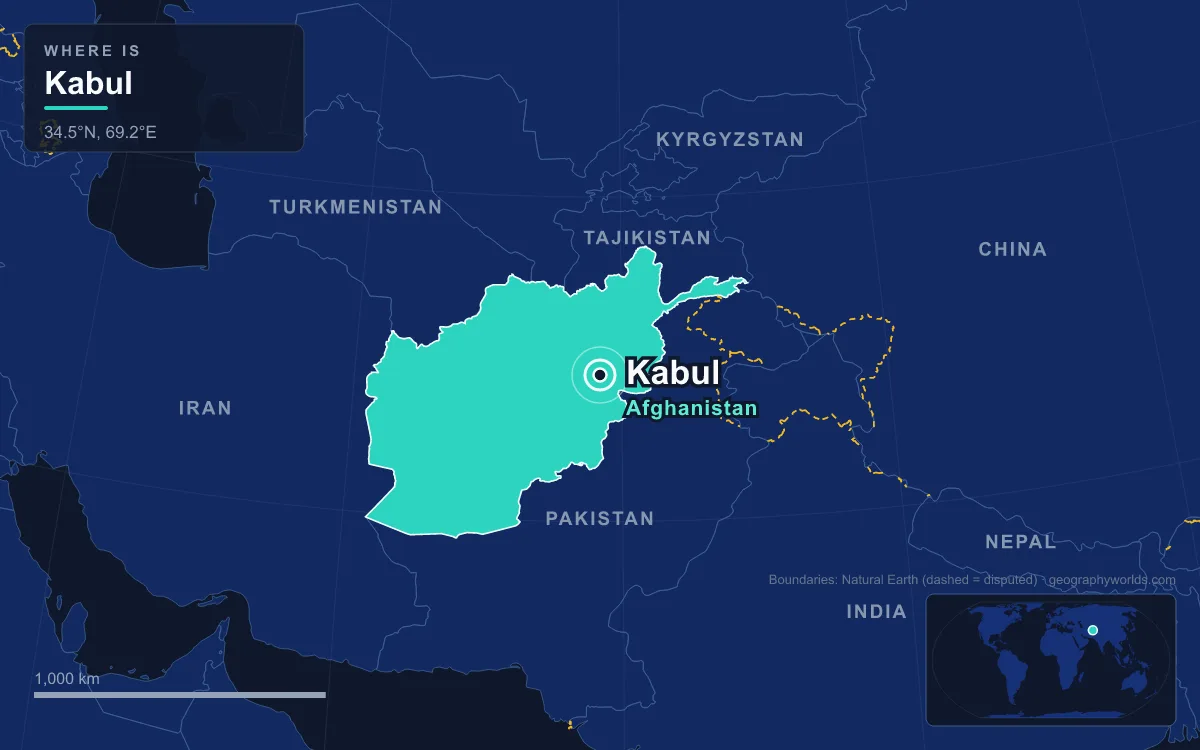
The capital of Afghanistan is Kabul, the country's largest city, with an estimated 5.3 million people in 2025. It lies in the east of the country in a narrow valley of the Hindu Kush along the Kabul River, at 1,791 metres above sea level, which makes it one of the highest capital cities in the world. Kabul has been the capital since 1776, when Timur Shah Durrani moved his court there from Kandahar, and it has been governed by the Taliban since 15 August 2021.
Power: From the Bala Hissar to the Arg Palace
Kabul is believed to be more than 3,500 years old. The Rigveda and the Avesta mention the Kabul River and a settlement called Kubha, and Greek writers knew the place as Kophen. Its value to rulers came from its position on the routes between India, Central Asia and Persia, and a long line of empires held it: Achaemenid, Seleucid, Greco-Bactrian, Mauryan, Kushan, Ghaznavid, Timurid and others. In 1504 Babur, the founder of the Mughal Empire, captured the city and made it his headquarters, and from here he launched his conquest of northern India in 1526. The Mughals kept Kabul for roughly two centuries, as the capital of Kabul Subah and a summer retreat.
For most of that time power sat in the Bala Hissar, the high fortress at the tail of the Sher Darwaza mountain on the south side of the old city. Its origins may go back to around the 5th century AD. The city walls, about 6 metres high and 3.7 metres thick, ran from the fortress along the mountain ridge down to the river. Nader Shah took Kabul in 1738, and after his assassination in 1747 Ahmad Shah Durrani founded the Afghan state. By then Kabul had shrunk to about 10,000 people. The decisive change came in 1776, when Ahmad Shah's son Timur Shah transferred the capital of the Durrani Empire from Kandahar to Kabul and encouraged scholars, Sufis and literary families to settle there with land grants.
The British came twice. In the First Anglo-Afghan War they reinstalled Shah Shuja in 1839, and the retreat from Kabul toward Jalalabad in 1842 cost the lives of about 4,500 regular troops and 14,000 civilians. In the Second Anglo-Afghan War of 1878 to 1880 the Bala Hissar was partly destroyed by a fire and an explosion, and British forces destroyed it in 1880. Emir Abdur Rahman Khan laid the foundations of a new citadel, the Arg, in 1880, on a 34-hectare site with a water-filled moat, and it has housed Afghanistan's rulers ever since.
The Arg has witnessed nearly every change of regime. King Amanullah Khan, who proclaimed the country's independence in foreign affairs in 1919, planned a new capital on open land south-west of the old city at Darulaman, where the 150-room Darul Aman Palace was built in the 1920s, linked to Kabul by the city's only railway, a tramway that ran from 1923 to 1929. The new city never replaced the old one. On 28 April 1978 President Mohammad Daoud Khan and most of his family were killed inside the Arg in the Saur Revolution. The Soviet Union invaded on 24 December 1979 and used Kabul as its command centre. After the fall of Mohammad Najibullah's government in 1992, fighting between mujahideen factions killed at least 30,000 civilians and destroyed about 80 percent of the city by 1996. The Taliban took Kabul on 27 September 1996, lost it in November 2001, and occupied the Arg again on 15 August 2021 after President Ashraf Ghani fled. Since the presidency was abolished, the palace has served as the meeting place of the Taliban cabinet.
Faith: Shah-Do Shamshira, Pul-e Khishti and the Tomb of Babur
Around 90 percent of Kabul's people are Sunni Muslims and about 10 percent Shia, most of them Hazaras living in the western district of Dashte Barchi. The city's religious buildings reflect the same succession of rulers as its palaces. The largest mosque, Pul-e Khishti, stands in the centre of the old city and is recognisable by its large blue dome. It was first built in the late 18th century, largely rebuilt under Zahir Shah in the late 1960s, damaged in the fighting of the 1990s and fully restored by 2019.

Just off the Kabul River on Andarabi Road, the yellow two-storey Shah-Do Shamshira Mosque, the Mosque of the King of Two Swords, was built during Amanullah Khan's reign between 1919 and 1929. It was modelled on the Ortaköy Mosque in Istanbul, and its Italian stucco has earned it the label Afghan Baroque. It stands next to the tomb of Chin Timur Khan, a Mughal general and cousin of Babur. The mosque was fully renovated in June 2021. In 1919 Amanullah also chose a religious setting, the Eidgah Mosque, to announce independence.
Babur himself lies in the city. He was first buried in Agra, but at his wish his body was brought to the garden he had laid out on the slopes of Kabul around 1504. Bagh-e Babur was later embellished by his descendants: Jahangir visited in 1607 and ordered a prayer platform before the grave, and Shah Jahan added a marble screen around the tomb and a small mosque on the terrace in 1638. The garden was restored in 2005 and receives up to a million visitors a year. Kabul's smaller communities have faded: the city had a Jewish quarter in the 12th century, recorded by al-Idrisi, but after the last known Jewish residents left in 2021 none are believed to remain in Afghanistan.

Trade: The Mandawi, the Kabul River and the Old Silk Road
Kabul lies roughly halfway between Istanbul and Hanoi, and it was traditionally seen as the meeting point of Central Asia, India and Persia. Under the Mughals it prospered as a frontier trading city. Akbar's chronicler Abul Fazl called it one of the two gates to Hindustan, the other being Kandahar, and Kabul ran a mint that struck gold and silver Mughal coins. Its population in that period was about 60,000, and its markets included the covered Char Chatta bazaar, which no longer survives. In 1842 the British demolished the main bazaar in reprisal after the retreat.
The river still structures commerce. The Kabul River flows through the heart of the city and divides the central bazaars, crossed by bridges such as Pul-e Khishti, Pul-e Shah-Do Shamshira and Pul-e Mahmoud; the Logar River joins it near the centre. The narrow streets of the old city hold markets such as the Mandawi and the Ka Foroshi bird market. The modern shopping districts cluster around the Mausoleum of Timur Shah Durrani and in Shahr-e Naw, Karte Char, Khair Khana and Dashte Barchi, and goods from across the country arrive along the Afghanistan Ring Road.
In the 20th century trade came through new channels. Leather and textile industries had developed by 1916; in the 1930s Zahir Shah's government built textile mills, power plants and carpet and furniture factories; and in 1955 a Soviet credit of 100 million dollars paid for roads, a cement plant and a mechanised bakery. The built-up area reached 68 square kilometres by 1962, almost fourteen times its size in 1925. In the 1960s and 1970s Kabul drew Western tourists on the Hippie trail to Chicken Street and the National Museum, and gained the nickname the Paris of Central Asia.
Daily Life: 5.3 Million People Between Sher Darwaza and Koh-e Asamai
The valley's shape governs everyday life. Mountains ring the city and rise within it, including Sher Darwaza in the south and Koh-e Asamai, known locally as Television Hill, in the west, and houses climb their slopes. The municipal area covers about 1,049 square kilometres, the largest of any Afghan city, divided into 22 municipal districts. The same geography made Kabul easy to bombard in the 1990s, when rival militias fired rockets into it from the surrounding mountains.
Altitude sets the climate. Kabul has a cold semi-arid climate with an annual mean of only 12.1°C, much cooler than Afghanistan's other large cities, and a January daily average of −2.3°C. Precipitation falls mostly in winter, largely as snow, and in spring. Water is a daily concern: the city relies mainly on deep wells, many of which have dried up, and the Kabul River now runs dry for much of the year. In winter, smoke from coal and low-grade fuel fills the valley with air pollution. Southeast of the old city, Hashmat Khan Lake, declared a protected area in 2017, is a resting stop for birds migrating between the Indian subcontinent and Siberia.
War has repeatedly reshaped the population. Kabul grew from about 500,000 in 1979 to 1.5 million in 1988 as refugees fled the countryside, then fell sharply in the 1990s, and quadrupled between 2001 and 2014, becoming one of the fastest-growing cities in the world. Much of that growth went into informal settlements, while gated estates such as Aria City were built for a growing middle class. Dari, a form of Persian, is the common language, with Pashto widely spoken. Since 2021, daily life for women has narrowed sharply: girls are barred from school beyond the age of 12, women were suspended from universities in December 2022, and in November 2022 they were banned from gyms and public parks. For more on the mountains that enclose the city, read our guide to the Hindu Kush; for the route east toward Peshawar, see the Khyber Pass, and for the network that made Kabul a crossroads, explore the Silk Road trade routes.
Quick Facts About Kabul
- Country: Afghanistan
- Continent: Asia (South Asia)
- Country population: approximately 45.0 million
- Capital city status: Kabul is the capital of Afghanistan, the seat of national government, and the location of foreign embassies, parliament, and the head of state's official residence.
Frequently Asked Questions
What is the capital of Afghanistan?
The capital of Afghanistan is Kabul. Kabul is the seat of national government, hosts most foreign embassies and consulates, and is typically where the head of state and parliament are located.
What continent is Kabul in?
Kabul, the capital of Afghanistan, is located in Asia, in the South Asia region. As Afghanistan's capital, Kabul serves as the country's primary connection to the broader Asian political, economic, and cultural sphere.
Why is Kabul the capital of Afghanistan?
Kabul was chosen as the capital of Afghanistan for reasons that typically combine geography, history, and politics. Capital city selections often reflect a desire for centrality (being accessible from across the country), historical importance (being a longstanding seat of government or culture), or neutrality (being acceptable to multiple regions or ethnic groups within the country). The specific reasons for Kabul's designation are detailed in the city's history above.
What is Kabul known for?
As the capital of Afghanistan, Kabul is best known for housing the country's central government institutions — parliament, presidential or royal residences, supreme court, and key ministries. It is also typically a major cultural and economic center within Afghanistan, hosting national museums, embassies, and signature monuments. The introduction and history sections above provide detailed coverage of the city's specific notable institutions and landmarks.
Related Pages
- Afghanistan Country Guide — full geography, climate, economy, and culture overview
- Flag of Afghanistan — meaning, history, and design of Afghanistan's national flag