

Manama is the capital and largest city of Bahrain. It sits on the northeastern tip of Bahrain Island in the Persian Gulf, facing the island of Muharraq across a short causeway, and a 2025 estimate puts its population at about 743,000. That is close to half of a country of roughly 1.59 million people (2024). Manama is best understood through its contrasts. It is a pearling port that became a banking centre, a desert city that gets less than 100 millimetres of rain a year, and a capital whose shoreline has moved several kilometres out to sea over the past century through land reclamation.
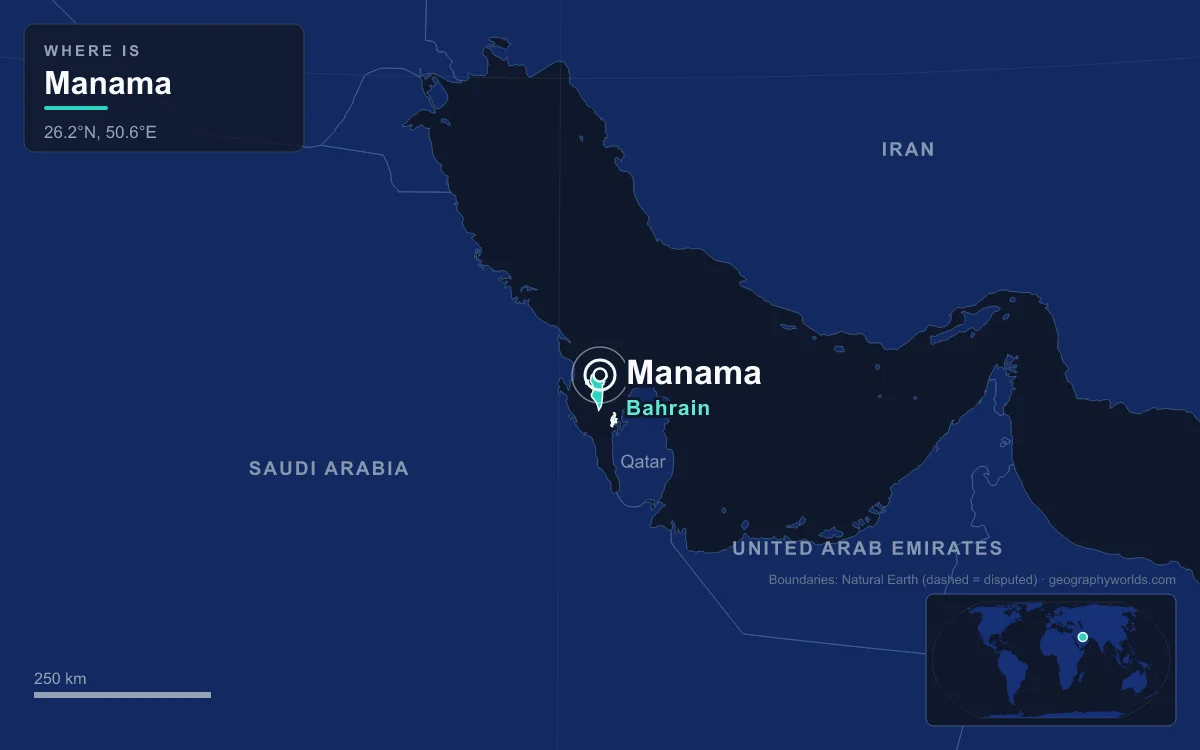
Manama Inside a Country of 780 Square Kilometres
Start with the country around it. Bahrain covered about 665 square kilometres before land reclamation added enough new ground to take it to roughly 780. It is the third-smallest country in Asia, after the Maldives and Singapore. The archipelago is made up of 33 natural islands plus about 50 artificial ones built by reclamation. Bahrain Island makes up about 80 percent of the land. The highest point, Jabal ad Dukhan (the Mountain of Smoke), rises only 134 metres. Roughly 92 percent of the country is desert.
Almost all of that land is taken up by one urban strip along the north coast, and Manama is its anchor. Bahrain was the world's fourth most densely populated sovereign state in 2010 at 1,646 people per square kilometre, with most of that population packed into the north. Manama belongs to the Capital Governorate, one of Bahrain's four governorates since the Central Governorate was abolished in 2014. Until 2002 it had its own municipality. So the question "how big is Manama?" gets a different answer depending on where you draw the line. The historic town was little more than the Manama Souq, with the old Manama Fort to its south. Today the city takes in districts such as Adliya, Salmaniya, Juffair and Seef. Adliya and Juffair were groves and marshes at the end of roads running south from the old town, and Adliya and Salmaniya are among the neighbourhoods swallowed up in the building boom after independence.
Population figures also show how open the country is. In 2024 Bahraini nationals numbered 739,736, or 46.6 percent of the population. The other 848,934 residents were foreign nationals. In 2008 roughly 290,000 Indian nationals lived in Bahrain, most of them from Kerala, making them the largest expatriate community. Manama, where most of the offices, shops and apartment blocks are, is where that mix is most visible.
Manama Versus Muharraq: The Rival Across the Causeway
Bahrain's capital has not always been Manama. The twin towns of Manama and Muharraq both grew up in the 1800s. Muharraq, on its own island, had the better defensive position and took the lead. It served as capital until the early twentieth century (1923 in some sources, 1932 in others). Muharraq was also the heart of the pearling industry, and its old quarter is now part of the Pearling Path, a UNESCO World Heritage Site.
Manama had the harbour and the merchants. It became the mercantile capital and the gateway to the main island, and Britain chose it as its base. After Isa ibn Ali Al Khalifa became ruler in 1869, Manama grew into the centre of British activity in the Gulf. A British political residency was built there in 1900, and in 1947 Britain moved its Persian Gulf Residency from Bushire in Persia to Manama. When Bahrain became independent in 1971, the new state named Manama its capital.
The two cities are now joined physically. A bridge first linked them in 1929, a causeway replaced the old wooden bridge in 1941, and today a causeway of about 2.8 kilometres carries the traffic. Muharraq had about 263,000 people in 2020 and ranks as Bahrain's third-most populous city. It hosts Bahrain International Airport, which opened in 1932 about 7 kilometres from Manama's central business district. The country's second city by area, Riffa, lies inland to the south. It was the main settlement on Bahrain Island until the port of Manama overtook it during the nineteenth century.
Pearls, Then Oil, Then Banks
Manama's economy went through three quite different phases in about a hundred years. The first was pearling. In 1907 the industry ran an estimated 917 boats and employed up to 18,000 people. Bahrain's earnings from pearl exports grew sevenfold between 1873 and 1900, and pearling brought in around £1.5 million a year in the mid-1920s. In those days the town imported rice, textiles, ghee, coffee, tea and livestock, much of it from India, and exported pearls, oysters and sailcloth. In 1911–12 only 52 steamships called at the port.
The collapse came fast. Japanese cultured pearls reached the world market in 1927, and between 1929 and 1931 pearl merchants lost more than two-thirds of their income. The Great Depression made things worse. Then oil was discovered in 1932 and exports began in 1934. Over the 1930s the oil industry took on divers whose trade had disappeared, and pearling faded away.
The third phase began as Bahrain's small oil reserves started to deplete. The Diplomatic Area in the northeast of the city was built to draw in financial firms, and 187 financial institutions were operating there by 1986. Today more than 200 banks and financial firms are based in the central business district and the Diplomatic Area, and Manama is a regional centre for Islamic banking. Bahrain is often described as one of the first post-oil economies in the Gulf. Oil revenue still makes up a large part of the government budget, though, so the shift is real but not complete.
A 94-Millimetre Year: Heat Against Rain in Manama
Manama's climate is a matter of extremes. Average daily highs recorded at Bahrain International Airport between 1991 and 2020 rise from 20.7°C in January to 39.7°C in July. The record is 47.6°C, set in May. Summer temperatures can reach 45°C, winter nights can fall to 7°C, and hail has occasionally fallen. The humidity of the Gulf makes the summer feel even hotter.
Rainfall barely registers. The same records give Manama about 94 millimetres a year. January is the wettest month at 18.1 millimetres, and June through September average no rain at all. Most rain falls between November and March. Historically, the city's water came from underground. The Dammam Aquifer, the country's main aquifer, is fed by groundwater flowing in from eastern Saudi Arabia, and heavy pumping by farms and households has made parts of it salty. The best weather comes in spring, when temperatures are mild and sea breezes cool the city.
Bab Al Bahrain Against the World Trade Center: Old Shore, New Shore
Two landmarks on either side of the old waterline show how far Manama has moved. Bab Al Bahrain, the "Gateway of Bahrain", opened in 1949. It was designed by Charles Belgrave, the British adviser who had run much of the state's administration since 1926, and it stood on the waterfront at Customs Square. It still marks the entrance to the Manama Souq, but land reclamation has left it several kilometres inland. In the 1920s the shoreline ran along Government Avenue. By the early 1930s it had moved out to King Faisal Road, which became the new coast road, and it has kept moving since.

The newer city stands on the reclaimed land. The Bahrain Financial Harbour, which cost about $1.5 billion, was built on the site of the old Manama pier. Its twin Harbour Towers, each 260 metres tall with 53 floors, opened in May 2007 and rank among the tallest buildings in the country. Next door is the Bahrain World Trade Center, completed in 2008: two sail-shaped towers 240 metres high with 50 floors. They were the first skyscraper in the world to build wind turbines into the design. Three bridges between the towers each carry a 225-kilowatt turbine 29 metres across, facing north into the wind off the Gulf. The turbines were designed to supply about 11 to 15 percent of the towers' electricity.
The streets tell the same story of growth. Manama's first car arrived in 1914. There were 395 cars in 1944, 3,379 in 1954 and 18,372 by 1970. To handle them the city built a series of ring roads: Isa al Kabeer Avenue in the 1930s, Exhibition Avenue in the 1960s and Al Fateh Highway in the 1980s. Each one pushed the coast further out. A public bus network did not start until 1 April 2015, with a fleet of 141 buses.
Manama at the End of a 25-Kilometre Causeway
Bahrain is an island, but it is not cut off. The King Fahd Causeway opened on 26 November 1986. It runs about 25 kilometres over five bridges and seven embankments, from Al Jasra in Bahrain to Khobar in Saudi Arabia, and Manama's King Faisal Highway, which runs past the Financial Harbour, is the road that leads to it. The link ties the capital's hotels, malls and offices to the Saudi mainland. Alcohol is legal in Bahrain, and bars and nightclubs operate in the city, which sets Manama apart from its larger neighbour, while the big shopping malls are clustered around Seef.
The religious landscape shows the same openness alongside long local tradition. Shia and Sunni communities have lived side by side in Manama for centuries. The Shia include the native Baharna, Hasawis and Qatifis from mainland Arabia, and Persian Ajam. The Sunni include Arab tribes that arrived with the Bani Utbah in the eighteenth century, and the Huwala. Every year the central districts host Muharram processions that draw hundreds of thousands of people from Bahrain and across the Gulf. The Al Fateh Grand Mosque in Juffair was built in 1987 and holds more than 7,000 worshippers under a 54-tonne fibreglass dome. Its complex has also housed the National Library since 2006. The Arab League named Manama the Capital of Arab Culture for 2012.
For the country beyond the capital, see the Bahrain country guide. To follow the causeway south, compare Manama with Riyadh, Saudi Arabia's inland capital. The closest comparison on the Gulf coast is the Qatari capital just across the water, Doha, across the water to the southeast.
Quick Facts About Manama
- Country: Bahrain
- Continent: Asia (Middle East)
- Country population: approximately 1.7 million
- Capital city status: Manama is the capital of Bahrain, the seat of national government, and the location of foreign embassies, parliament, and the head of state's official residence.
Frequently Asked Questions
What is the capital of Bahrain?
The capital of Bahrain is Manama. Manama is the seat of national government, hosts most foreign embassies and consulates, and is typically where the head of state and parliament are located.
What continent is Manama in?
Manama, the capital of Bahrain, is located in Asia, in the Middle East region. As Bahrain's capital, Manama serves as the country's primary connection to the broader Asian political, economic, and cultural sphere.
Why is Manama the capital of Bahrain?
Manama was chosen as the capital of Bahrain for reasons that typically combine geography, history, and politics. Capital city selections often reflect a desire for centrality (being accessible from across the country), historical importance (being a longstanding seat of government or culture), or neutrality (being acceptable to multiple regions or ethnic groups within the country). The specific reasons for Manama's designation are detailed in the city's history above.
What is Manama known for?
As the capital of Bahrain, Manama is best known for housing the country's central government institutions — parliament, presidential or royal residences, supreme court, and key ministries. It is also typically a major cultural and economic center within Bahrain, hosting national museums, embassies, and signature monuments. The introduction and history sections above provide detailed coverage of the city's specific notable institutions and landmarks.
Related Pages
- Bahrain Country Guide — full geography, climate, economy, and culture overview
- Flag of Bahrain — meaning, history, and design of Bahrain's national flag