

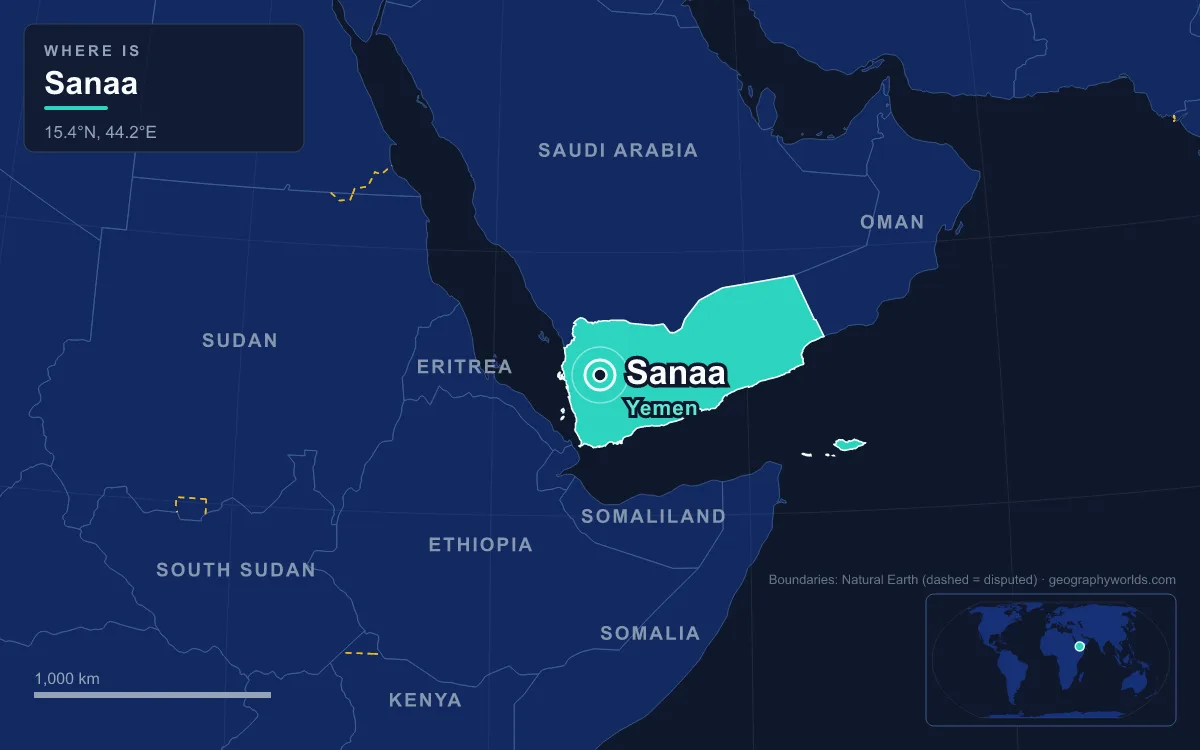
Sanaa is the capital and largest city of Yemen, set on a high plain in the country’s western mountains at about 2,300 metres above sea level, which makes it one of the highest capitals in the world. It had roughly 3.3 million people in 2023. Its walled Old City, lived in for more than 2,500 years and packed with decorated tower houses, has been a UNESCO World Heritage Site since 1986. Sanaa remains Yemen’s constitutional capital, but since the Houthi movement took the city in September 2014, the internationally recognised government has worked from Aden, which it declared the temporary capital in March 2015. That split is only the latest turn in a long record of rulers arriving, leaving and returning. Sabaeans, caliphs, Ismaili queens, Zaydi imams, Ottoman pashas and republican officers have all governed from here, and the city is easiest to follow era by era.
Sabaean Fortress and Ghumdan Palace, Before 600 CE
The city’s name points to its first purpose. It comes from the Sabaic root ṣnʿ, meaning “well-fortified”, and appears as ṣnʿw in old Sabaean inscriptions, most of them from the 3rd century CE. The Kingdom of Saba, whose main capital was the oasis of Marib to the east, used Sanaa as a secondary capital and a military base for campaigns against the rival kingdom of Himyar to the south; several inscriptions announce a triumphant return to Sanaa from the wars. The same texts name the Ghumdan Palace, the city’s great fortified residence.
Geography explains the choice. Sanaa sits at the narrowest point of its plain, between Jabal Nuqum, which rises about 500 metres above the city to the east, and the foothills of Jabal An-Nabi Shu’ayb, Yemen’s highest mountain, whose peak lies 25 kilometres to the west. The site also lay where routes linking Marib to the Red Sea crossed, which made it a trading hub for the surrounding tribes. Later Islamic tradition gave it a grander origin, saying it was founded by Shem, son of Noah, and the 10th-century historian al-Hamdani recorded its ancient name as Azāl. In the early 6th century, around the reign of the last Himyarite king Dhu Nuwas, Sanaa also served as the capital of the Aksumite viceroys, and tradition holds that the Abyssinian ruler Abrahah built a Christian church there.
The Great Mosque and the Caliphs’ Governors, c. 630–1062
Islam arrived with a building that still stands at the centre of the Old City. Early Islamic sources say that around 630 the Prophet Muhammad ordered a mosque built in Sanaa, and the Great Mosque is often dated to about 633. It was raised partly from the stones of the Ghumdan Palace and of Abrahah’s church, and its earliest recorded renovation came under the Umayyad caliph al-Walid I in the early 8th century. During restoration work in 1972, workers found in it the Sanaa manuscript, one of the oldest known Quranic texts.
Under the caliphs Sanaa was the seat of the deputy who ran one of Yemen’s three provinces, and every later Yemeni state competed to hold it. The jurist al-Shafi’i, who visited several times in the 8th century, left the city a line still quoted today: “Sanaa must be seen.” In the 10th century the Persian geographer Ibn Rustah called it the greatest, most populous and most prosperous city in Yemen.
Sulayhid Queens, Ayyubid Sultans and Zaydi Imams, 1062–1547
In 1062 the Sulayhid dynasty took Sanaa. Its founder, Ali al-Sulayhi, and his wife Queen Asma made it the capital of a small kingdom aligned with the Ismaili Fatimid caliphate in Egypt rather than the Abbasids in Baghdad. After Ali was assassinated by the rival Najahids of Zabid, the Sulayhid queen Arwa al-Sulayhi moved the capital south to Jibla, from where she ruled much of Yemen from 1067 to 1138, and the Ismaili Hamdanids took over Sanaa.
In 1173 Saladin sent his brother Turan-Shah to conquer Yemen, and the Ayyubids held Sanaa from 1175. They switched official allegiance back to the Sunni Abbasids and added the garden land west of the Sa’ilah, known as Bustan al-Sultan, where they built a palace. Their capital, though, was Taiz, and their control of Sanaa was patchy. From 1323 to 1454, while the Rasulid and Tahirid dynasties ruled most of Yemen, Sanaa stayed largely in the orbit of the Zaydi imams of the northern highlands; most of the city’s inhabitants still follow Zaydi Islam today. The Mamluks of Egypt arrived in Yemen in 1517.
Ottoman Pashas and Zaydi Revival, 1547–1918
The Ottoman Empire entered Yemen in 1538 and, under Özdemir Pasha, conquered Sanaa in 1547. European captains trading at Aden and Mocha visited the city to secure commercial privileges. The Zaydi imams fought back: Imam al-Mu’ayyad reasserted control from 1602 and forced the last Ottoman troops out in 1629. A lookout fort went up on Jabal Nuqum in 1607, and west of the walls a garden suburb called Bi’r al-Azab, first mentioned in 1627, became the Turkish quarter. In 1680 Jews returning from the Mawza Exile settled a new Jewish Quarter beside it.
The imams ruled until the Ottomans came back in the 19th century. Their troops landed on the coast in 1835 but did not take Sanaa until 1872, when Ahmed Muhtar Pasha entered the city. The Tanzimat reforms brought Sanaa its first city planning, new roads, schools and hospitals, rushed through to hold the city against an expanding Egypt, the British in Aden, and Italian and French influence on the Somali coast, though the changes stayed limited.

The Old City that survives took shape across these centuries. Its clay walls stand 9 to 14 metres high and enclose more than 100 mosques, 12 hammams and about 6,500 houses. The tower houses, built of stone and fired brick, reach up to eight storeys; each traditionally housed one extended family, adding floors as sons married, with animals and grain on the ground floor and a top-floor reception room, the mafraj, used for afternoon gatherings. Each quarter centred on a mosque, a bathhouse and a garden watered with grey water from the mosque’s ablution pool.
Imam Yahya’s Closed Capital, 1918–1962
Imam Yahya became the Zaydi leader in 1904, as Ottoman power in Yemen waned, and after the Ottoman Empire agreed to withdraw under the Armistice of Mudros in 1918 he entered Sanaa, declared Yemen independent and ruled it as the capital of an isolated kingdom. He avoided international politics, built little infrastructure and closed the Ottoman girls’ school. The city became a centre of dissent instead. In the 1930s reform groups formed around scholars at the Fulayhi Madrasa and a “Committee of the Struggle”; by 1936 most of their leaders were in prison. Another group called in 1941 for a parliament and a national renaissance, and its leaders were executed after Yahya’s son Ahmad inherited power in 1948.
That year Sanaa lost its status. Imam Ahmad lived in Taiz, so Taiz became the capital, and most government offices followed. A few years later most of Sanaa’s Jewish community emigrated to Israel, ending a presence that had shaped the western quarters for centuries.
Republican Sanaa and the Gulf Remittance Boom, 1962–1990
Imam Ahmad died in September 1962, and a week later pro-republican army officers sympathetic to Egypt’s Gamal Abdel Nasser overthrew the imamate. Sanaa became the capital again. The civil war that followed pitted the largely republican city against royalist tribes backed by Saudi Arabia, damaged parts of its heritage and ended in a settlement at the end of the 1960s. The new government built Tahrir Square on the old imam’s palace grounds and knocked down several city gates and sections of the wall.
Growth came in the 1970s, paid for by Yemenis working in the Gulf states and sending money home. Development spread along Taizz Road to the south and west towards the new Sittin avenue, helped by a ring road built on the recommendation of the United Nations Development Programme. Returning migrants brought concrete-block construction learned on Gulf building sites, and families left the Old City for houses with cars and running water. One well-meant project backfired: pipes laid in the late 1970s brought water into the Old City with no way to drain it, and the rising groundwater undermined foundations and brought down many houses.
Capital of Unified Yemen and a Divided State, 1990 to Today
On 22 May 1990 North and South Yemen merged, and Sanaa became capital of the new Republic of Yemen, home to the presidential palace, parliament, supreme court and ministries. Rural migration swelled it far beyond the walls; the city’s growth rate has been put at 7% a year against 3.2% for the country, and only about a tenth of residents now live in the Old City, whose population was 63,398 in 2003. Sanaa was the Arab League’s Arab Cultural Capital in 2004, and in 2008 the Al Saleh Mosque, the country’s largest, opened on the southern outskirts with room for more than 40,000 worshippers.

The 2011 revolution that ousted President Ali Abdullah Saleh centred on Sanaa, and fighting between May and November that year became the Battle of Sanaa. On 21 September 2014 the Houthis seized the city. Saudi-led coalition airstrikes on 12 June 2015 destroyed historic houses in the Old City, and a strike on a funeral hall on 8 October 2016 killed at least 140 people. In May 2017 the Red Cross reported a cholera outbreak in the city that had killed 115 people, and late that year fighting between the Houthis and forces loyal to Saleh ended with the former president’s death. On 17 May 2022, under a UN-brokered truce, the first commercial flight in six years left Sanaa International Airport.
Through all of it the physical setting has stayed the same: a cold desert climate with about 265 millimetres of rain a year, falling mostly between April and August, and a city boxed in by mountains so that it can only grow north and south. For how the capital compares with Aden, Taiz and Hodeidah, see the largest cities in Yemen; the Gulf of Aden guide explains the coast that the rival government now governs from; and the wider country is covered in the Yemen country guide.
Quick Facts About Sanaa
- Country: Yemen
- Continent: Asia (Middle East)
- Country population: approximately 43.0 million
- Capital city status: Sanaa is the capital of Yemen, the seat of national government, and the location of foreign embassies, parliament, and the head of state's official residence.
Frequently Asked Questions
What is the capital of Yemen?
The capital of Yemen is Sanaa. Sanaa is the seat of national government, hosts most foreign embassies and consulates, and is typically where the head of state and parliament are located.
What continent is Sanaa in?
Sanaa, the capital of Yemen, is located in Asia, in the Middle East region. As Yemen's capital, Sanaa serves as the country's primary connection to the broader Asian political, economic, and cultural sphere.
Why is Sanaa the capital of Yemen?
Sanaa was chosen as the capital of Yemen for reasons that typically combine geography, history, and politics. Capital city selections often reflect a desire for centrality (being accessible from across the country), historical importance (being a longstanding seat of government or culture), or neutrality (being acceptable to multiple regions or ethnic groups within the country). The specific reasons for Sanaa's designation are detailed in the city's history above.
What is Sanaa known for?
As the capital of Yemen, Sanaa is best known for housing the country's central government institutions — parliament, presidential or royal residences, supreme court, and key ministries. It is also typically a major cultural and economic center within Yemen, hosting national museums, embassies, and signature monuments. The introduction and history sections above provide detailed coverage of the city's specific notable institutions and landmarks.
Related Pages
- Yemen Country Guide — full geography, climate, economy, and culture overview
- Flag of Yemen — meaning, history, and design of Yemen's national flag