
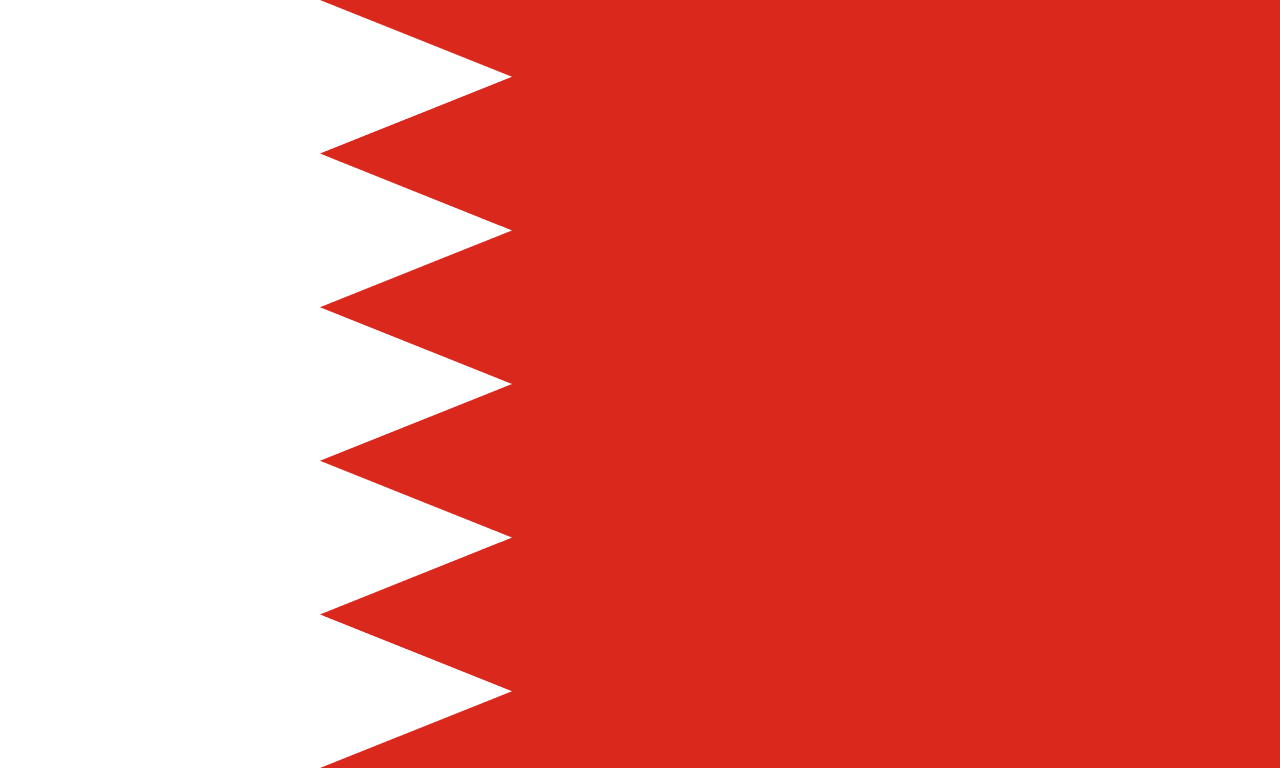
Few national flags manage to say so much with just two colors. The flag of the Kingdom of Bahrain pairs a bold red field with a slim white stripe down the hoist, separated by a jagged, zigzagging line that looks almost like the teeth of a saw. That serrated edge is not a decorative flourish or a printing accident; it is the flag's signature feature, a deliberate design choice that carries religious meaning and instantly tells Bahrain's banner apart from its neighbors. For an island nation in the Persian Gulf with a long maritime history, the flag is a compact statement of faith, peace, and identity.
A Banner of Two Colors
At its simplest, the Bahraini flag is built from red and white, two colors with deep roots in the Gulf region and in the history of this small archipelago. The red dominates, covering most of the field, while the white occupies a band along the hoist (the side nearest the flagpole). What makes the flag immediately recognizable is the boundary between these two colors, which is not a straight line but a row of triangular points. The eye is drawn straight to that interlocking edge, and once you have seen it, you never confuse Bahrain's flag with a plain bicolor again.
The choice of red ties Bahrain to a broader Gulf tradition. Red is the historic color of the Kharijite sect associated with the region, and across the lower Gulf many ruling houses and emirates flew red banners for generations. White, by contrast, signals peace, and its presence as a fringe of calm against the strong red field gives the flag a balanced, deliberate feel rather than a purely martial one.
The Meaning Behind Red and White
Color symbolism on the Bahraini flag is straightforward but meaningful. Red represents the Kharijite sect historically connected with the region, anchoring the flag in the religious and cultural lineage of the Gulf. White stands for peace, a value the country has long associated with its identity as a trading and pearling hub where merchants of many origins mingled.
The most distinctive symbolic element, though, lives in the shape of the dividing line. The white serrated band is cut into five white points, and those five points are understood to represent the Five Pillars of Islam: the declaration of faith, prayer, almsgiving, fasting during Ramadan, and the pilgrimage to Mecca. So the flag does double duty, using both color and geometry to express the country's Islamic faith. It is a clever piece of vexillological design: the part that makes the flag visually unique is the same part that carries its deepest meaning.
How the Design Is Laid Out
The construction follows a clear logic. A white vertical band runs along the hoist, and the rest of the rectangle is red. Where the two meet, the white band ends in five points that jut into the red field, creating the saw-tooth or "swallowtail-in-reverse" effect that defines the flag. Each point is a triangle, and the troughs between them belong to the red.
Earlier versions of the flag used a different number of points, and the design was simplified and standardized over time before settling on the five-point arrangement that ties so neatly to the Five Pillars. The current proportions and the exact count of points were fixed in the modern era, giving the country an official, unambiguous standard. The result is a flag that is easy to draw, easy to recognize at a distance, and rich with meaning up close.
From Earlier Banners to the Modern Flag
Bahrain's flag did not appear fully formed. It evolved from earlier red-and-white designs that the country and its rulers used across the twentieth century, themselves descended from the plain red banners common among Gulf states. At various points the serrated white band carried a different number of teeth, and over the decades the design was modified and refined.
The version flown today was adopted in 2002, the year that coincided with Bahrain's transformation into a kingdom and a wave of constitutional reform. That update settled the flag at five points, locking in the symbolic link to the Five Pillars of Islam and producing the clean, official design now seen on government buildings, ships, and sporting fields. If you would like the broader context of the country's geography and history behind these changes, the bahrain country guide is a good companion read.
Telling It Apart From Qatar and Other Gulf Flags
The most common point of confusion is with the flag of neighboring Qatar, and the resemblance is no coincidence. Both flags share the serrated-band concept, a legacy of their shared Gulf heritage, and at a glance they can look like variations on a single theme. Yet the differences are clear once you know what to look for.
- Color: Bahrain's field is red; Qatar's is a distinctive deep maroon. The two are easy to separate side by side.
- Number of points: Bahrain uses five points, tied to the Five Pillars of Islam. Qatar's flag carries a larger number of points and a much wider white band.
- Proportions: Qatar's flag is unusually elongated, while Bahrain's keeps more conventional rectangular proportions.
Beyond Qatar, Bahrain's red-and-white palette echoes the broader family of Gulf flags, many of which use red prominently. But the serrated white band makes Bahrain instantly identifiable, a rare case where a single graphic device sets a flag apart from every other in the world except its closest cousin.
The Flag in National Life
For Bahrainis, the flag is woven into everyday civic and cultural life. It flies over ministries and schools, marks national holidays, and appears prominently around Bahrain's National Day celebrations in December, when red and white decorate streets, buildings, and cars across the islands. The flag is also a familiar sight in international sport: it accompanies athletes at the Olympics and Asian Games and waves over the Bahrain International Circuit, home to the Formula 1 Bahrain Grand Prix, one of the country's most visible windows to a global audience.
That visibility matters for a small island nation. Bahrain sits in the Persian Gulf and is part of the continent of Asia, and its flag is one of the most efficient ways it projects a distinct identity in a crowded regional neighborhood. The banner's blend of faith (the five points), peace (the white), and Gulf heritage (the red) makes it a tidy emblem of how the kingdom likes to present itself.
Interesting Facts at a Glance
- The five white points stand for the Five Pillars of Islam, making the count itself symbolic rather than purely decorative.
- The current five-point design was adopted in 2002, the same period Bahrain became a kingdom.
- Red on the flag references the Kharijite sect historically linked to the region, while white represents peace.
- Bahrain's flag is most often confused with Qatar's, but Qatar uses maroon and many more points, while Bahrain uses true red and exactly five.
- The serrated band is a hallmark of Gulf vexillology, shared chiefly between Bahrain and Qatar and rare almost everywhere else.
Frequently Asked Questions
When was the current flag of Bahrain adopted?
The flag in its present form, with five white points along the serrated band, was adopted in 2002, around the time Bahrain became a kingdom and undertook constitutional reform. Earlier red-and-white designs with different numbers of points preceded it.
What do the colors and points on the Bahraini flag mean?
Red represents the Kharijite sect historically associated with the region, and white symbolizes peace. The five white points of the serrated band represent the Five Pillars of Islam: the declaration of faith, prayer, almsgiving, fasting during Ramadan, and pilgrimage to Mecca.
What continent is Bahrain on?
Bahrain is an island country in the Persian Gulf and is part of the continent of Asia, lying off the eastern coast of the Arabian Peninsula near Saudi Arabia and Qatar.
Why does Bahrain's flag look like Qatar's flag?
Both flags grew out of a shared Gulf tradition that combines a colored field with a white serrated band, so the family resemblance is genuine. The key differences are color and count: Bahrain uses red with five points, while Qatar uses a deep maroon with many more points and a more elongated shape.
