
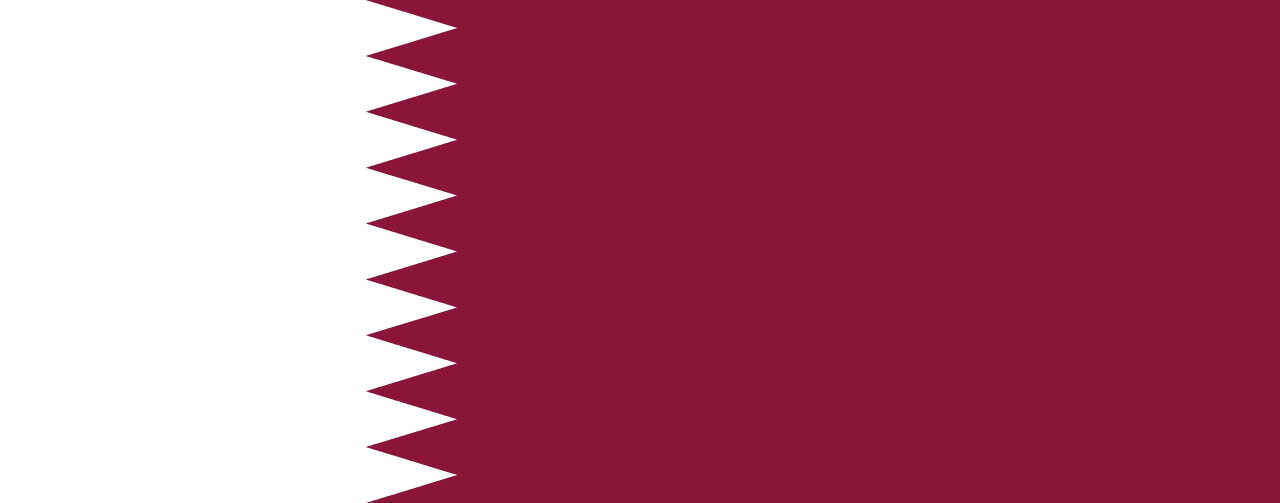

Among the world's national banners, few are as instantly recognizable for their proportions and palette as the flag of Qatar. While most countries reach for red, blue, or green, this small but influential Gulf nation chose a deep, unmistakable maroon paired with a crisp white serrated band. The result is a flag that looks like nothing else flying at the United Nations, in stadiums, or over the gleaming skyline of Doha. Adopted in 1971 as Qatar stepped onto the world stage as an independent state, the design carries layers of meaning rooted in trade, regional history, and the desert sun itself.
This article walks through what those two colors mean, why the band is jagged rather than straight, how an ordinary red flag turned into the maroon icon we know today, and how it compares to the strikingly similar banner of its neighbor across the Persian Gulf. Whether you are a flag enthusiast, a student, or simply curious about the country that hosted a World Cup, the story of Qatar's flag is richer than its two simple colors suggest.
Two Colors, Two Meanings
The flag of Qatar uses just two colors, and each carries weight. The dominant maroon field is the signature element. According to Qatar's own national symbolism, this dark reddish-brown represents the blood shed in the country's wars and struggles over the centuries, particularly during conflicts in the nineteenth century as Qatari communities defended their territory and identity. It is a color of sacrifice and endurance.
The white section, by contrast, stands for peace. This pairing of sacrifice and peace is a recurring theme in regional flags, where the price of independence and the hope for stability sit side by side. The juxtaposition gives the flag a quiet dignity: the heavy maroon anchors it, while the bright white lightens and balances the composition. Together they tell a compact national story without a single word, emblem, or coat of arms.
The Design and Its Distinctive Layout
At first glance the layout seems simple: a maroon field separated from a white band by a vertical line. Look closer and the defining feature appears. The boundary between the white and maroon is not a smooth straight edge but a serrated band with nine triangular points, like the teeth of a saw. The white runs along the hoist (the side nearest the flagpole), and the maroon fills the larger fly portion.
That nine-point serration is not decorative. The points symbolize Qatar's status as the ninth member of the "reconciled emirates" of the Gulf, a reference to its place among the territories that came under treaty arrangements with Britain in the region's history. So even the shape of the dividing line encodes a piece of political heritage.
The most talked-about technical feature is the flag's unusual proportions. Qatar's flag is famously elongated, using an 11:28 ratio of height to width. That makes it the only national flag in the world with this particular dimension, and one of the most horizontally stretched banners anywhere. Where many flags sit at a tidy 2:3 or 1:2, Qatar's stretches noticeably longer, giving the maroon field plenty of room to dominate.
From Red to Maroon: How the Flag Evolved
The maroon color was not the original plan, and that fact is one of the most charming details in the flag's history. Early versions of the flag were red, in keeping with a regional tradition of red-and-white banners common across the Gulf. The story goes that the intense desert sun and the natural dyes used at the time caused the red fabric to fade over the years into a deep maroon or purplish-brown shade.
Rather than fight this transformation, Qatari authorities embraced it. The faded maroon became a point of distinction, a way to set the national flag apart from the red banners of neighbors. Over the second half of the nineteenth century and into the twentieth, the design was refined, the white band and serrations were standardized, and the maroon was formally adopted as the official color.
The flag in essentially its modern form was confirmed in 1971, the year Qatar gained full independence and ceased to be a British protectorate. From that point the maroon-and-white serrated banner became the official emblem of the new sovereign state, flying over a country that would soon transform itself through oil and natural gas wealth into one of the wealthiest nations per capita on Earth. To learn more about the country behind the flag, see our qatar country guide.
Qatar and Bahrain: A Tale of Two Serrated Flags
No discussion of Qatar's flag is complete without mentioning Bahrain. The two flags are frequently confused, and for good reason: both feature a white band on the hoist separated from a colored field by a serrated, saw-toothed line. They are arguably the most similar national flag pair in the world, born from a shared Gulf heritage of red-and-white banners.
The differences, once you know them, are easy to spot:
- Color: Bahrain's field is bright red; Qatar's is dark maroon. This is the quickest way to tell them apart at a glance.
- Number of points: Bahrain's serration has five points (often described as representing the five pillars of Islam), while Qatar's has nine points tied to its place among the reconciled emirates.
- Proportions: Bahrain uses a more conventional ratio, whereas Qatar's elongated 11:28 shape makes it visibly longer and narrower.
Both flags trace back to the same regional tradition, yet each evolved its own identity, a neat illustration of how shared history can branch into distinct national symbols.
Cultural Significance and National Identity
For Qataris, the maroon flag is far more than a state insignia, it is a marker of identity that distinguishes their nation within the crowded Gulf neighborhood. The color maroon itself has become shorthand for Qatar. National sports teams wear it, the airline and many state institutions echo it, and citizens proudly display it. When you see that specific shade, your mind goes straight to Qatar in a way that few national colors achieve so exclusively.
The flag is officially celebrated each year on Qatar National Day, observed on December 18, when the maroon-and-white appears on buildings, cars, traditional dress, and public squares across Doha and beyond. The country even marks a dedicated National Flag Day, underscoring how central the banner is to civic life and the narrative of independence and self-reliance that Qatar has cultivated.
The Flag in Modern Life
In recent decades, Qatar's flag has gained a global audience. As the nation invested heavily in international sport, diplomacy, and media, the maroon banner began appearing on the world's biggest stages, from football pitches to international summits. The flag's unmistakable color helped Qatar build a recognizable brand far beyond the Gulf, turning a once-obscure desert emirate into a household name.
Domestically, the flag flies over government ministries, schools, embassies abroad, and the headquarters of state enterprises. It features in national celebrations, military parades, and cultural festivals. For the large expatriate population that now calls Qatar home, the maroon flag is the everyday symbol of the place where they live and work, a constant visual reminder of the country's identity amid rapid modernization.
Interesting Facts About Qatar's Flag
- Qatar's flag is the only national flag in the world with an 11:28 height-to-width ratio, making it one of the most elongated banners anywhere.
- Maroon is the widest color band on the flag, dominating the design and giving it a heavy, grounded look.
- The flag's color was originally red and faded to maroon under the desert sun before the darker shade was officially adopted.
- The nine serrated points reference Qatar's status as the ninth of the reconciled Gulf emirates.
- Qatar and Bahrain share the rare serrated-band design, making them the world's most look-alike national flag pair.
- The current flag was made official in 1971, the year of Qatar's full independence.
Frequently Asked Questions
When was the flag of Qatar adopted?
The modern flag of Qatar was officially adopted in 1971, the year the country gained full independence and ended its status as a British protectorate. Earlier versions of a red-and-white serrated flag existed in the nineteenth and early twentieth centuries, but the standardized maroon-and-white design was formalized at independence.
What do the colors of the Qatar flag mean?
The maroon field represents the blood shed in Qatar's wars and struggles, a symbol of sacrifice and endurance, while the white band stands for peace. The nine triangular points of the serrated band symbolize Qatar as the ninth member of the reconciled emirates of the Gulf region.
What continent is Qatar on?
Qatar is located in Asia, specifically on a peninsula extending into the Persian Gulf from the larger Arabian Peninsula in the Middle East. It shares its only land border with Saudi Arabia, while the rest of its territory is surrounded by Gulf waters.
Why do the Qatar and Bahrain flags look so similar?
Both flags descend from a shared Gulf tradition of red-and-white serrated banners. They differ in key ways: Qatar's field is maroon while Bahrain's is red, Qatar has nine serration points to Bahrain's five, and Qatar uses an unusually long 11:28 ratio. The color is the fastest way to tell them apart.