

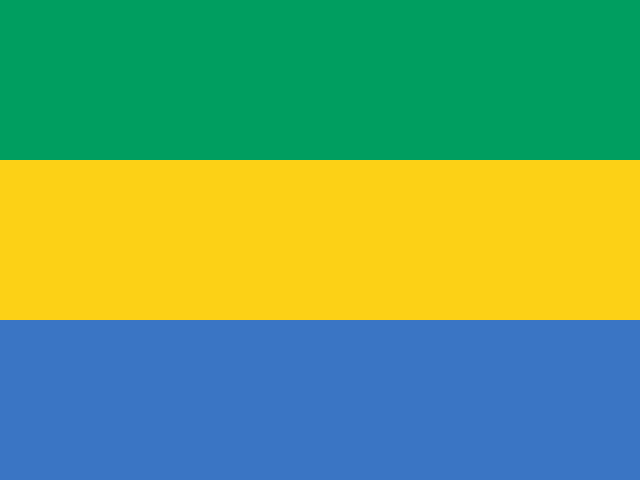
Among the world's national banners, the flag of Gabon stands out for its quiet confidence: three clean horizontal stripes of green, yellow, and blue, with no crests, stars, or emblems to interpret. It is one of the most minimalist designs in Africa, yet every band carries a piece of the country's geography. Hoisted for the first time as the Central African nation stepped out from under French rule, the flag reads almost like a cross-section of the land itself, top to bottom: rainforest, equator, and ocean.
A Snapshot of the Design
Gabon's flag is a horizontal triband, divided into three stripes stacked one above the other. From top to bottom the colors run green, yellow, and blue. There is no central charge, no coat of arms, and no canton in the corner. What gives the design its distinctive rhythm is the proportions: the central yellow band is broader than the two stripes that frame it, a deliberate choice that lifts the middle of the flag and gives it visual weight. That widened gold belt is not just an aesthetic flourish; it is meant to evoke the equator, the invisible line that slices almost directly through the country.
The flag flies at a standard ratio of 3:2, slightly squarer than the more common 2:1 banners seen elsewhere. The simplicity is the point. With only three solid colors and no fine detail, the flag is easy to draw, easy to recognize, and just as legible fluttering on a flagpole as it is printed on a lapel pin. That clarity has helped it serve faithfully for more than six decades without revision, an unusually stable record on a continent where many flags have been reworked after coups, mergers, or shifts in ideology.
What the Colors Stand For
Each stripe maps onto a feature of Gabon's natural setting. The green band at the top represents the vast forests that blanket the country. Gabon is one of the most heavily forested nations on Earth, with dense equatorial rainforest covering roughly nine-tenths of its territory, so the choice is no decorative shorthand. The yellow in the center signals both the sun and the equator that crosses the land. The blue stripe along the bottom stands for the sea, a nod to Gabon's Atlantic coastline along the Gulf of Guinea.
Read together, the three colors trace a journey through the landscape. Forest gives way to the sun-soaked midline of the planet, which in turn gives way to the ocean. Few flags so neatly compress a country's physical character into a single vertical sequence. The logic is geographic rather than political: where many flags encode a revolution, a dynasty, or a religion, Gabon's encodes latitude and terrain.
Independence and the Story Behind the Flag
Gabon spent the colonial era as part of French Equatorial Africa and, like many of France's territories, moved toward self-government in the late 1950s before achieving full sovereignty. It first received internal autonomy in 1958 as a member of the French Community, flying a provisional banner during that interim. The flag in its present form was adopted in 1960, the year Gabon became independent from France on the seventeenth of August. For a young nation, the decision to lead with the forest, the equator, and the sea was a statement about identity rooted in place rather than in borrowed European motifs.
That earlier 1959 version had carried a French tricolor in the upper-left canton and a much narrower yellow stripe pinched between broader green and blue bands. At full independence those colonial ties were dropped: the canton disappeared, and the central yellow band was widened into the prominent equatorial belt seen today. The clean break, swapping a corner reference to the former ruler for a self-contained tricolor, is a small lesson in how newly independent states used vexillology to assert ownership of their own story. The redesign turned the emblem inward toward Gabon's own geography rather than outward toward Paris.
How Gabon's Flag Compares to Other Flags
At first glance a green-yellow-blue tricolor invites comparison with the Pan-African palette of red, gold, and green popularized by Ethiopia and later adopted across the continent. Gabon, however, sits deliberately outside that tradition. By choosing blue over red and ordering its colors by landscape rather than by liberation symbolism, it sidesteps the most common African flag family entirely. There is no red of bloodshed and struggle here, an omission that reflects Gabon's relatively peaceful path to independence.
The closest visual cousins are flags that also pair green, gold, and blue. Rwanda's flag, redesigned in 2001, uses blue, yellow, and green stripes with a sun emblem, yet none share Gabon's exact arrangement. The feature that most reliably distinguishes the Gabonese flag is the central yellow band combined with the green-on-top, blue-on-bottom order. Where a viewer might briefly confuse two red-gold-green tricolors, Gabon's sequence is genuinely uncommon, which is partly why it remains so recognizable. It wins attention not by adding detail but by choosing colors its neighbors did not.
A Symbol of National Identity
For Gabonese citizens, the green-yellow-blue tricolor is the most visible shorthand for the nation. It flies over government buildings in the capital, Libreville, appears on official documents, and turns up wherever the state represents itself abroad. Because the design avoids any reference to a particular ethnic group, region, or ruling dynasty, it functions as common ground, a banner that belongs equally to everyone living between the forest and the coast.
The flag's emphasis on natural features also resonates with Gabon's modern reputation as a center for conservation. A country that has set aside roughly a tenth of its land as national parks finds an apt mascot in a flag whose dominant top stripe is forest green. If you want to dig deeper into the landscape, wildlife, and culture behind the banner, the gabon country guide offers a fuller portrait.
The Flag in Everyday and Civic Life
Beyond official settings, the tricolor appears when national feeling runs highest. It is waved during independence celebrations each August, displayed at civic ceremonies, and draped by supporters of the national football team, nicknamed the Panthers. Athletes representing Gabon at the Olympic Games and the Africa Cup of Nations carry the colors into the stadium, and fans paint them on cheeks and banners in the stands. The flag's strong, simple palette reproduces cleanly at any size, which keeps it recognizable whether it is the size of a sticker or stretched across a grandstand. Schoolchildren learn the meaning of its three bands as part of civic education, weaving the banner quietly through daily life.
Quick Facts Worth Knowing
- The flag is a horizontal triband of green, yellow, and blue, with no additional symbols or emblems.
- The central yellow stripe represents the equator that crosses the country, while drawing on the sun for warmth and light.
- It was adopted in 1960, the year Gabon gained independence from France.
- Green stands for the forests, yellow for the sun and equator, and blue for the sea.
- Gabon sits in Central Africa, on the Atlantic coast straddling the equator.
- An earlier transitional flag from 1959 included a French tricolor in the corner and a thinner yellow band before the independence redesign.
Frequently Asked Questions
When was the flag of Gabon adopted?
The current flag was adopted in 1960, the year Gabon achieved independence from France. A transitional design used earlier had included a French canton and a narrower yellow stripe; at independence the colonial reference was removed and the central band was widened.
What do the colors of the Gabonese flag mean?
Green represents Gabon's extensive forests, yellow symbolizes the sun and the equator that runs through the country, and blue represents the sea along its Atlantic coastline. The arrangement reads from forest at the top to ocean at the bottom.
What continent is Gabon on?
Gabon is located in Central Africa, on the western coast of the continent along the Gulf of Guinea. The equator passes directly through the country, which is why the central yellow stripe carries such symbolic weight.
How does Gabon's flag compare to other tricolors?
Many national flags use three horizontal stripes, but Gabon's stands apart through its emphasis on the central yellow band and its unusual green-yellow-blue sequence. By choosing blue over the red found in the Pan-African palette, it avoids the most common African flag family and remains easy to distinguish at a glance.
Why does the flag have no emblem or coat of arms?
Gabon's designers chose a purely abstract tricolor so the flag would represent the land and all its people rather than any single group, leader, or institution. The absence of an emblem keeps the design timeless and instantly reproducible, and it has allowed the banner to remain unchanged since 1960 even as the nation's politics evolved.