
Few national flags carry as deliberate a message of renewal as the one flown over Rwanda. Adopted in 2001, this banner of blue, yellow, and green topped by a golden sun is among the youngest flag designs in the world, created with a specific purpose: to mark a clean break from a painful chapter in the country's history. Where older symbols had become associated with division and tragedy, the new flag was conceived as an emblem of hope, unity, and forward momentum for a nation determined to rebuild.
Its calm, modern appearance hides a story of intentional reinvention that makes it one of the more thoughtful flag changes of the early twenty-first century.
A Tricolor Built Around the Sun
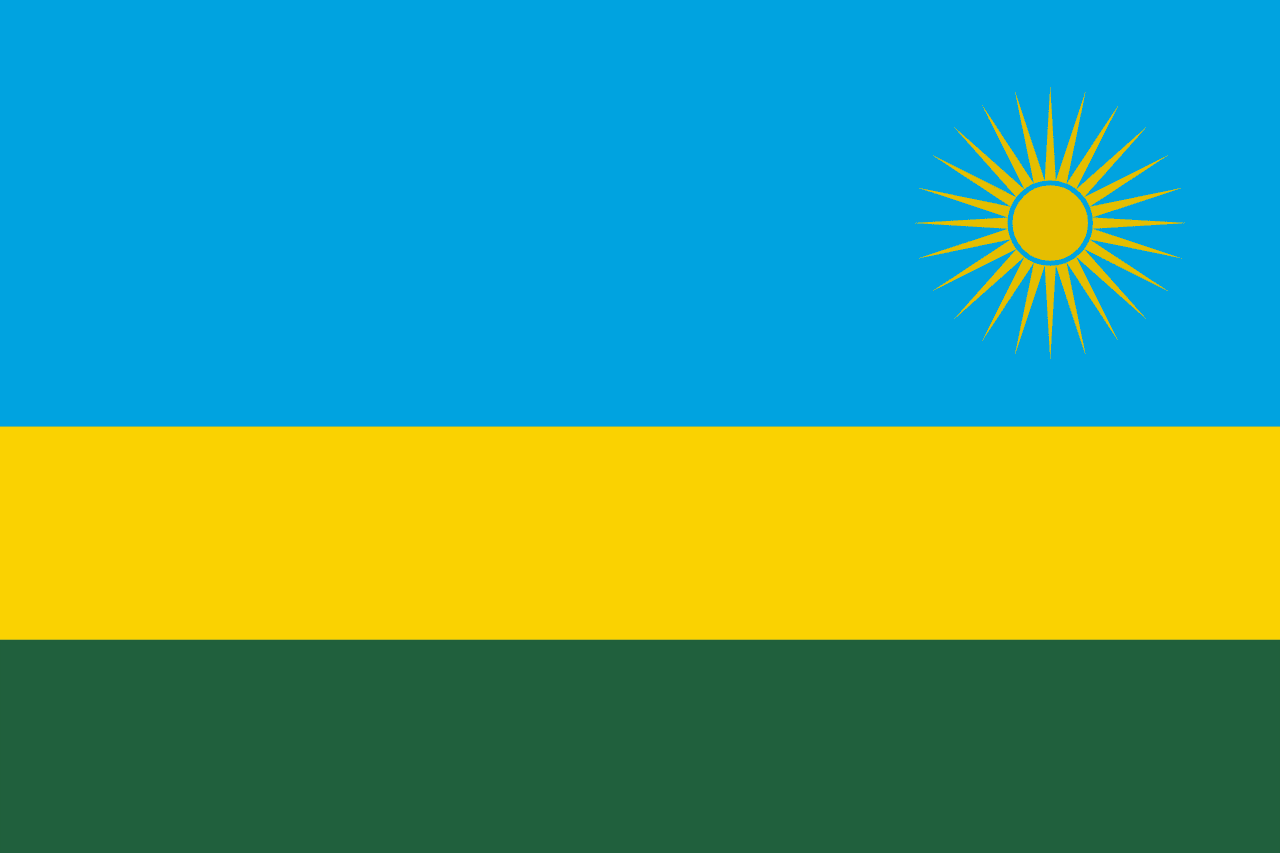
The Rwandan flag uses a horizontal triband layout, but it is far from a simple three-stripe design. The top band of light blue is the deepest, occupying roughly half of the flag's height. Beneath it sit two narrower bands of equal size: yellow in the middle and green along the bottom. Tucked into the upper-right corner of the blue field is a golden sun with twenty-four straight rays radiating outward.
That asymmetry, with one wide stripe balanced by two thinner ones and the sun set off to one side, gives the flag a distinctive sense of openness. The eye is drawn upward and to the corner, toward the sun, which reinforces the design's central theme of dawn and new beginnings. The official proportions follow a two-to-three ratio of height to width, and the sun is rendered in the same warm gold as the central stripe, tying the upper and middle sections together rather than letting the emblem float as an unrelated detail. The result is a layout that feels modern and uncluttered, a deliberate contrast to busier, emblem-heavy flags.
What the Colors and Sun Represent
Every element of the Rwandan flag was chosen to express the optimism of a country looking ahead. The symbolism is straightforward and uplifting:
- Blue stands for happiness and peace, the broad sky under which the nation hopes to flourish.
- Yellow represents economic development and the country's mineral and natural wealth.
- Green signifies prosperity and the promise of growth, fitting for a land famous for its lush hills.
- The golden sun symbolizes enlightenment, the light of knowledge and unity meant to guide the people forward.
Read together, the palette tells a single coherent story. Peace at the top, the resources to build in the middle, and the fruits of growth at the base, all illuminated by the rising sun of understanding. The order matters as much as the individual meanings: by placing happiness and peace above material development, the designers built a kind of moral hierarchy into the cloth, suggesting that prosperity should rest on a base of stability and contentment rather than the other way around. The sun's twenty-four rays, meanwhile, are sometimes read as enlightenment reaching outward in every direction.
Why Rwanda Replaced Its Old Flag
The story behind this flag is inseparable from the most difficult moment in Rwanda's modern history. The previous national flag, in use since independence in 1962, featured vertical bands of red, yellow, and green with a large black letter R in the center. The R distinguished it from the near-identical flag of Guinea and stood for Rwanda, revolution, and referendum. By the late 1990s, those colors had become painfully linked in the public memory with the genocide of 1994 and the divisions that fueled it.
In the years of rebuilding that followed, the government concluded that national symbols associated with that era should be retired. A new flag was commissioned as part of a broader effort to forge a shared, unifying identity, one that did not evoke ethnic division or the violence of the past. The winning design was created by artist and engineer Alphonse Kirimobenecyo and hoisted for the first time in October 2001 alongside a new national anthem, Rwanda Nziza, and a redesigned coat of arms. The choice to drop red entirely was itself meaningful, removing a color that many associated with bloodshed.
This makes Rwanda's flag unusual. Most national flags evolve gradually or commemorate a founding moment. Rwanda's was an act of deliberate national healing, a symbol chosen specifically to help a society move beyond trauma toward reconciliation.
How Rwanda's Flag Compares to Its Neighbors
Set against other African flags, Rwanda's stands out precisely because of what it leaves out. Many flags across the continent draw on the Pan-African palette of red, gold, and green, popularized by Ethiopia and the Garveyist movement. By stepping away from that scheme, Rwanda signaled a break not only with its own past but with a broader visual tradition.
The blue, yellow, and green combination is rarer and gives the flag a closer kinship with banners that evoke sky, sun, and land rather than struggle and sacrifice. The sun emblem invites comparison with the flags of Argentina and the Philippines, which use a radiant sun as a symbol of dawn or freedom, though Rwanda's is smaller, gold, and pushed into a corner rather than centered. Closer to home, neighboring Burundi, Uganda, and the Democratic Republic of the Congo all favor very different layouts, so there is little risk of confusing Rwanda's flag with theirs once the corner sun is spotted.
The Flag and Rwandan Identity Today
For a country located in the heart of East-Central Africa, sometimes called the "Land of a Thousand Hills," the flag has become a genuine source of pride rather than a reminder of the past. It flies during the Independence Day celebrations on the first of July and at Liberation Day the following day, and it is a fixture at the national commemorations that anchor Rwanda's calendar of remembrance and renewal.
The colors also turn up well beyond official settings. Rwandan athletes carry them at the Olympics and regional games, the national football and cycling teams wear them with visible enthusiasm, and cycling in particular has raised the country's profile as Kigali has hosted major international races. Citizens encounter the flag daily on number plates, school uniforms, and currency, as well as at the Umuganda community events that capture the collective spirit the design was meant to embody. Travelers exploring the gorilla-trekking regions and volcanic landscapes can learn more in this rwanda country guide, where the flag's themes of growth and renewal play out across the real geography of the country.
Interesting Facts About the Flag of Rwanda
- It is one of the newest national flag designs in the world, having been adopted only in 2001.
- The sun's twenty-four rays are a defining feature that set the flag apart from the many other tricolors used across Africa.
- The top blue band is wider than the yellow and green bands combined are tall, an intentionally unbalanced layout.
- The flag was introduced alongside a new national anthem and coat of arms as part of a coordinated symbolic renewal.
- By dropping the color red, the design consciously avoided the palette of the flag it replaced.
- The design was the work of artist and engineer Alphonse Kirimobenecyo, who also contributed to the new national emblem.
Frequently Asked Questions
When was the flag of Rwanda adopted?
Rwanda adopted its current flag in 2001, making it one of the most recently designed national flags. It replaced the earlier red, yellow, and green flag that had been associated with the period of division and the 1994 genocide.
What do the colors of the Rwandan flag mean?
Blue represents happiness and peace, yellow stands for economic development, and green signifies prosperity and growth. The golden sun in the upper corner symbolizes enlightenment and the light of unity guiding the nation forward.
What continent is Rwanda on?
Rwanda is located in Africa, specifically in the East-Central part of the continent. Landlocked and mountainous, it is widely known as the "Land of a Thousand Hills," a landscape its green stripe and growth-focused symbolism reflect.
How does Rwanda's flag compare to other African flags?
While blue, yellow, and green tricolors share a family resemblance with several flags around the world, Rwanda's golden twenty-four-ray sun and its distinctive wide-top, narrow-bottom band proportions make it easy to tell apart. Notably, by avoiding red it stands out from the many African flags that use the Pan-African color scheme.
What did Rwanda's flag look like before 2001?
The earlier flag, flown from independence in 1962, had three vertical bands of red, yellow, and green with a large black letter R at the center. The R both stood for Rwanda and set the flag apart from Guinea's nearly identical design. It was retired because its colors had become tied to the divisions and violence of the early 1990s.
