
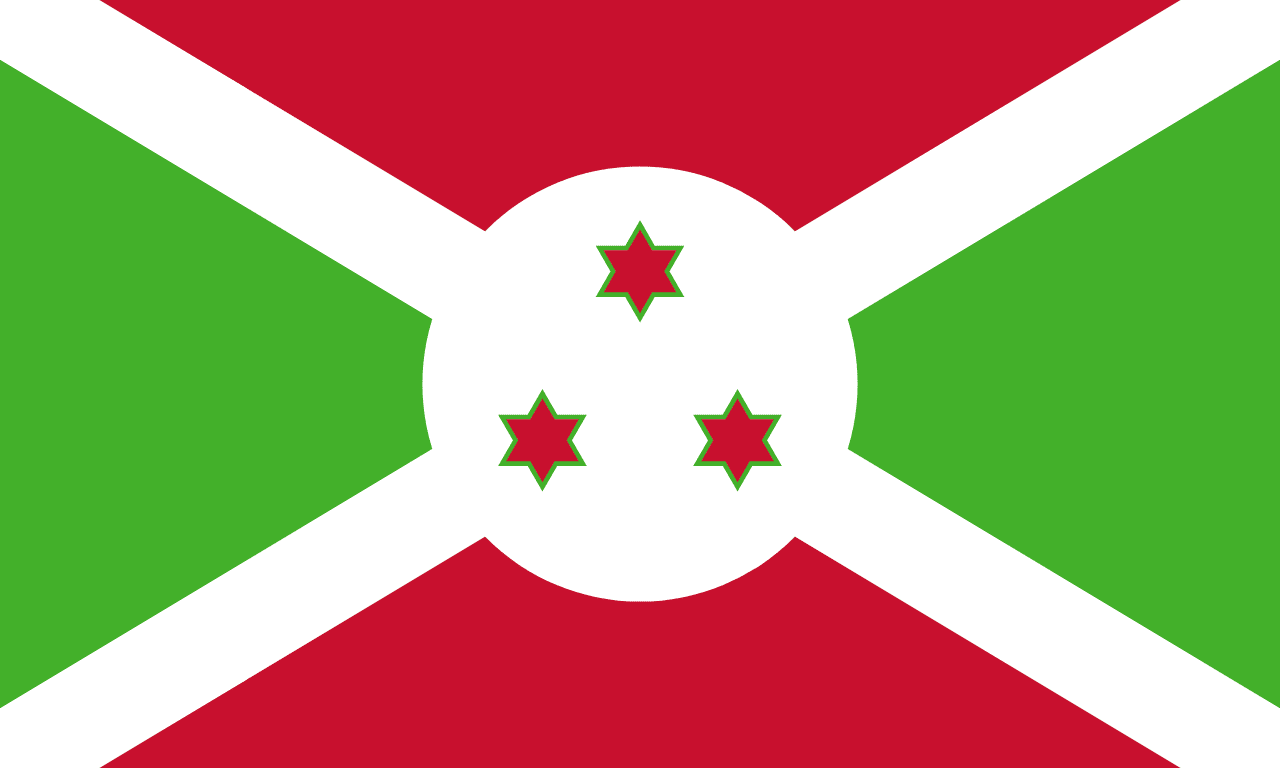

Few national flags pack as much meaning into so compact a design as the flag of Burundi. At first glance you see a bold diagonal cross slicing a green field into four triangles, with a white center holding three red stars. Look closer and the banner becomes a small constitution in cloth, encoding the hopes and wounds of one of Africa's most densely populated nations. Adopted in 1967, a few years after Burundi shook off colonial rule, this flag stands for a country still working to reconcile its past with its future.
A Banner Built on a Diagonal Cross
The defining feature of Burundi's flag is its saltire, a diagonal cross in the shape of an X. White bands run corner to corner, dividing the rectangle into four fields: the top and bottom triangles are red, the left and right green. Where the diagonals intersect at the heart of the flag sits a white disc, and inside it are three six-pointed red stars edged in green, arranged with one pointing up and two below.
This arrangement is deliberate and balanced. The white saltire keeps the composition from feeling cluttered, leading the eye inward toward the stars. Rather than the horizontal stripes that dominate so many world flags, the diagonal layout gives Burundi's banner an immediately recognizable silhouette.
The design also follows careful conventions of proportion. The flag flies in a ratio of three to five, and the white disc is sized to sit comfortably at the crossing point without crowding the four triangles. The green edging on each red star keeps the stars from disappearing against the white field, so the emblem stays legible from a small lapel pin to a stadium banner.
What the Colors and Stars Mean
Burundi's designers chose three colors, each carrying a specific message. Red represents the suffering endured during the struggle for independence and the hardships of the nation's history. Green stands for hope, the optimism of a young country looking toward growth and renewal. White signifies peace, the steadying value the country aspires to maintain.
The three red stars are the flag's most pointed symbol. They represent the three principal ethnic groups of Burundi, the Hutu, the Tutsi, and the Twa, presented together as an emblem of national unity. In a country whose modern history has been shadowed by ethnic tension, placing all three communities shoulder to shoulder in the center of the flag is a quiet but powerful statement. The stars also tie to the national motto, rendered in French as Unité, Travail, Progrès ("Unity, Work, Progress"), so the three points of light can also be read as those guiding ideals.
This double meaning makes the emblem durable. Whether a viewer reads the stars as the three peoples or the three words of the motto, the message converges on one idea: that the country's strength lies in holding its parts together.
How the Flag Took Shape
Burundi gained independence in 1962, emerging from Belgian administration that had grouped it with neighboring Rwanda in the territory of Ruanda-Urundi. The earliest post-independence flag reflected the kingdom that then governed the country, incorporating royal imagery such as a karyenda drum, a sacred instrument associated with the monarchy, and a sorghum plant standing for agriculture. When Burundi became a republic in the mid-1960s, those royal symbols no longer fit the new political order.
The flag was modified several times in those turbulent early years as the new republic searched for symbols that spoke to all citizens rather than to a deposed dynasty. The version that endures was settled in 1967, when the monarchical emblems gave way to the three stars and the design was streamlined into the saltire-and-stars composition recognized now. A later adjustment in 1982 fine-tuned the official proportions, but the essential identity has held steady for decades.
How It Compares to Other Flags
Burundi's banner belongs to a small family of flags built around a diagonal cross rather than stripes. The saltire recalls the X-shaped crosses of Scotland and Jamaica, yet Burundi's reads differently because its arms are formed by the meeting of colored triangles rather than a solid bar. Jamaica's flag, for instance, uses a golden saltire dividing green and black triangles, a similar geometric idea in an entirely different palette.
The color scheme invites comparison too. Red, green, and white appear together on flags as varied as Italy, Hungary, and Madagascar, but Burundi uses them in a configuration no other nation shares. It avoids the black-red-green-gold Pan-African palette popularized by Ghana and Ethiopia, choosing instead a quieter trio tied to suffering, hope, and peace. The clearest point of distinction is the cluster of three green-edged red stars in a central white disc, an emblem no other national flag carries.
A Symbol of Identity and Reconciliation
For Burundians, the flag is more than decoration. Because its central message is unity among the country's communities, the banner carries an explicitly reconciliatory tone that many national flags lack. After episodes of conflict in the late twentieth century, the image of three stars bound together inside one circle took on added weight, a reminder of the shared nationhood that violence repeatedly threatened.
The colors resonate beyond politics. Green echoes the hilly, fertile landscape of a country known for its rolling highlands, while red and white pair sacrifice with the longing for calm. To see how these symbols connect to the land, people, and culture they represent, explore the wider burundi country guide for the flag's fuller national context.
The Flag in Everyday and Civic Life
The flag appears across Burundi's public life, from government buildings to schools, embassies, and ceremonies. It is raised on Independence Day each July, marking the country's freedom in 1962, and flown during commemorations such as Unity Day. Sports offer another stage: Burundian footballers and long-distance runners carry the green, red, and white onto the international field in events from the Olympics to the Africa Cup of Nations.
Because the design is so graphic and uncluttered, it adapts easily to banners, lapel pins, murals, and emojis alike. Schoolchildren learn the meaning of the colors and stars as part of civic education, so the symbolism is widely understood. Its three stars have become shorthand in artwork and signage for the nation as a whole.
Quick Facts Worth Knowing
- The flag uses a saltire (diagonal cross) rather than the more common vertical or horizontal stripes.
- Its three colors are red, green, and white, each tied to suffering, hope, and peace respectively.
- The three red stars stand for the Hutu, Tutsi, and Twa and echo the motto "Unity, Work, Progress."
- The current design was adopted in 1967, after the monarchy gave way to a republic.
- The flag flies in a 3:5 ratio, with proportions refined in a later 1982 update.
- Burundi sits in East-Central Africa, landlocked near Lake Tanganyika and bordered by Rwanda, Tanzania, and the Democratic Republic of the Congo.
- Earlier flags featured royal symbols such as a sacred drum and a sorghum plant before the stars replaced them.
Frequently Asked Questions
When was the flag of Burundi adopted?
The flag in its current form was adopted in 1967, following Burundi's shift from a monarchy to a republic. The banner had been modified several times after independence in 1962, and the 1967 redesign removed the older royal emblems in favor of the three-star saltire still in use today.
What do the colors and stars of the Burundi flag mean?
Red represents the suffering of the people, green symbolizes hope, and white stands for peace. The three red stars represent the country's three main ethnic groups, the Hutu, Tutsi, and Twa, and also reflect the national motto of unity, work, and progress.
What continent is Burundi on?
Burundi is in Africa, in the East-Central region of the continent. It is a small, landlocked nation near Lake Tanganyika, bordered by Rwanda to the north, Tanzania to the east and south, and the Democratic Republic of the Congo to the west.
Why does the Burundi flag look similar to other flags?
The diagonal saltire layout invites comparison to other cross-based flags like Jamaica's or Scotland's, but Burundi's combination of green and red fields with a white cross and three green-edged red stars is unique. The trio of stars in a central white disc makes it instantly distinguishable from any other national banner.
What were the earlier flags of Burundi like?
Burundi's first flags reflected its monarchy, carrying royal imagery including a sacred karyenda drum and a sorghum plant against red and green fields. When the country became a republic in the mid-1960s, these emblems were removed, and in 1967 the three stars were introduced to symbolize national unity instead of the crown.